


At least 72 people died reaching a Spanish enclave in North Africa. Four days later, Trump sent a glowing message to Morocco’s king and deepened U.S. recognition of Moroccan claims to territory that isn’t Morocco’s — territory a House appropriations bill had already quietly put on the table months before the water cannons came out.
This is the story of one state’s three faces: the border it weaponized, the land it occupies, and the World Cup it’s about to host, and why it matters to the Borderlands.
The Same Wall, Two Sides: Ceuta, Western Sahara, and the World Cup of Hypocrisy
A border crisis, a film shoot in occupied territory, and a Congressional vote nobody covered — all pointing the same direction.
By Three Sonorans
Four days after at least 72 people died trying to reach a Spanish enclave on the coast of Africa, Donald Trump sent a warm message to the King of Morocco. He praised the king’s “wise leadership.” He reaffirmed U.S. recognition of Morocco’s claim to a territory that isn’t Morocco’s. And he did it days after Morocco named a 655-mile highway after him, in thanks for exactly that recognition.
Here is everything that happened in between.
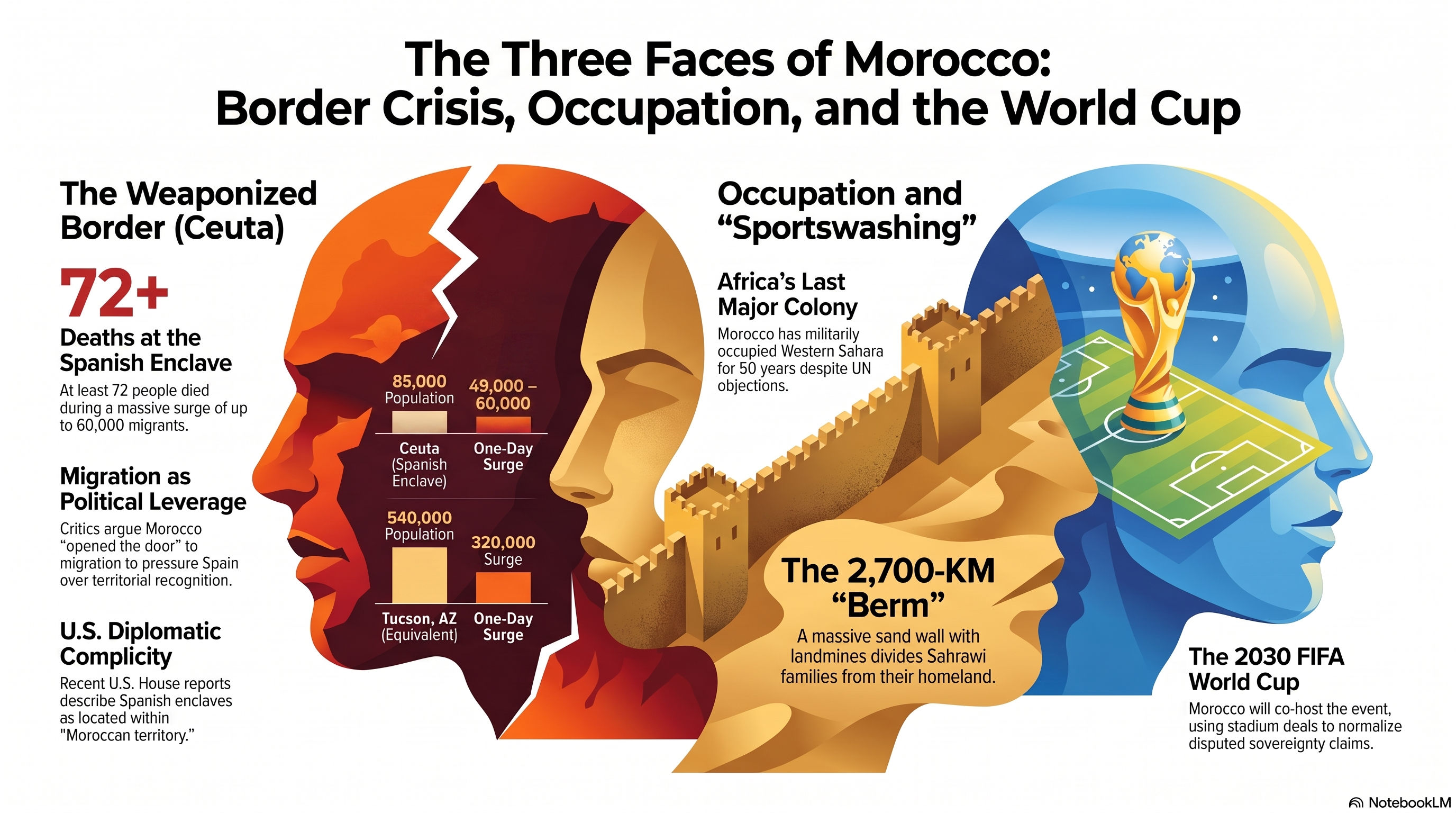
At least 72 people are dead, up from an initial count of 67 as Spanish officials continued recovering bodies through the weekend. Some drowned trying to reach Spain’s North African enclave of Ceuta.
Others were crushed in a stampede at a breakwater barrier. Spain’s government delegate in Ceuta, Miguel Ángel Pérez Triano, confirmed the updated toll Sunday, four days after somewhere between 49,000 and 60,000 people crossed from Morocco into a city of roughly 85,000 in about twenty-four hours.
Let me explain why a Tucson publication is dedicating so much coverage to North Africa. It’s not because the footage is dramatic, though it is. It’s because this week gave us, in one tidy package, almost every mechanism we already recognize from our own border: a wall, a body count, a state weaponizing migration for leverage, and a political class more interested in scoring points off the dead than answering for them.
Congress already voted on this
Trump’s highway message wasn’t a one-off gesture.
He pledged deeper cooperation with Morocco on energy, artificial intelligence, critical minerals, and defense, and said that any other route to resolving the Western Sahara issue “prolongs the status quo and is unacceptable.”
Marco Rubio’s State Department did the same dance in miniature. The day before the surge peaked, Rubio congratulated King Mohammed VI on Throne Day and called Morocco “a pillar of stability.”
A day later, with Ceuta’s death toll climbing, his department condemned “the flagrant violation of sovereignty and human rights” without naming Morocco once, and pinned the migration crisis instead on “deliberate efforts by the Spanish government to facilitate and promote mass illegal migration.” You’d almost admire the whiplash if people weren’t dying in the water while it happened.
And none of it was improvised.
In late April, a House Appropriations Committee report attached to H.R. 8595, the National Security, Department of State, and Related Programs Appropriations Act, described Ceuta and Melilla as Spanish-administered cities that “are located in Moroccan territory and remain the subject of Morocco’s longstanding claim.”
The language was pushed by Florida Republican Mario Díaz-Balart, one of Rubio’s closest congressional allies. The House passed the bill 217–209 in July. Every Republican but Kentucky’s Thomas Massie voted for it.
Massie has since called out his own party, posting the report itself and noting that the same colleagues now expressing shock at the Ceuta “invasion” had, two weeks earlier, backed language treating Spain’s own cities as negotiable. It took Congress’s most reliable “no” vote to notice his own party had already said yes to this.
The argument for handing Ceuta and Melilla to Rabat wasn’t cooked up this week. It was sitting inside a U.S. budget document months before the water cannons came out.
Two weeks before Ceuta erupted, a different story broke about the same country: Christopher Nolan’s The Odyssey and its filming in occupied Western Sahara. These are not separate stories. They are one state’s relationship to territory, told three times over.
The math of a manufactured crisis
Ceuta’s population is roughly 85,000. On the low end, 49,000 people entering in a day is a 58 percent surge. On the high end, 60,000 is more than seven in ten residents’ worth of new arrivals in a single stretch. If Tucson took an equivalent hit, we’d be talking about roughly 320,000 people showing up before sunset — every clinic, shelter, and checkpoint in the county buried by lunch.
By the time you read this, the crisis is already reversing. More than 48,000 people had voluntarily returned to Morocco by Friday evening. Spain’s interior minister, Fernando Grande-Marlaska, told reporters the situation has been “almost entirely reversed.”
Spain is installing a 500-meter containment barrier along the sea border so this doesn’t happen again — or so it doesn’t happen again this way, which isn’t quite the same guarantee.
Spain deployed the military. Morocco deployed water cannons against its own citizens, pushing people back into the water it had, by every visible account, just let them cross. First the door swings open, then the fire hose — Homeric in its rhythm, almost elegant in its cruelty. You almost have to admire the choreography — right up until you remember the death toll.
Pedro Sánchez, who traveled to Ceuta the day after the surge began, called it what it was in blunt terms rarely used by a sitting prime minister about his own country’s coastline: “a violation of Spain’s territorial integrity.”
One state, two faces
On July 17, Christopher Nolan’s adaptation of The Odyssey premiered worldwide amid boycott calls, with most American coverage burying it as a footnote.
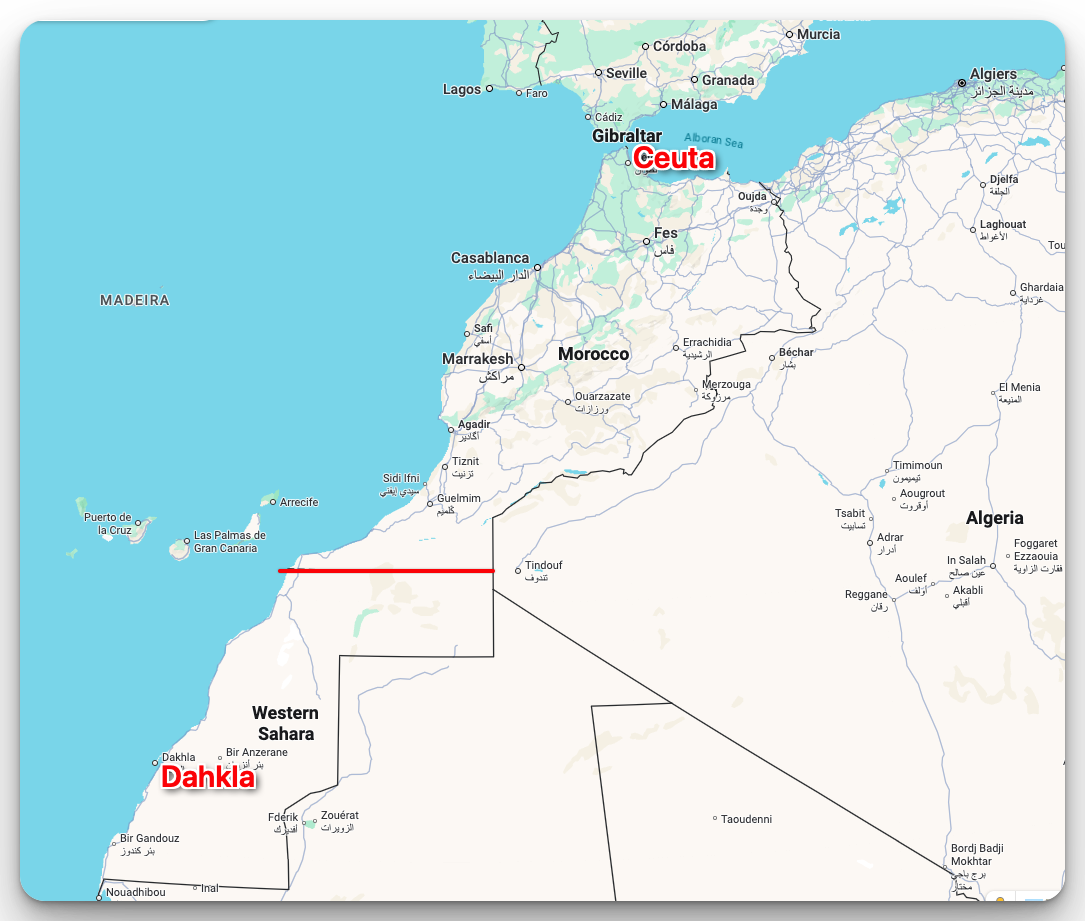
Nolan filmed part of the movie in Dakhla, a city in Western Sahara, a territory Morocco has militarily occupied for fifty years and that the United Nations still lists as a non-self-governing territory: Africa’s last major colony.
Morocco annexed most of it after Spain’s 1975 withdrawal, against the finding of the International Court of Justice, and has held it ever since behind “the Berm,” a 2,700-kilometer sand wall studded with landmines that divides Sahrawi families between the occupied zone and refugee camps in Algeria, where tens of thousands have lived in exile for five decades.
The UN referendum on self-determination promised in the 1991 ceasefire has never happened.
Sahrawi activists asked Nolan to leave a year before the premiere. Instead, he was photographed with Moroccan culture minister Mehdi Bensaid, who openly said the shoot would promote Dakhla as a filming and tourist destination.
“By staying silent for one year and then using this footage, Nolan has basically become an accomplice to Moroccan occupation of Western Sahara,” said María Carrión of FiSahara, the Sahara International Film Festival.
The sharpest voice belongs to Abidin Mohamed Hamudi, a Sahrawi filmmaker born in the Tindouf refugee camps whose parents were born in Dakhla. He cannot go home.
“Christopher Nolan, backed by Universal Pictures... can just go there and film and be complicit in the occupation of my homeland, and then me being denied of going there. It is such a metaphor of how the Western world uses human rights, democracy narratives whenever they want, and then ignore it in other parts of the world.” — Abidin Mohamed Hamudi, Sahrawi filmmaker, speaking from the Tindouf refugee camps
If Hamudi tried to film in his own ancestral city, he says he’d be arrested, like Naâma Asfari, the Sahrawi activist on hunger strike in a Moroccan prison, whose release the United Nations has already called for.
Now put Ceuta and Western Sahara side by side, because they are the same story.
The Moroccan security apparatus that jails Sahrawi filmmakers, and that Amnesty International and UN observers have documented committing arbitrary detention in the occupied territory, is the same apparatus that stood aside this week while tens of thousands of its own citizens rushed the fences at Ceuta.
Sánchez himself has rejected the idea that a single tidy explanation covers what happened, calling it “completely unfounded” to reduce the surge to a court ruling or organized crime alone.
What we’re left with is simpler and harder to explain away: a state that can lock a border down to a hair’s width when it serves its interests, and somehow could not, this week, manage the same discipline it applies daily to Sahrawis trying to go the other direction.
And there’s the colonial symmetry nobody in Washington or Brussels wants to name. Ceuta and Melilla are Spanish enclaves on African soil, held since the 1400s and 1500s, colonial holdovers Morocco claims as rightfully its own.
Morocco’s position is worth stating because it’s the hinge on which the whole dispute turns. Rabat calls Western Sahara its “Southern Provinces” (its own preferred name for the territory it occupies), offers autonomy instead of a vote, and simultaneously argues Ceuta and Melilla should revert to Morocco on the same territorial logic it denies the Sahrawi.
In plain terms: Morocco says its physical proximity to Ceuta means Ceuta should be Moroccan, while insisting that Western Sahara’s status as a whole, undivided territory means the people living there don’t get to vote to separate from Morocco.
Both arguments, held at once. That’s not a legal philosophy.
That’s power picking whichever argument is convenient that week.

Who else wanted Spain to lose Ceuta
Pro-Israel and pro-Morocco voices in Washington and Tel Aviv have spent years treating Spain’s enclaves as a bargaining chip, and Ceuta gave them an opening to say so out loud.
In May 2019, Yair Netanyahu, son of Israel’s prime minister, tweeted a map of Ceuta and Melilla urging “Arabs and Muslims” to free “occupied Arab Islamic lands,” in the middle of a spat with Spain’s far-right Vox party over Israeli policy.
American Enterprise Institute fellow Michael Rubin made a similar argument less rhetorically in March, writing that Moroccans “should gather, send bulldozers to the border, and then enter Ceuta and Melilla unarmed to raise the flag.”
Then, on the Friday Ceuta was overwhelmed, Israel’s UN ambassador Danny Danon posted that Spain, which “never misses an opportunity to lecture Israel,” should explain “why it still maintains colonial enclaves in Africa.” Spain’s own transport minister, Óscar Puente, quote-tweeted him back: “Well, it all seems to be becoming quite clear.”
A UN ambassador and a sitting cabinet minister, doing diplomacy by subtweet. This is apparently where the international order lives now.
To be precise: there is no evidence Morocco orchestrated the Ceuta surge on Israel’s behalf, and none of the above is a conspiracy. But it’s a public record of people with real influence in Washington and Tel Aviv treating Spain’s colonial-era territory as a bargaining chip, published for years before the water cannons came out.
Sánchez, who has called Israel’s war on Gaza a genocide, already had one of Europe’s most strained relationships with Netanyahu’s government before Ceuta. Whether or not anyone planned Ceuta, the crisis left that relationship colder still. It happened on the ground pro-Israel voices had already marked it as contested.
The fight this crisis actually exposed
Within days, Italy’s government announced a temporary suspension of Schengen with Spain, imposing checks on air and sea travel for August.
Foreign Minister Antonio Tajani tied the crisis to Madrid’s now-closed plan to regularize more than a million undocumented residents, calling it “profoundly wrong.”
Czech Prime Minister Andrej Babiš called for Spain’s Schengen membership to be suspended outright; Finland and Denmark backed the move. Twenty-two EU member states sent a joint letter warning against letting the crisis be read as proof “illegal entry into the European Union is possible.”
Notice what that sentence does: it treats the optics of the crisis as the emergency, not the 72 people who didn’t survive it.
Spain’s foreign minister, José Manuel Albares, called Tajani’s message “unbecoming of the Foreign Minister of a partner and friendly country,” and summoned Italy’s ambassador.
Sánchez hit back on social media: “Solidarity and empathy are optional. Respect for European treaties and data is not.”
He cited Frontex figures showing Spain has recorded half the irregular border crossings Italy has over the 2021–2026 period, and called the push to isolate Spain “driven by prejudice, fake news, ignorance or political interest.”
Because nothing says “European solidarity” like invoking a treaty exception to punish the one country actually absorbing the emergency.
Coming soon to a stadium near you
In 2030, Morocco co-hosts the FIFA World Cup with Spain and Portugal.
FIFA’s bid materials treated Morocco’s sovereignty claims as unproblematic: no asterisk, no “disputed territory,” just stadium renderings. It’s the stadium deal that papers over the broken promise, the ribbon-cutting scheduled over the unmarked grave.
Sportswashing isn’t a foreign import. We usually just watch it from the other side of the fence.
Spain’s own press was faster to name what this pattern is than most American outlets managed. El País ran it under the headline “La doble vara de medir de Trump: de la complacencia con Marruecos a la incomodidad con España,” written by Jesús Sérvulo González — Trump’s double standard: complacency with Morocco, discomfort with Spain.
That is not spin. It is the plain sequence of events: a Spanish enclave absorbs a death toll that climbed past 70 and a humanitarian emergency, and four days later the American president uses the occasion of a Moroccan royal holiday to deepen the very recognition that gives Rabat’s territorial ambitions their cover, without a public word of concern for the people who died reaching Ceuta or the people still waiting behind the Berm.
Why the Borderlands should care
The Sahrawi are an indigenous people displaced by settler annexation, confined behind a wall, their resources extracted, phosphates, fisheries, wind farms, their referendum indefinitely deferred, their filmmakers jailed while a celebrity director shoots an epic on their grandparents’ beach.
Ask the Tohono O’odham, whose nation the border wall cuts in half, what it means when a line on a map outranks a people’s memory.
Ask anyone who has walked the Sonoran Desert corridor, where humanitarian groups count the dead every summer, what it means when migration becomes a weapon instead of a journey.
And Ceuta is ours too, mirrored.
When tens of thousands move in a day, the right calls it invasion, coalition governments fracture over whose fault it is, and 72 deaths become a rounding error in an argument about Schengen membership. Sánchez, defending his government’s numbers against Italy’s, is fighting the same fight anyone defending humane border policy fights here: the argument that any death is a policy failure gets drowned out by the argument that any crossing is an invasion.
The real odyssey isn’t Homer’s, and it isn’t Christopher Nolan’s either.
It belongs to the people who died in the water off Ceuta and the people who live behind the Berm in Western Sahara, both moved, blocked, filmed, and forgotten by states that treat human beings as instruments. A film shoot in occupied Dakhla, a border surge in Ceuta, a committee report nobody read until it was too late: the count comes due, and the state at the center of all of them counted on nobody adding it up.
The World Cup is coming to Morocco in 2030. Between now and then, someone should keep saying the names: Western Sahara. Dakhla. Naâma Asfari. At least 72 people who drowned or were crushed trying to cross a fence this week. The Sahrawi have been waiting fifty years for the vote they were promised.
The least the rest of us can do is refuse to look away from either story.
What Do You Think?
The Sahrawi have been organizing for fifty years, from the refugee camps of Tindouf to the occupied cities, and they aren’t waiting for permission. FiSahara, the Western Sahara International Film Festival, screens Sahrawi-made films every year and is coordinating the Odyssey boycott. Closer to home, groups like No More Deaths do the work the Sahrawi would recognize instantly: refusing to let a desert or a sea be used as a weapon against people in motion.
Should the United States reverse its 2020 recognition of Moroccan sovereignty over Western Sahara, or is that door now permanently open regardless of who’s president?
When dozens of people die crossing a border, why does the political fight that follows focus on Schengen membership instead of the deaths themselves?
What would solidarity actually look like between the Borderlands and the Sahrawi struggle, if we stopped treating these as unrelated stories?
Three Sonorans is an independent Substack rooted in Tucson and the borderlands, where a wall is never just a wall; it’s a state deciding whose movement counts, and a government deciding which ally gets the benefit of the doubt. This week that logic played out in Ceuta, in Rabat’s highway-naming ceremony, and in a State Department statement that managed to defend Spanish sovereignty and blame Spain in the same breath. We’re not interested in covering one part of that and ignoring the rest. If this piece connected dots the wire services keep separate, share it. That’s how the word crosses walls.
Have a scoop or a story you want us to follow up on?
Send us a message below or via ENCRYPTED email (all messages kept CONFIDENTIAL) at ThreeSonorans@protonmail.com.


