



Two Arizona agencies killed their license-plate camera contracts in a single week this August — one because an automated audit caught something no human ever had. Pima County hasn’t run that audit, hasn’t answered who it shares plate data with, and hasn’t been asked in public. This is what happens when the accountability mechanism that just worked somewhere else simply doesn’t exist here.
She Bought a Hidden-Camera Detector. The Tracker Was Her Boyfriend’s Police Badge.
In the first week of August, an audit ended Flock’s cameras in Chandler and the Fourth Amendment ended them in Pinal County. In Pima County, nobody’s even asked who’s watching.
by Three Sonorans
Marci Bakely couldn’t figure out how her ex-boyfriend always seemed to know where she’d been. She installed home cameras. She bought a hidden-camera detector. She took her car to a mechanic three times, looking for a tracker that wasn’t there.
The answer was simpler and worse.
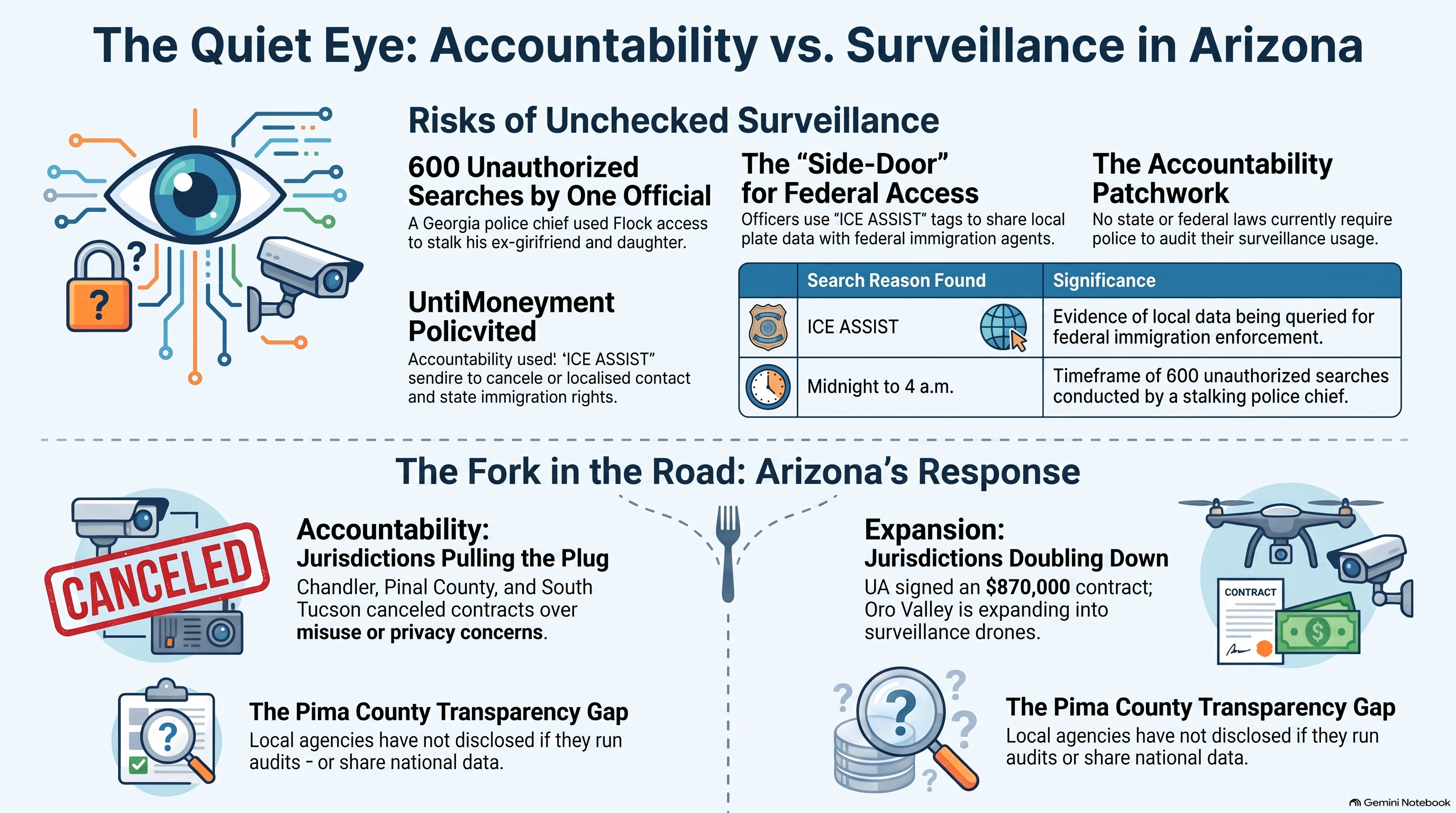
Her ex, Michael Steffman, was the police chief of Braselton, Georgia, a small town in the Atlanta suburbs, working about 15 miles from her home in Jefferson. According to the Washington Post’s investigation, he had Flock access, and public search logs show he used it: roughly 600 queries on plates tied to Bakely and her teenage daughter over about thirteen months, many of them run between midnight and 4 a.m. He eventually told her himself, by text, that he’d been using Flock to track her.
In August 2025, Bakely sought a restraining order. A judge denied it, calling Steffman’s conduct “concerning” but ruling she lacked evidence to support an active stalking claim, and suggested she take the complaint to the local sheriff’s office instead.
The sheriff’s office referred it to the Georgia Bureau of Investigation. Three months later, the GBI arrested Steffman on charges including stalking, harassment, violation of his oath of office, and license-plate-reader misuse. He was found dead in his home the following April, in what officials ruled a suicide, before the case reached trial.
No supervisor caught it.
No audit flagged it.
Six hundred searches, over more than a year, from a sitting police chief with unsupervised access. As an alarm, the system was silent. It took an outside tip to the GBI to start the investigation, and only afterward did Flock’s own logs help investigators build the case. Bakely found out the way most victims do: from the outside, using a third-party tool built by volunteers, or in her case, from her stalker’s own confession. Her ex is one of at least 50 officers nationwide who have been charged or accused of abusing these systems, per the Washington Post’s investigation.
Now hold that next to what happened in Arizona that same week. In both cases that follow, somebody pulled the plug. Watch who, and what.
On Friday, August 7, the city of Chandler announced it was pulling the plug on all 40 of its Flock cameras, not because of politics, but because the machines had caught one of their own. A routine audit, run through Flock’s “Audit Assistance” feature, flagged activity in the system “that could not be explained through standard police action.” Roughly 200 Chandler employees had their access revoked on the spot. An internal investigation is underway.
The timing was almost theatrical.
Chandler’s city council had been scheduled to vote on renewing its $153,000 Flock contract on August 13. That vote is now moot. So is months of fierce resistance from residents, who packed council chambers in May and watched, mid-meeting, as police removed a camera near Galveston Elementary School in a failed bid to calm the room.
And here is the detail that should linger: just two months ago, Chandler Police were the poster agency for responsible Flock use, telling ABC15 they blocked immigration-related searches and ran clean audits. They had, by their own account, three years of clean human audits.
It was the software, Flock’s own anomaly detection, that finally caught a person, not a supervisor, not a civilian review board, not the city council that had been sitting on the renewal vote for three months. Chandler deserves a strange kind of credit here: unlike in Georgia, something actually worked, and it was the automated tripwire that never existed for Bakely.
Flock itself responded to Chandler’s decision, saying it was “disappointed” the city was ending its use of the technology over potential misuse. But the company also said the episode “underscores exactly why we created our robust auditing tools,” the same tools that caught the anomaly in the first place. It is a strange position for a company to be in: publicly losing a client over the very feature meant to prevent losing clients this way.
Chandler wasn’t even the first shoe to drop.
Two days earlier, on Wednesday, August 5, Pinal County Sheriff Ross Teeple told his Board of Supervisors he would not renew the county’s contract with Flock Safety, the nation’s largest maker of automated license plate readers, citing Fourth Amendment concerns. The cameras go dark at the end of September.
Five Arizona jurisdictions have now canceled, paused, or terminated Flock contracts: Flagstaff, Sedona, South Tucson, Pinal County, Chandler. Nationwide, 82 agencies walked away between August 2021 and May of this year, driven by a drumbeat of abuse cases like Bakely’s.
But look at the map of jurisdictions where the dominoes have fallen, and then look at the rest of Pima County.
Here, in the state’s border county, home to a port of entry, tribal land, and one of the most heavily surveilled populations in America, the network isn’t broadly shrinking. South Tucson, the one-square-mile city within the city of Tucson, is the one exception, and it’s a real one. But among the county’s other Flock agencies, the ones still running the cameras, it is holding. In places, it is growing.
In Chandler, software caught something no one could explain. Pinal County’s sheriff read the Fourth Amendment and walked away. South Tucson’s council voted the cameras out. Now look for any of those mechanisms among the Pima County agencies still running Flock. No agency here has disclosed running an audit. No official has taken a public stand. Among the county’s remaining Flock agencies, the only surveillance vote on record, Oro Valley’s, went the other way: toward expansion, not exit.
There is no obvious path to Chandler’s Friday here. Nothing in this county is built to get there.

The holdouts
Here’s what that looks like, agency by agency. Start at the University of Arizona, the largest Flock deployment in Southern Arizona.
In February 2025, the university quietly signed an $870,000, five-year contract with Flock for 62 license plate readers on and around campus, roughly $160,000 a year, according to records obtained by Tucson Spotlight. Activists counting cameras on the ground have found closer to 54 installed, an 8-camera gap the university hasn’t explained; Three Sonorans has not independently verified either figure against UA’s own inventory. There was no public announcement.
Students, faculty, and staff learned they were being tracked in August, when the activist group Desert Rising Tucson broke the news. Campus labor followed: United Campus Workers Arizona issued a formal condemnation.
The local group Deflock Tucson has been campaigning against the cameras ever since.
UAPD Chief Chris Olson has defended the system, telling reporters that plate data is deleted after 30 days and that no outside agency can touch it without UAPD approval or a court order.
But reporting by Arizona Public Media surfaced a telling detail: UAPD’s cameras were formerly part of Flock’s national sharing network: the setting that lets thousands of police departments across the country query your data. When that toggle was flipped off, and why, the university has not said.
Then there is Oro Valley, Flock’s most loyal local customer, a relationship dating to a 2020 pilot. In February, the town council voted unanimously to accept $146,000 in state grant money for a new Flock product that has nothing to do with license plates: drones. Four of them, stationed at two launch sites, framed explicitly as a tool for “border-related crime enforcement.”
Oro Valley is an affluent suburb roughly 100 miles from the international border, worth sitting with for a second, given what comes next. Its police drones are authorized to operate outside the town’s jurisdiction. Tucson Spotlight reported Lt. Kevin Peterson’s own estimate that the full program could cost $850,000 over three years, a cost the town’s grant doesn’t cover.
The City of Tucson may be getting Flock specifically, though this claim rests on a single source. Per public records cited by the activist group Deflock Tucson, Tucson Police intend to launch a Flock pilot program. Three Sonorans has not independently confirmed this through TPD or a public contract; no contract has surfaced publicly, and TPD has not publicly confirmed the program. If that account holds up, it means Tucson residents learning their city may be about to install a plate-tracking network heard it from activists first, not from City Hall. That, too, is part of the story.
Worth noting: Tucson isn’t starting from zero, and it already reads plates.
Since October 2024, TPD has run its own real-time monitoring hub, the Community Safety Awareness and Response Center, pulling roughly 1,000 cameras, license plate readers, gunshot-detector alerts, and drone feeds into a single map for analysts, per the department’s own materials and independent local reporting.
None of it is Flock, and TPD says it doesn’t share that data with ICE.
But it’s the same shape: a real-time surveillance network built without the kind of public accountability debate Chandler and Pinal County are having right now. So if a Flock pilot lands here, it won’t be bringing plate-tracking to Tucson. It’ll be adding the one thing this city’s current setup doesn’t have: a national network that federal immigration agents have already been shown to access through the side door.
And the Pima County Sheriff’s Department, the largest law enforcement agency in the region, hasn’t publicly said what it runs, what it shares, or whether it audits anything.
The pipeline that already exists
The one local agency with a clean answer is Marana. And its answer is a warning.
Marana doesn’t use Flock. It uses Motorola’s Vigilant plate readers: four cameras and a mobile trailer, purchased in 2019 with federal money from Operation Stonegarden, the Department of Homeland Security grant program that pays local police to collaborate with Border Patrol.
In other words, the thing civil libertarians fear about Flock, a backdoor from local plate data to federal immigration enforcement, has existed in Pima County for seven years, under a different vendor’s logo, funded directly by DHS.
Which brings us to the question no national outlet will ask, because it isn’t their border.
The side door
Immigration and Customs Enforcement has no contract with Flock. Flock says so, and it’s technically true. It’s also beside the point.
Last year, 404 Media obtained records showing that ICE gets what researchers call “side-door access”: local police officers, logged into their own departments’ Flock accounts, run plate lookups on ICE’s behalf.
The Arizona Center for Investigative Reporting confirmed that Arizona agencies appear in the data, with search reasons such as “ICE ASSIST” entered directly into the justification field.
ABC15 documented a Mesa officer, working out of the East Valley Fusion Center, running Flock searches in response to Department of Homeland Security requests. Flock itself has admitted to past pilot programs with Customs and Border Protection and Homeland Security Investigations. The company says those pilots have ended.
The entire system of accountability comes down to a dropdown menu. Each police agency chooses its own sharing setting. The options are no one, named agencies, the whole state, or Flock’s entire national network.
One checkbox, set by someone you’ll never meet, determines whether a plate scan on Speedway Boulevard can be queried from an office in Washington.
Nobody in Pima County has said publicly which boxes are checked. Not UAPD, not Oro Valley, not Tucson, not the Sheriff.
Think about what that means in a border county.
A plate reader doesn’t know citizenship. It records the car that takes a kid to school in south Tucson the same way it records anyone else’s. When agencies here plug into a national network that federal immigration agents have demonstrably accessed, through the side door, with a friendly local officer typing “ICE ASSIST” into a search box, the question stops being abstract.
Whose driveway is in that database, and who gets to ask?
Who audits the auditors
Flock’s CEO, Garrett Langley, has been candid about the arrangement. His company, he says, does not want to “police the police.”
Flock builds the tool; 18,000 law enforcement agencies set their own rules. Confronted with the pattern of officers nationwide, including Steffman, using that same tool to stalk women, Flock’s answer hasn’t changed: the agencies set the rules, not the company. There is no federal law requiring anyone to audit anything. There is no Arizona law either.
The patchwork is the point: in one town, searches require a case number and get audited monthly; in the next, an officer can run plates from his phone at 2 a.m., which is, per the Washington Post’s investigation, exactly what Michael Steffman did, hundreds of times, before anyone looked.
So here is a question every Flock agency in Pima County should have to answer in public: Do you run Audit Assistance?
So far, none of them- not UAPD, not Oro Valley, not Tucson, not the Sheriff- has said. And if that stays unanswered, the follow-up writes itself: would anyone here catch a Chandler? Or would it take a confession, as it did for Bakely?
And even as Audit Assistance flags anomalies inside a department, Flock has begun stripping officer names from audit logs shared across agencies nationwide, replacing them with anonymized ID numbers, after roughly 200 officers raised doxxing and safety concerns. A Chandler-style catch in Pima County might now surface a badge number, not a name.
The poles
Chandler’s cameras are dead, but they are not gone. The cameras and poles belong to Flock, and removal happens on Flock’s schedule. For weeks, maybe months, 40 dead-eyed cameras will stand over Chandler’s streets: monuments to a surveillance network the city no longer wants but cannot itself take down.
In Pima County, no one has even asked.
The University of Arizona’s five-year contract, signed in February 2025, runs through 2030.
Oro Valley’s drones are coming.
Tucson’s pilot may be coming too, unconfirmed, and it would be landing in a city that already runs its own real-time camera network.
The Sheriff hasn’t said anything publicly.
And in the middle of the metro area sits South Tucson, the square-mile, majority-Latino city whose council voted 5-1 in February to rip out its cameras, becoming the third city in Arizona to do so.
South Tucson looked at the same technology its richer neighbors are expanding, weighed the promises (yes, the portal showed searches that helped homicide investigations; the tradeoffs are real), and chose differently.
The dominoes fall where people push.
Chandler’s residents pushed for three months before the audit did the rest. In Flagstaff, Sedona, Pinal County, and South Tucson itself, the pressure worked.
The tools to push here are public: Deflock Tucson maintains a map of every camera activists have found. Third-party sites like Have I Been Flocked let you check whether your own plate has been searched. A petition to end mass surveillance contracts across Pima County has been circulating since February.
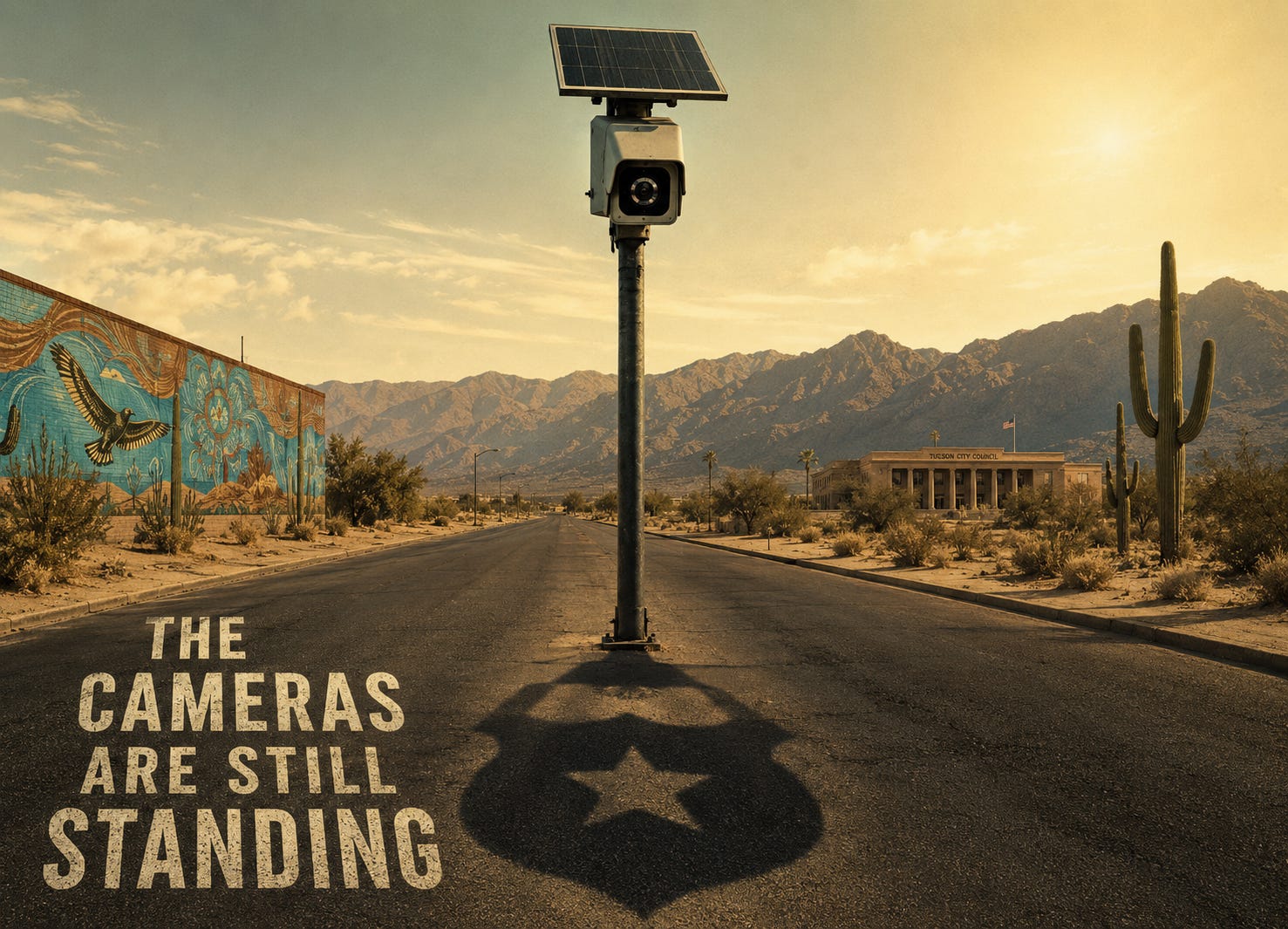
The cameras in this county are still standing on their poles, solar panels angled at the sun, reading every plate that passes — yours included.
Somebody should ask why.
Three Sonorans follows surveillance where it becomes personal: in a Georgia woman’s driveway, on a South Tucson street, across a university campus, and inside the data-sharing systems of a border county. This is the kind of local accountability journalism we practice—tracking the contracts, the cameras, the unanswered questions, and the people who have to live under them. If you want more reporting like this, share the piece and help make official silence harder to maintain.
Have a scoop or a story you want us to follow up on?
Send us a message below or via ENCRYPTED email (all messages kept CONFIDENTIAL) at ThreeSonorans@protonmail.com.


