



Rocque Perez lost his state Senate race in July. Three weeks later he was back before Pima County asking for another year of the $122,000 contract that pays him nearly double what either of his predecessors ever earned — and a records search turns up a second, better-documented conflict he never mentioned. Four residents did the math the county’s own staff wouldn’t.
This is what they found.
📊 Four Strangers, One Spreadsheet: How Pima County Almost Paid $91K to the Guy Two Women Ran the Job For Half Of
The math nobody at the county bothered to do
by Three Sonorans
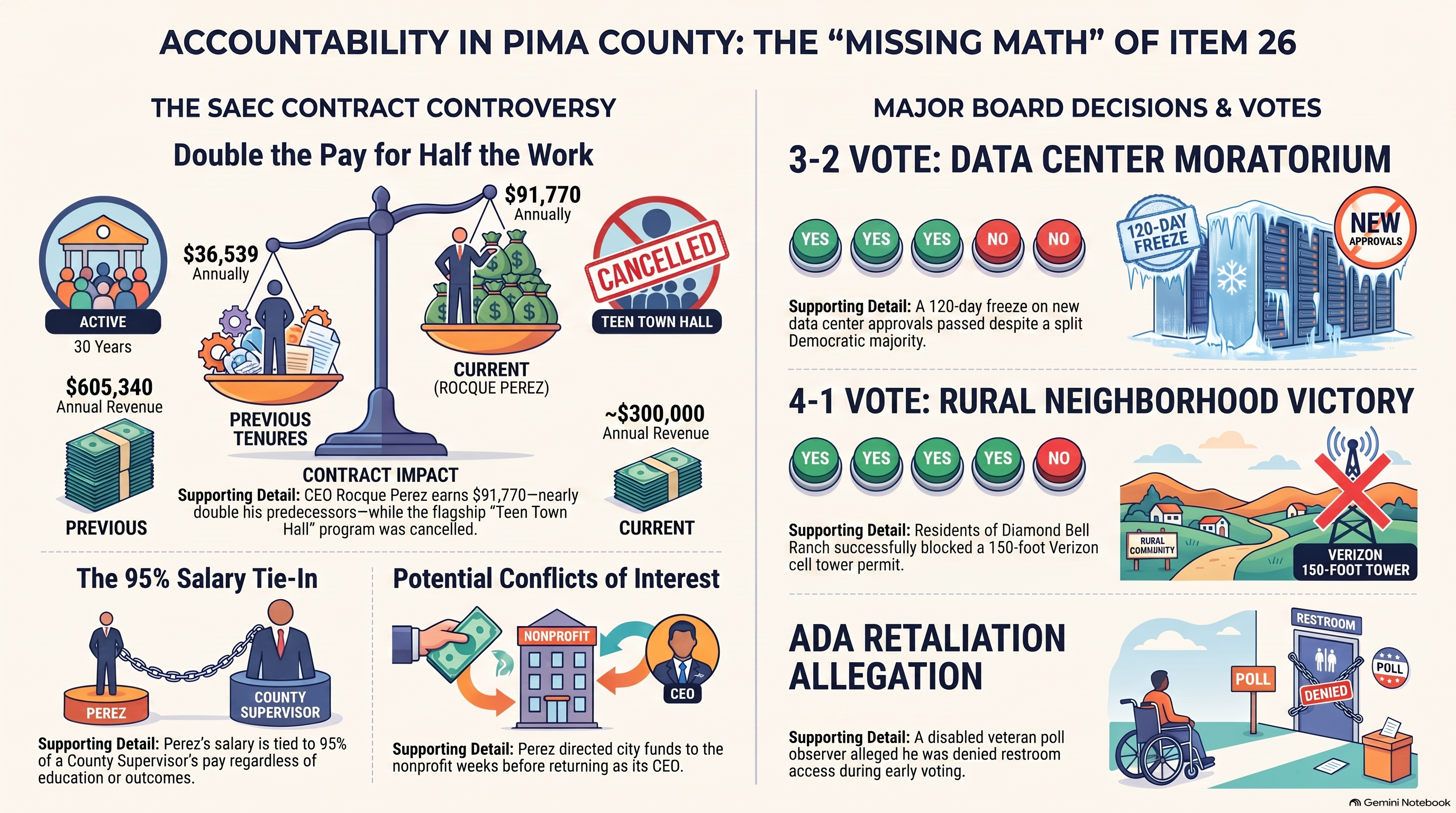
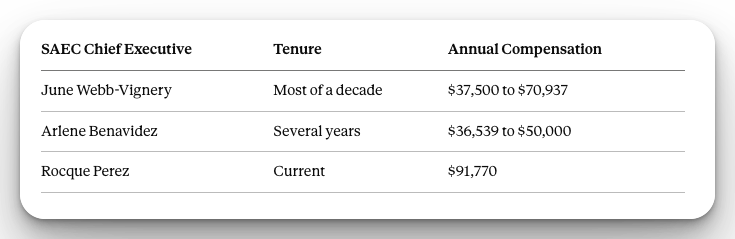
Rocque Perez is being paid $91,770 this year to run a nonprofit whose flagship program didn’t run at all. His two predecessors did the same job, combined, for most of a decade, on salaries as low as $36,539. Four Pima County residents worked out that gap in the 48 hours before Tuesday’s Board of Supervisors meeting, each writing independently: a sitting state senator, a 20-year Tucson classroom teacher, a Democratic Party volunteer, and a school foundation board member who emailed all five supervisors’ offices at once.
All four sent letters. All four landed on the same math, and asked the same question the county’s own staff memo never got around to: why?
Board Chair Jen Allen didn’t allow Item 26 to reach a vote Tuesday night. She pulled it. Continued, 5-0, over what she called “inconsistencies” in the paperwork, the bureaucratic equivalent of an incomplete.
It was one of three moments Tuesday when the county’s own process caught up with itself: a contract renewal stalled before it could pass, a data center moratorium that split the Democratic majority after an hour behind closed doors with lawyers, and a rural neighborhood that beat Verizon at its own hearing. Agenda order had none of this at the top. Public impact does.
The SAEC Contract Didn’t Die. It Got Held Back a Grade.
Rocque Perez lost his state Senate primary on July 21 to Rep. Alma Hernandez.
Three weeks later, he was back in the Board of Supervisors chambers, in person, waiting on a vote to renew the $122,000 county contract that funds the nonprofit he still runs, the Southern Arizona Education Council, formerly the Metropolitan Education Commission.
His own signature turns up on the funding trail, too, and not just at the county level.
In August 2025, four months before his return to MEC as CEO, Perez, then Ward 5’s Tucson councilmember, directed part of a $500,000 discretionary and ARPA fund toward a slate of south-side grants and direct investments. AZPM reported that the Metropolitan Education Commission, the organization Perez would soon return to lead full-time, was among the recipients.
Perez’s own office published a follow-up accounting that November listing MEC again among the “final recipients” of more than $520,000 in total Ward 5 community investment, weeks before his December 2 return to MEC’s payroll. Neither source specifies how much of that money reached MEC.
This isn’t the political-network overlap Levy raises below, a mayor and council endorsing a campaign.
It’s simpler than that.
When the council appointed him in May 2025, Perez himself told members he’d step down from his MEC role because the commission receives city funding, the Arizona Daily Star reported at the time. Five weeks later, on June 3, he was seated for the vote to adopt the city’s FY26 budget, the same budget that carried MEC’s city allocation.
SAEC’s own institutional history page tells a different story about what “stepping down” meant in practice: it describes Perez as “then Tucson City Council Member and Chair for the Commission,” simultaneously, through that period. Whether he recused himself from the June 3 vote isn’t something Three Sonorans has been able to confirm in the public record checked so far. It’s the kind of question a city clerk’s minutes could settle in an afternoon. The money was his to direct. The recipient was the nonprofit he’d told the council he was stepping away from.
The letters got there first.
Sen. Sally Ann Gonzales wrote in Sunday night, laying out the math with a former classroom teacher’s precision: SAEC brought in “substantially more revenue” during her predecessors’ tenures than it does now, she noted, yet Perez’s salary is set at 95 percent of a Pima County Supervisor’s pay, a figure tied to the office rather than to any credential or outcome.
“I am asking the Pima County Board of Supervisors to reject the renewal as written on August 11,” Gonzales wrote. “Show us the outcomes. Show us the work. Show us the accountability.”
Andy Kunsberg, a retiree active in local Democratic Party service, put a number on that same revenue gap: SAEC reported $605,340 in revenue in one prior year, he wrote, nearly twice what it brings in now. He filed the sharpest question of the four: Perez’s compensation was made retroactive to December 2, 2025, “right as that campaign was getting underway,” and the contract authorizing it wasn’t signed until January 26, 2026.
“That timeline deserves an explanation,” Kunsberg wrote, before landing a line that reads less like a policy critique and more like an accusation:
“Why is he being paid to launch a PAC to just troll 3 elected officials who he spent the last year attacking?”
Becky Vargas, a Pima County public educator for over 20 years, brought the credentialing argument the county’s own memo never raises. “To stand in front of a classroom, I had to earn a degree in my field, complete supervised training, pass state certification requirements, and maintain that credential year after year,” she wrote.
Perez, she noted, holds no education degree or administrative credential and is paid roughly double what many classroom teachers in the county earn.
“If a teacher failed to deliver an entire year’s worth of curriculum, there would be consequences,” Vargas wrote, referring to SAEC’s 30-year-running Teen Town Hall program, which didn’t happen this contract year. “Please do not renew this contract as written.” Actual educators, meanwhile, need a diploma just to apply for the jobs SAEC’s own org chart is supposed to be full of.
Randi Levin, co-chair of the Social Action Committee at Congregation Kol Ami and a board member at the Catalina Foothills School District Foundation, sent her letter to all five supervisors’ district offices simultaneously. She raised a second discrepancy buried in SAEC’s own paperwork: the organization’s Quarter 3/4 report described an active, decade-long Peer Coach partnership with AmeriCorps and Arizona Serve.
The county’s August memo says that partnership “ended,” with no explanation offered. “I urge the Board to freeze it and require SAEC to provide a complete accounting: line by line,” Levin wrote.
One of the four said it out loud in person Tuesday, and a fifth resident joined her. Douglas Levy, a longtime supporter of Democratic candidates in Arizona since 1995 who wrote no letter but showed up to speak, widened the picture beyond the council seat already covered above: Tucson Mayor Regina Romero endorsed Perez’s Senate campaign, and so did every sitting City Council member except Paul Cunningham. Romero herself swore Perez into that same Ward 5 seat, and the City of Tucson is one of SAEC’s funders.
“I am not suggesting that an endorsement by itself is improper,” Levy said. “But when the same political network intersects with an organization receiving public money... the public has a legitimate right to ask questions.”
Levin, whose letter had made the same case two days earlier, also spoke in person, adding a line that landed harder from the podium than it had on paper: “None of the teachers I work so hard to support would even have the luxury of doing this.”
Chair Allen, who currently sits on SAEC’s own governing council alongside Tucson Council Member Lane Santa Cruz, meaning the official pulling the item Tuesday night is also, in her other capacity, a member of the body being funded, pulled the item herself.
“I noticed some inconsistencies between the contract that was included in the materials along with the other materials from the report that we’ve seen,” she said, citing conflicting staff counts of SAEC’s employee headcount across different documents.
Supervisor Rex Scott, a former MEC board member who per SAEC’s own institutional history co-led the organization’s 2025 evolution into SAEC alongside Perez, backed the continuance and added his own number: the City of Tucson is contributing less than a sixth of what the county is being asked to put in, and even that smaller amount only reached last year’s level because two council members personally kicked in money from their own office budgets.
The continuance passed 5-0.
Scott’s concerns didn’t start Tuesday night. On June 3, he sent County Administrator Jan Lesher ten numbered questions about SAEC’s budget, its membership, its staff duties, and why the 30-year Teen Town Hall tradition died, and told her plainly:
“I request that no new contract with the SAEC be forwarded to the Board of Supervisors for our consideration until these requests and questions are addressed.”
The county’s answering memo arrived August 5, six days before the vote, and answered nearly every substantive question by handing the explanation back to Perez himself.
Do the math on that 95 percent figure, and it raises more questions than it answers. Ninety-five percent of what, exactly? Not test scores. Not FAFSA completions. Not the Teen Town Hall that didn’t happen. A Pima County Supervisor’s salary, full stop, meaning Perez’s raise rides automatically whenever the Board votes itself one, no outcome required on either side of the ledger.
No date has been set for the item’s return, and no dollar figure has been reduced. Staff’s own recommendation, going in, was to renew at the full $122,000 with a new reporting matrix attached, meaning the real fight, when Item 26 resurfaces, isn’t renew-versus-reject. It’s whether four independent letters and two in-person testimonies bought Pima County residents anything more than a delay.
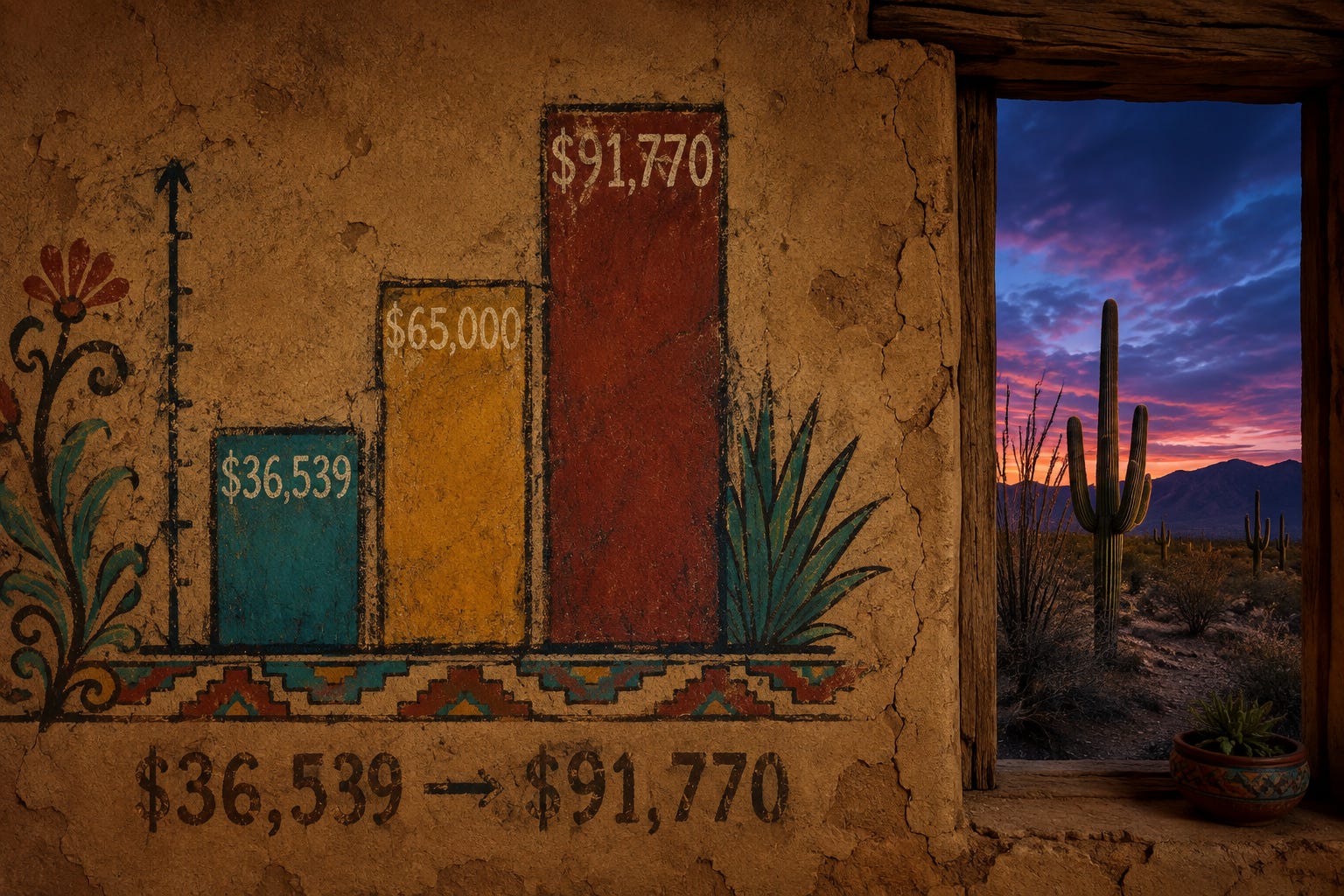
What isn’t in question is what $91,770 currently buys a nonprofit whose own founding paperwork says it exists to “advance educational equity,” in a region where the two biggest school districts SAEC’s mission is built around, TUSD and Sunnyside Unified, are nearly two-thirds and nearly nine-tenths Hispanic, respectively. SAEC’s own mission statement uses the word equity.
Its own org chart this year ran on two part-time work-study students and a president who was paid to chase a state Senate seat instead.

A Democrat Sides With the Lawyers, and Loses
Buried in Tuesday’s regular agenda addendum was Item 2: a directive to draft a 120-day moratorium on new data center approvals in unincorporated Pima County, while the county finishes writing a zoning ordinance to govern them permanently.
It’s the kind of item that, on paper, should have been a formality for a five-member board with a 4-1 Democratic majority still nursing the political wounds of Project Blue, the data center deal that blew up in public backlash last year.
It wasn’t.
Chair Allen requested an executive session before the vote, “to be able to talk with our lawyers,” and the Board disappeared behind closed doors for close to an hour, apparently to see whether a moratorium on data centers could survive its own discovery period. When they came back, Supervisor Rex Scott asked for a roll call vote, an unusual move that all but guarantees a public paper trail on a contested item.
Supervisor Andrés Cano: aye.
Supervisor Steve Christy, the board’s lone Republican: no, unsurprising from the dais’s most reliable defender of business interests.
Supervisor Matt Heinz: yes.
Then Rex Scott, Democrat, District 1, broke from the party’s presumed line: “Based on the advice of legal counsel, I vote no.” It’s a hedge lawyers love and headline writers love more: not “no,” just “no, allegedly, on the advice of counsel,” the political equivalent of pleading the fifth while still raising your hand.
Chair Allen closed it out with an aye. Final tally: 3-2, with Cano and Heinz carrying it alongside her.
The moratorium directive squeaked through, but not on party lines, and not without a Democratic supervisor going on the record that his own attorneys had counseled against it, a detail that will likely get more attention from the data center industry’s lawyers than from anyone celebrating the win.
The deal itself traced back to Pima County rezoning and selling land to Beale Infrastructure, which then blew up spectacularly when the City of Tucson’s own residents revolted, and the Council pulled its annexation and water agreement.
The city has since passed its own data center restrictions requiring discretionary rezoning approval rather than an outright ban.
Tuesday’s county-level moratorium directive, paired with a separate item revising the county’s NDA and “enhanced due diligence” policies that Project Blue exposed as too narrow, is Pima County’s attempt to build the regulatory scaffolding it didn’t have in place the first time. The Board’s entire substantive discussion of the moratorium, per the Tucson Sentinel’s own reporting, happened behind closed doors in executive session, meaning the public record shows a vote but not the reasoning behind it.
Whether three votes out of five hold when the actual ordinance comes back this fall is an open question, especially with one Democratic supervisor already on the record voting no on his own attorneys’ advice.
Diamond Bell Ranch Gets the Last Word, 4-1
Residents of Diamond Bell Ranch, a rural subdivision on the county’s western edge near Kitt Peak zoned CR-1 around a CB-1 commercial pocket where the tower itself sits, spent more than an hour Tuesday night doing something rare: getting the Board of Supervisors to overturn a hearing administrator’s approval of a cell tower.
Verizon came for better reception.
The neighborhood gave it a dead zone instead.
Can you hear me now?
Nine residents spoke.
Charles Murdoch, representing the formal appeal, kept his argument narrow and procedural: Pima County code requires an applicant to document why alternative sites and shorter tower configurations were rejected, and the written record didn’t show that analysis happened, a point county staff itself had flagged before the hearing administrator’s approval.
Others made it personal.
Lindsay Chastain, whose home sits roughly 300 feet from the proposed 150-foot tower, described raising a son in the quiet of the desert: “This isn’t just a parcel on a map to us, this is our home.” Joseph Ebus and his partner, Hanley Trahear, said they’d recently bought a lot specifically because the community buried its utility lines and adopted zoning meant to keep structures low. Sean Lakeman cited multiple property-value studies suggesting cell towers depress home values 2 to 20 percent, and argued the hearing administrator’s own justification, that a business hub would eventually grow around the tower, ignored 50 years of Diamond Bell Ranch staying exactly as rural as it started.
Verizon’s team pushed back with the numbers carriers always bring: a coverage gap, a half-million-dollar facility, and an RF engineer with 36 years of experience testifying, with a straight face, that the tower “needs to be that height, regrettably.”
“Why did God not put our eyes at our feet but put them on the top of our head? Because we have to be able to see what’s going on around us.”
County staff, when pressed by Supervisor Scott, confirmed that the Board had denied similar cell tower permits only twice in the past five years, and both denials required the Board to build a specific, fact-based record explaining why.
Chair Allen, whose district includes Diamond Bell Ranch, built that record herself. She moved to grant the appeal and deny the permit, walking through the code’s actual requirements: the applicant needed to show that alternative sites and shorter-tower options were considered, and explain in writing why each was rejected, for the community to evaluate.
“That needs to be put in writing for the community to be able to assess,” Allen said.
She also pushed back directly on the hearing administrator’s underlying assumption that a commercial “business hub” would eventually justify the tower’s height: “This assumption that there will be commercial growth there... we have not seen in 50 years.”
Supervisor Rex Scott seconded and voted yes; Supervisor Matt Heinz voted no, telling Allen bluntly it was “pretty awful” to deny the tower, then admitting, when Allen needled him, that he might feel differently if it were in his own district.
The appeal passed 4-1.
A Veteran’s ADA Complaint Against the County Recorder
Before any of the above, Call to the Public produced its own uncomfortable allegation, one that got a single line in the meeting and deserves more than a clause here. Tim Locks, a VA-rated disabled veteran who served as a poll observer at the Pascua Yaqui reservation during early voting, told the Board he was repeatedly denied restroom access over seven days of observation.
He said poll workers directed him to a locked or occupied administration building roughly 350 feet from the vote center, and when that failed, to a casino over 1,000 feet away. “I should not have to tell anybody about my disability,” Locks said. “It’s simply no one’s business.”
Locks framed the pattern as retaliation from the County Recorder’s office, tied to a court case that required the office to allow observers at early voting locations, and argued it likely violated the Americans with Disabilities Act.
He also alleged that the Board itself was out of compliance with state election code requirements governing board approval of election workers.
No county official responded to the specific allegations on the record Tuesday, and Three Sonorans has not independently verified Locks’s account beyond his testimony. It is, as written into the county’s own public record, a serious claim that names a specific office and a specific chain of decisions, and one this publication intends to follow up on rather than let sit as a single line in a meeting recap.
Also at the meeting
Call to the Public rounded out with routine business and unrelated speakers. Tucson Electric Power’s JD Wallace gave the board a summer grid update: peak demand hasn’t yet topped last year’s August 6 record of 2,502 MW, and flagged that the state’s Power AZ bill-assistance program is scheduled to end September 30, powering through his three minutes with more wattage than the grid itself. A caller running a write-in campaign for the District 5 seat used her three minutes to allege a prior law enforcement raid on her property.
Ajo Domestic Water Improvement District dissolution and sale to Arizona Water Company passed 5-0, with sale proceeds set to fund local nonprofits pending a follow-up staff report on distribution.
Three liquor license hearings (Taco Giro Mexican Grill & Seafood, Rocky Point Drive-Thru, and a golf club ownership restructuring at Torres Blancas) passed 5-0 with no speakers.
The Pima County Economic Development Strategic Plan 2026-2029 was continued to the Board’s August 25 meeting at the county administrator’s request, announced at the top of the meeting during agenda adjustments.
The county’s legislative agenda for the coming session passed 4-1 after a brief dispute over whether staff should rank priority items; Supervisor Cano argued against ranking, and Chair Allen deferred to his experience.
Revisions to the county’s NDA-disclosure and enhanced due-diligence policies (the rules Project Blue exposed as too narrow) passed as part of the addendum, expanding the due-diligence trigger to cover large water and energy users regardless of how a project enters the county’s pipeline.
A Constable disciplinary action involving Justice Precinct 2’s Frank Lopez passed 5-0 to proceed as discussed in executive session, with no public detail disclosed.
Revisions to the county’s weapons policy for county facilities and vehicles passed 5-0, with Chair Allen adding Ajo Court to the list of covered buildings by friendly amendment.
The Board approved a special meeting for October 20 to conduct County Administrator interviews in executive session, part of the process to replace outgoing administrator Jan Lesher.
The Pima Animal Care Center will receive $256,509.80 from the estate of a Tucson resident who died, approved as part of a bundled consent vote.
Three Sonorans exists because a records search into a city councilmember’s own discretionary account, and four county residents doing the math the county’s own staff wouldn’t, found what a twenty-seven-item agenda was built to bury.
If this piece moved you, share it. That’s how a $122,000 contract, a half-million-dollar fund, and one open question for the city clerk stop hiding on page six.
Have a scoop or a story you want us to follow up on?
Send us a message below or via ENCRYPTED email (all messages kept CONFIDENTIAL) at ThreeSonorans@protonmail.com.


