

The Trump administration says teaching college educators to support traumatized students is a civil rights violation. Pima Community College is fighting that claim in federal court — while also defending a $12.77 million donor agreement with the company threatening Southern Arizona's water supply. On June 10th, the community showed up to ask hard questions. Most of them are still waiting for answers. This is what happened, what the documents say, and what you can do about it.
This podcast is created based on the article below, making it easy and convenient to listen to as you get ready for your day. The article offers extra information and resources to deepen your understanding.
⚖️ PCC's $12.7 Million Beale Deal Came With a Conflict-of-Interest Law Baked In. Nobody's Answered Whether It Was Followed
by Three Sonorans
The boardroom at Pima Community College was full on Tuesday night. The agenda said “budget hearing.” The people who showed up had other plans.
A hydrologist. A geographer. An award-winning energy resource economist. A systems engineer who failed Calc II at U of A, retook it at Pima, got an A, and now works full-time in that field. A department head who is now the only person at the institution with “sustainability” in her title.
None of them came by accident. Something was wrong, and they wanted it on the record.
They got more than they bargained for. Before a single member of the public spoke, General Counsel Jeffrey Silvyn stood before the board and explained — in the careful language of someone who has learned not to say what he actually thinks — why the Trump administration has been systematically defunding PCC’s TRIO programs for first-generation, low-income students.
The federal government’s stated rationale, written directly in the denial letters: PCC had been providing Social-Emotional Learning (SEL) training to TRIO faculty and staff.
Board Chair Greg Taylor, who doesn’t usually editorialize, went quiet for a moment.
“I hope for anybody listening that the absurdity of that position is self-evident,” he said.
He paused.
“It strikes me as beyond absurd.”
Welcome to public education in 2026. Teaching educators to care about traumatized students is now a federal civil rights violation. And one of Southern Arizona’s most vital community institutions is fighting in court to keep the lights on for the students it was built to serve.
Somewhere in the fine print of a public contract tied to Beale Infrastructure, a statute called A.R.S. § 38-511 was quietly waiting to be read.
That was Tuesday night at PCC’s Governing Board meeting: three sessions stacked back-to-back in a boardroom on Broadway, with an executive session behind closed doors before any of it. Democracy at its most punctual.
The board approved a $346.9 million budget, voted to charge high school students $10 per credit hour for dual enrollment, and sat through a packed public comment session dominated by one question: why did you close the sustainability office and take millions from the same company threatening our water?
Here is what happened. Here is what it means.
⚔️ TRIO Under Siege — Again, Still, and Worse
📌 What is TRIO?
TRIO is a set of federally funded programs created by Congress in 1965 to help first-generation, low-income, and disabled students access and complete college. Nationally, the White House’s preliminary FY2027 budget proposes eliminating programs that currently serve about 817,000 students. At PCC, TRIO programs have served hundreds of high school students annually through tutoring, mentoring, advising, and college preparation — at no cost to families.
When the federal government cuts TRIO, it is not cutting bureaucracy. It is cutting the ladder
If you’ve been following this story, here’s the recap:
June 2025: Trump’s Department of Education terminated PCC’s Upward Bound grants at the Northwest and Downtown campuses, more than $1 million killed mid-cycle. As Inside Higher Ed reported, colleges received no warning.
July 2025: PCC briefly secured $4 million in new TRIO funding. A moment of hope.
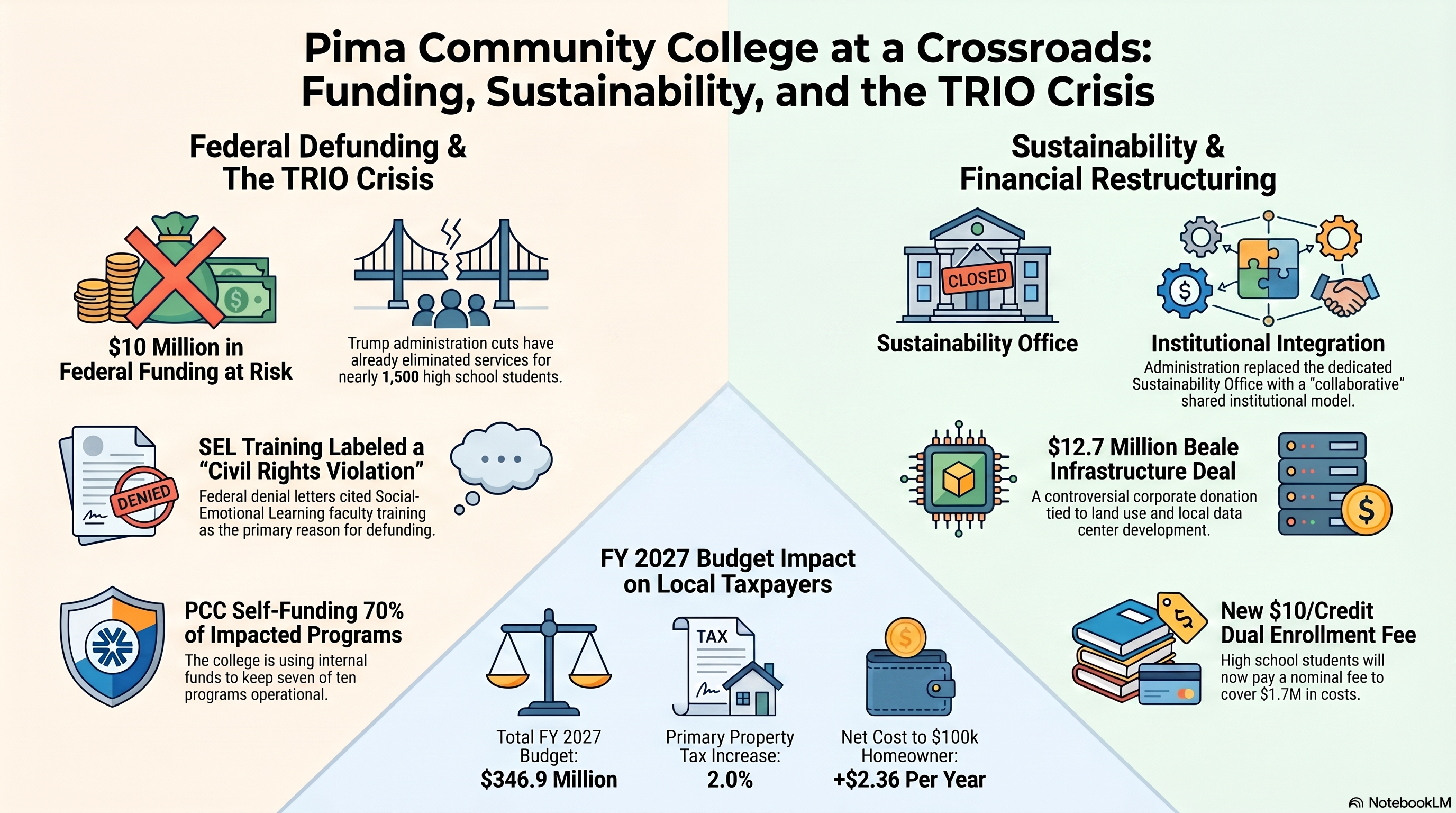
September 2025: Three more grants were cut mid-cycle. $1.7 million vanished. Services ended for nearly 1,500 Pima County high school students per year, and AZ Luminaria reported PCC warned of over $10 million in total lost federal funding. Apparently, helping those students was a civil rights problem now.
October 2025: The Upward Bound offices shut down on October 10th. Three days later, the board finally authorized legal declarations to fight back. We didn’t let that timing slide.
April 2026: PCC is now self-funding seven of ten TRIO programs out of its own pocket. The White House’s preliminary FY2027 budget proposes the complete elimination of TRIO nationally.
So when Silvyn stood before the board on June 10th, nobody in that room was hearing about this for the first time.
What was new was the specific language the Department of Education used to justify the denials — and Chair Taylor’s refusal to let it pass without naming it.
The SEL Pretext
Silvyn explained that the denial letters cited PCC’s Social-Emotional Learning training for TRIO faculty as potentially violating nondiscrimination law — letters that claimed the training “might not align with the priorities of this administration.”
Let that sink in.
SEL is a pedagogical approach that helps educators support students from traumatic or disadvantaged backgrounds. The Department of Education has apparently renamed itself the Department of Irony.
“Even though it’s not targeted toward any particular demographic group,” Silvyn said carefully, “it’s just an approach that’s trying to be more inclusive and more sensitive to students who come from very diverse and sometimes very challenging backgrounds. And there’s something about that approach that seems to not be viewed favorably by the Department of Education.”
Board Member Kristen Randall asked whether PCC had changed its approach for the next five-year TRIO application cycle. Silvyn was honest: he’d been focused on the legal defense, not the next application.
Don Harp felt the need to clarify during the staff segment that “first generation in the context of TRIO refers to students whose parents did not attend college — it’s not immigration at all.”
The fact that he felt the need to say it, and that the chair immediately affirmed it, tells you everything about who the federal government is targeting.
Nationally, only about 25% of TRIO grant renewals are expected to be funded, with state-level applications receiving preference over institutional ones.
The Council for Opportunity in Education went back to federal court on June 9th — the day before this meeting — to seek expedited relief, arguing that the Department of Education “again followed the wrong process and not applied the correct standards” in its latest round of reconsidered denials.
PCC has submitted a further objection. Both efforts are pending. The next board update is expected in August or September 2026.
What’s Actually in the Courtroom
The executive session agenda, beginning at 3:00 p.m., shows the board sought legal advice on:
TRIO grants litigation: defense of terminated and threatened programs
HSI grants litigation: the 23-year-old Hispanic Serving Institution program under federal threat
Department of Education Office of Civil Rights: cases 08-20-2069 and 08-24-2385
Potential implications of recent U.S. Presidential Actions including Executive Orders for PCC
Arizona Civil Rights Division cases: CRD-2025-0227 (dismissed) and CRD-2025-0584
Two employment-related cases: Carrillo v. PCC and Raymond v. PCC
A demand letter from the parent of a former student
The Adult Basic Education services agreement
Details are confidential under Arizona’s Open Meeting Law. What isn’t confidential: PCC is in a multi-front legal fight with the federal government over the education of Pima County’s most vulnerable students.
🌱 The Sustainability Fight: “The Most Important Word Is Community”
Chair Taylor made a deliberate move early in the evening. He pulled the administrative reports on sustainability and federal grants ahead of the regular public comment period.
“There does seem to be a lot of misunderstanding about certain things that are happening at the college,” he said — in the measured register that elected officials use when they mean: this is about to be a conversation.
He was right. The community came loaded.
What the Chancellor Said
Chancellor Jeff Nasse opened with a masterclass in institutional reframing.
PCC had eliminated the Director of Sustainability and closed the Office of Sustainability as a standalone unit. Not a retreat, he insisted — an “integrated approach,” a “more collaborative” model, a “shared institutional commitment” most effective “when it’s part of our everyday work here at the college, not an isolated position.”
If you listen closely, you can almost hear the sustainability director’s office furniture being quietly moved to the parking lot.
He was equally direct about the Beale concern: the two are entirely unrelated. Beale was selected by Pima County through a separate process; PCC was identified as a potential beneficiary for workforce development and scholarships.
The timeline, he said, is a coincidence.
Nothing says “we’re committed to sustainability” quite like accepting $5.9 million from the same company that’s busy turning aquifer water into data center coolant. That is the administration’s position, made in public, on the record.
Dr. Nicola Richmond, Vice Chancellor for Strategy, Analytics and Research, who has coordinated PCC’s sustainability work since 2021, presented the accomplishments report, including greenhouse gas reductions, the Climate Action and Sustainability Plan, agroecological programming, and broader institutional integration.
She added something worth noting amid the diplomatic fog: “Climate change is real. The evidence is overwhelming, and the effects are being felt across the world, including here in southern Arizona.”
In 2026, a college administrator felt compelled to say that out loud. Because now it’s a political statement.
What the Contract Says
The paperwork tells a more complicated story than the talking points.
According to the board backup memo, this did not begin as a random act of corporate generosity. In December 2025, as part of a land sale in Pima County, Beale and Pima County entered into an agreement committing $15 million in community donations over the life of the project. PCC was specifically named as a potential recipient before the board ever voted on anything.
That means the college was written into the Beale deal before PCC was ever at the table — not selected later through vibes and destiny.
And the agreement is bigger than the public shorthand suggests. The initial gift is $5,912,992, but the option for a second five-year extension worth $6,854,778 makes the total potential relationship $12,767,770. Not “$5.9 million.”
KGUN9 reported that Pima County itself suggested Beale donate to the college, which makes the arms-length framing even harder to sustain.
This was not a donation that drifted down from the heavens on a cloud of civic goodwill. It was built into a development arrangement, routed through county government, and presented as though the only real issue was whether the money might help students.
The Fine Print Nobody Read Aloud
One structural detail warrants public attention.
The donor agreement explicitly invokes Arizona’s conflict-of-interest statute, A.R.S. § 38-511, which allows cancellation of public contracts when someone significantly involved in negotiating or creating the agreement on behalf of a public agency has a substantial interest in the other party.
Points for transparency: the contract that may have a conflict-of-interest problem comes pre-loaded with the statute you’d need to cancel it.
PCC’s General Counsel, Jeffrey Silvyn, is the college’s top lawyer. His wife, Keri Silvyn, is a principal at Lazarus & Silvyn, P.C., a Tucson land-use and development firm whose clients include private developers who do business before local government bodies.
Three Sonorans has not established whether Keri Silvyn’s firm represented Beale in this specific transaction, nor whether Jeff Silvyn reviewed this agreement without recusal. Those are answerable questions. Any member of the public can request PCC’s contract routing records and conflict-of-interest disclosure documentation for Control Number 2565 under Arizona Public Records Law, A.R.S. § 39-121 by emailing RecordRequest@pima.edu.
The contract itself tells you which statute to cite.
What the Community Said
Seven people stood at the microphone. None of them yelled. All of them had done their homework.
Dr. Crystal McKenna, the only full-time instructional faculty member at PCC with “sustainability” in her title, was clear: “The cut of ‘a single staff position’ and therefore the entire Office of Sustainability has, in turn, cut the expertise capacity of this institution in half.” She did not reject the reaffirmed commitments. She asked that they be backed by “the expertise and capacity necessary to achieve them” — ACE Gold coordination, community partnerships, climate curriculum development, metrics tracking, reporting. Each item, she noted, “requires time.”
Charlie McCabe, a 25-year PCC Geography adjunct with 40 years in higher education, cut through: “It defies logic to replace a dedicated point person with extensive sustainability expertise with someone who has neither — and especially someone with numerous other responsibilities.” He raised a process question that never got answered: “Why weren’t stakeholders afforded the opportunity to give input, which in my experience is the normal way things are done at PCC?”
Garrett Weaver, a Southern Arizona native who failed Calc II at U of A, retook it at Pima, got an A, and now works as a systems engineer here, raised the sharpest governance point of the night.
The board once voted to create the Office of Sustainability. Dismantling it by administrative restructuring, without a vote or community input, does not match how it was created.
“This board decided, voted, to create the Office of Sustainability. It should vote to decide how it should be structured.”
Barbara Liguori delivered the evening’s best line: “The most important word in the name of this institution is community.“ She noted that Chancellor Nasse’s published goals use “community” five times, but only in investment contexts. “Climate” does not appear at all.
John “Skip” Laitner, an award-winning energy resource economist and board member of Sustainable Tucson, put a number on the stakes. Climate-related temperature changes may cost Pima County residents and businesses “on the order of $200 million this year alone.” He formally requested reinstatement of the Office of Sustainability “as an important investment in the long-term prosperity and social, environmental, and economic well-being of our community.”
Hans Huth, a hydrologist and PCC student, raised a separate issue that got zero response from the dais: a proposed transition to eight-week course formats. He learned about it through an informal instructor survey, not official communication. Students in industrial and creative arts worry it disadvantages working students and caregivers. This has not appeared as a formal board agenda item. It deserves its own piece. Watch this space.
An unnamed Pima County resident pressed hardest on Beale. He described the company’s alleged role in generating fake local support emails — classic astroturfing — for a data center project in Catoosa, Oklahoma. “The mayor and the vice mayor were receiving emails from local residents expressing support for the data center, and those same residents, when contacted by us, said they never sent those emails and didn’t know who was saying that in their name.” His conclusion: “You can’t trust any gifts from these people.”
Then he brought it home: “You take money from this company that is kind of acting as the enemy of local sustainability right now... it just makes me very skeptical.”
Lee Stanfield, speaking online, made the point the administration most wanted to avoid: “It can be both. Maintaining the Office of Sustainability is the best way of advancing our college and serving our community.”
Where It Stands
No board action. No vote. No structural commitment. The community went home without an answer to the governance question Weaver posed.
A final note: Phil Berry wrote on LinkedIn in May 2026 that PCC had “completely eliminated its climate action and sustainability office and programs.” When an insider calls it “complete elimination” and the chancellor calls it “integration,” the community’s skepticism is not a misunderstanding. It is a reasonable response to conflicting accounts.
📚 Dual Enrollment: $10 a Credit and the Access Promise
Here is a number that will define educational access in Pima County for years: $10 per credit hour, beginning in the 2027–2028 academic year, for high school students enrolled in PCC courses at their high schools.
PCC currently charges nothing for dual enrollment — students earn college credit at no cost to families — but the state stopped funding the program in 2009. It now costs PCC $1.7 million annually in personnel, compliance, technology, and quality assurance, with zero state reimbursement, zero tuition revenue, and more than 6,700 students benefiting every year.
Chancellor Nasse recommended the $10-per-credit option after consulting with Pima County superintendents. For a typical three-credit course, families would pay $30 total. For context:
PCC resident tuition: $103 per credit hour
Arizona state universities: roughly $450 per credit hour
Some Pima County districts already charge $74 per credit hour through other dual enrollment providers
Pima JTED: still free for eligible students
Board Member Randall asked the equity question directly: will waivers be available so no student is priced out? Chancellor Nasse confirmed: “We never want finances to be a barrier for our students into dual enrollment.”
That commitment now needs to become a formal policy: announced clearly, accessible without bureaucratic hurdles, and monitored for uptake. The vote was 5-0. The accountability starts now.
💰 The Budget: $346.9 Million, $2.36 a Year, and a November Question
Dr. David Bea, Executive Vice Chancellor for Finance and Administration, presented the FY 2027 budget with the methodical clarity of someone who has explained tax levies enough times to do it in his sleep.
Board Member Randall called the budget “a moral document.” Here is what that moral document says:
Total proposed FY 2027 budget: $346.9 million (up from $332.7M)
Primary property tax levy increase: 2.0%, generating $2.91 million in new revenue
Tax rate: decreases from $1.2176 to $1.2021 per $100 assessed value (property valuations rose 4.6%)
Net impact on a $100,000 home: $2.36 more per year
PCC: fourth-lowest primary tax rate among Arizona’s community colleges
For the cost of one bad coffee per year — the kind from a vending machine in a hospital hallway at 2 a.m. — you too can help PCC self-fund the programs the federal government just tried to kill.
Where the money goes:
Employee salary increases: 2.5% or one experience step, whichever is greater
Healthcare: an estimated 9.7% increase, absorbed by the college
Mandatory contractual increases tied to utilities and inflation
Replacement funding for lost federal grants
Operational savings: PCC has already exceeded its $4 million efficiency target for the year
The big new variable is built-in capacity for a potential General Obligation Bond initiative heading to Pima County voters in November 2026. If voters approve, PCC begins capital projects immediately; if not, the capacity goes unused. The Finance and Audit Committee is already planning.
No public comment was offered during either budget hearing. Both passed unanimously: 4-0 on the tax levy, with Vice Chair Karla Bernal Morales briefly unreachable from abroad, and 5-0 on the full budget, with her “aye” appearing in chat like a small bureaucratic miracle.
✅ Strategic Targets and Chancellor Evaluation
The board approved updated Strategic Targets for 2029–2030 (4-0) and Chancellor Jeff Nasse’s 2025–2026 annual performance evaluation (4-0), both following executive session. No public comment.
🔭 Items to Watch
🔴 The Unresolved
TRIO Legal Battle: Next Update Late Summer. With only 25% of renewal grants expected to be funded nationally and the White House proposing full TRIO elimination in FY2027, PCC’s legal strategy is a survival strategy. The next board update from Silvyn and Vice Chancellor Conover is expected in August or September.
Sustainability Governance: Will It Make the September Agenda? Garrett Weaver made a specific, procedurally sound request: put sustainability governance on a board vote with community input. September 14th is the next opportunity. If it doesn’t appear, the reaffirmations were words, not commitments.
Conflict of Interest Disclosure: Was There One? The donor agreement invokes Arizona’s conflict-of-interest statute. The public still does not know who reviewed the contract on PCC’s side, whether any recusal occurred, or whether the college disclosed the relevant relationship. That silence should not survive a public records request — and any member of the public can file one.
🟡 The Ongoing
Dual Enrollment Waivers: Policy Must Follow the Vote — The $10-per-credit fee is defensible. The equity promise now needs to become a concrete, well-publicized waiver policy before the 2027–2028 rollout. Before it is a policy, it is just a talking point.
The GO Bond: Voters Decide in November — PCC is heading to Pima County voters this fall with a General Obligation Bond initiative. Details are under development; the Finance and Audit Committee is already planning.
Eight-Week Course Formats: Silence Is Not an Answer — Hans Huth raised this from the public microphone and was met with silence. A structural shift with real implications for working students, caregivers, and program continuity should not roll out through informal faculty surveys. It belongs on the board agenda with community input.
Beale Infrastructure: Show Your Work The community’s skepticism did not leave when the meeting ended. PCC has work to do to show that Beale’s money is genuinely serving sustainability and student access rather than providing cover for eliminating the infrastructure that would hold those claims accountable.
📅 What’s Next
The next PCC Governing Board meeting with executive session is September 14, 2026:
Executive Session: 3:30 p.m., Board Conference Room C-228
Open Session: 5:30 p.m., Community/District Board Room C-105
Address: 4905 E. Broadway Blvd., Tucson, AZ 85709
Register for public comment online or email pcc-boardstaff@pima.edu. Open sessions are livestreamed on PCCTV’s YouTube channel.
✊ Get Involved
The people who showed up on June 10th did not yell. They came with data, credentials, and specific asks. You do not have to be an energy economist or a systems engineer.
You just have to show up.
The chair opens public comment at every meeting, the Zoom link is free, and the microphone is yours. September 14th is twelve weeks away. Register online or email pcc-boardstaff@pima.edu — the board needs to hear from more than the people who already know how to find the agenda.
Three Sonorans is an independent Substack born in the borderlands, where the desert meets the federal government’s latest target, the public microphone is still free, and the fine print still belongs to the public. We’ve covered PCC’s TRIO fight since the first grants were killed in June 2025 and the Beale deal since the money changed hands, because 1,500 students losing college access and a public contract with a conflict-of-interest clause should have made bigger news than they did. If this piece moved you, share it. If you want to stay in the room where it happens, subscribe at threesonorans.substack.com. That’s how the word spreads when the watchdogs get muzzled.

Have a scoop or a story you want us to follow up on?
Send us a message below or via ENCRYPTED email (all messages kept CONFIDENTIAL) at ThreeSonorans@protonmail.com.