

Arizona made itself $1.4 billion poorer on purpose, and Pima Community College is paying the price. This story shows how tax cuts, adult education losses, and jail GED closures are squeezing Tucson first.
This podcast is created based on the article below, making it easy and convenient to listen to as you get ready for your day. The article offers extra information and resources to deepen your understanding.
The Crumbs They Offer Us: Pima Community College Confronts a State That’s Starving Its Own Students
Study Session | June 15, 2026 | 5:00 PM | Hybrid Meeting
by Three Sonorans
“This is a $1.4 billion tax cut budget. It’s all that matters in this budget. Everything else is small potatoes.”
— Rep. David Livingston, House Appropriations Committee Chair, Arizona Legislature
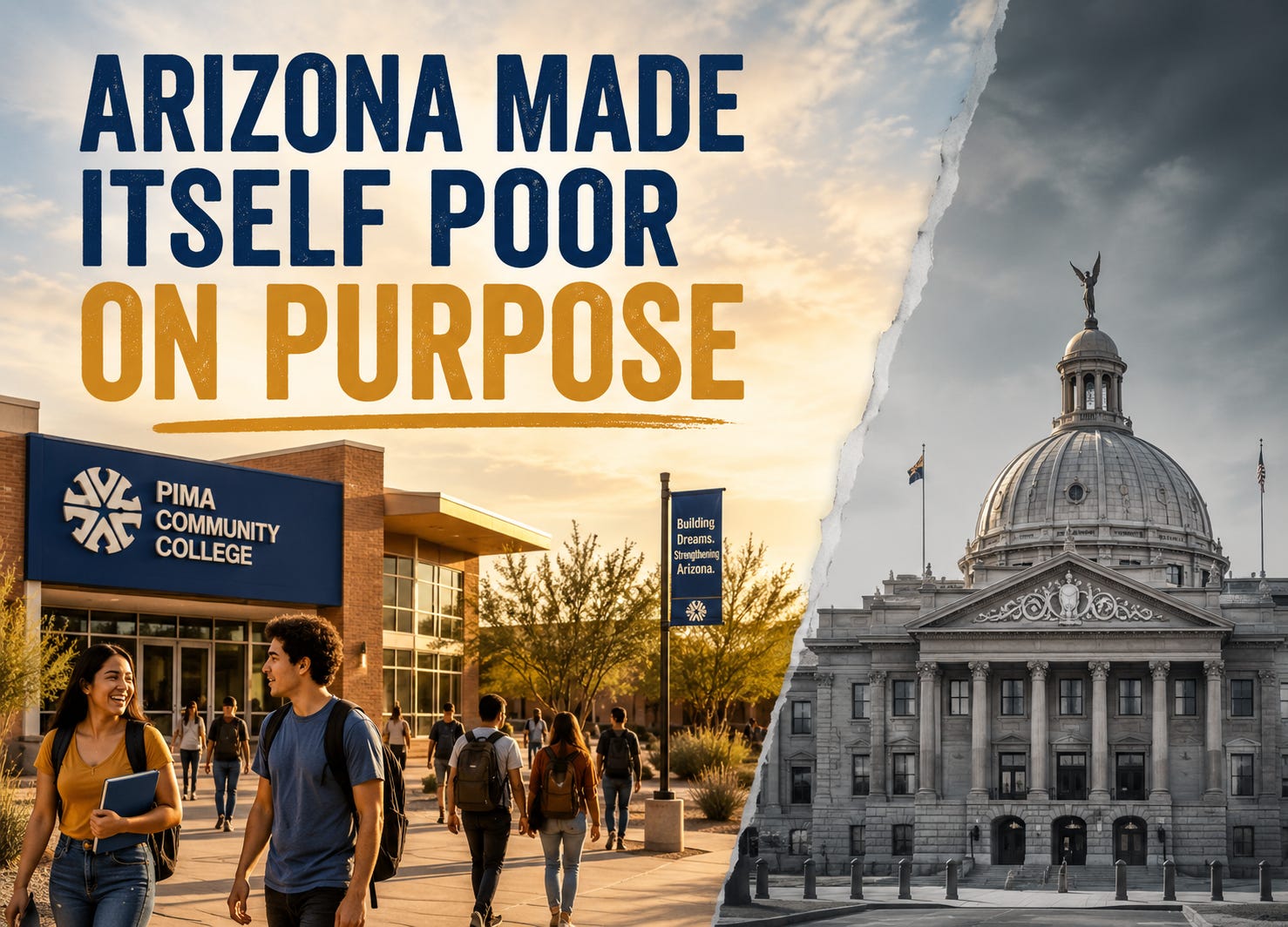
Arizona made itself $1.4 billion poorer on purpose.
Then it told Pima Community College to be grateful for crumbs.
On the evening of June 15, PCC’s Governing Board sat through a study session that was less a budget update and more a post-mortem: three programs eliminated, operations funding still gone after twelve years, adult education money lost in the final budget scramble, and a lobbyist who delivered perhaps the most honest assessment of Arizona’s structural problems that anyone in a government meeting room has said out loud all year.
Nobody else covered this meeting. The livestream drew a handful of viewers, which is roughly how Arizona has always preferred to discuss public education: quietly, in rooms that seat more accountants than people.
What PCC Lost
Before explaining why, here is what happened:
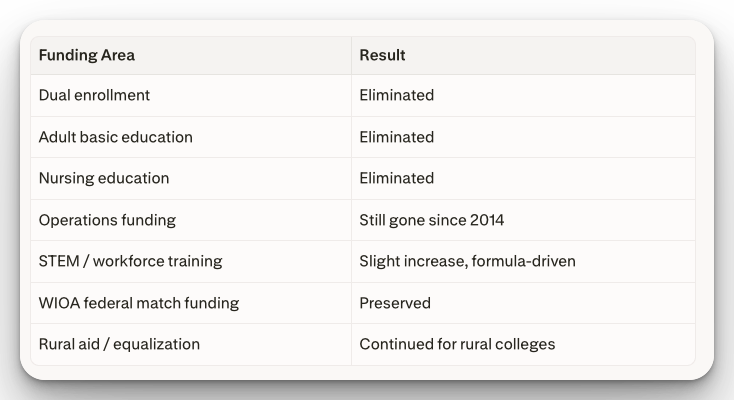
Three programs cut. Zero operations funding.
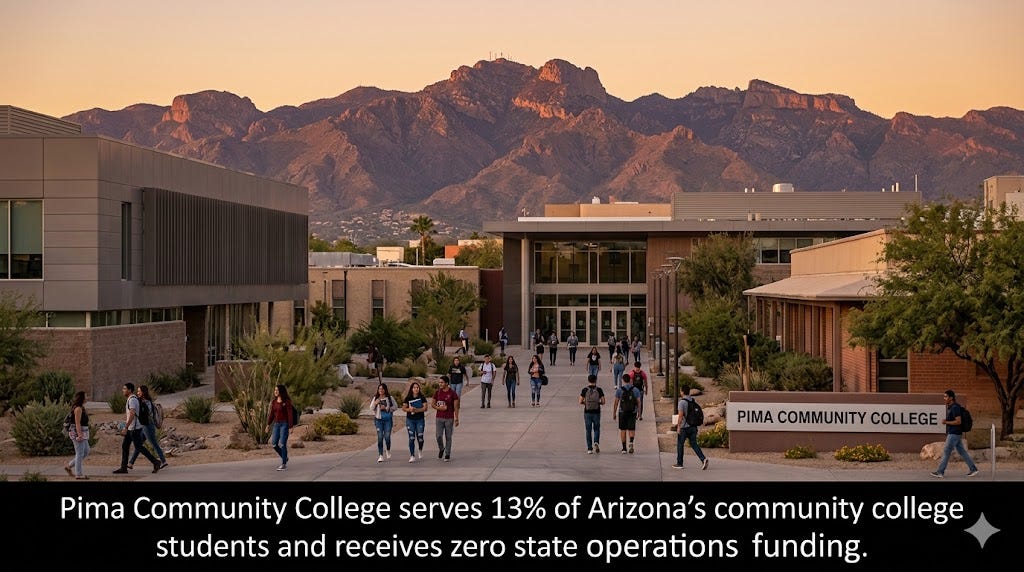
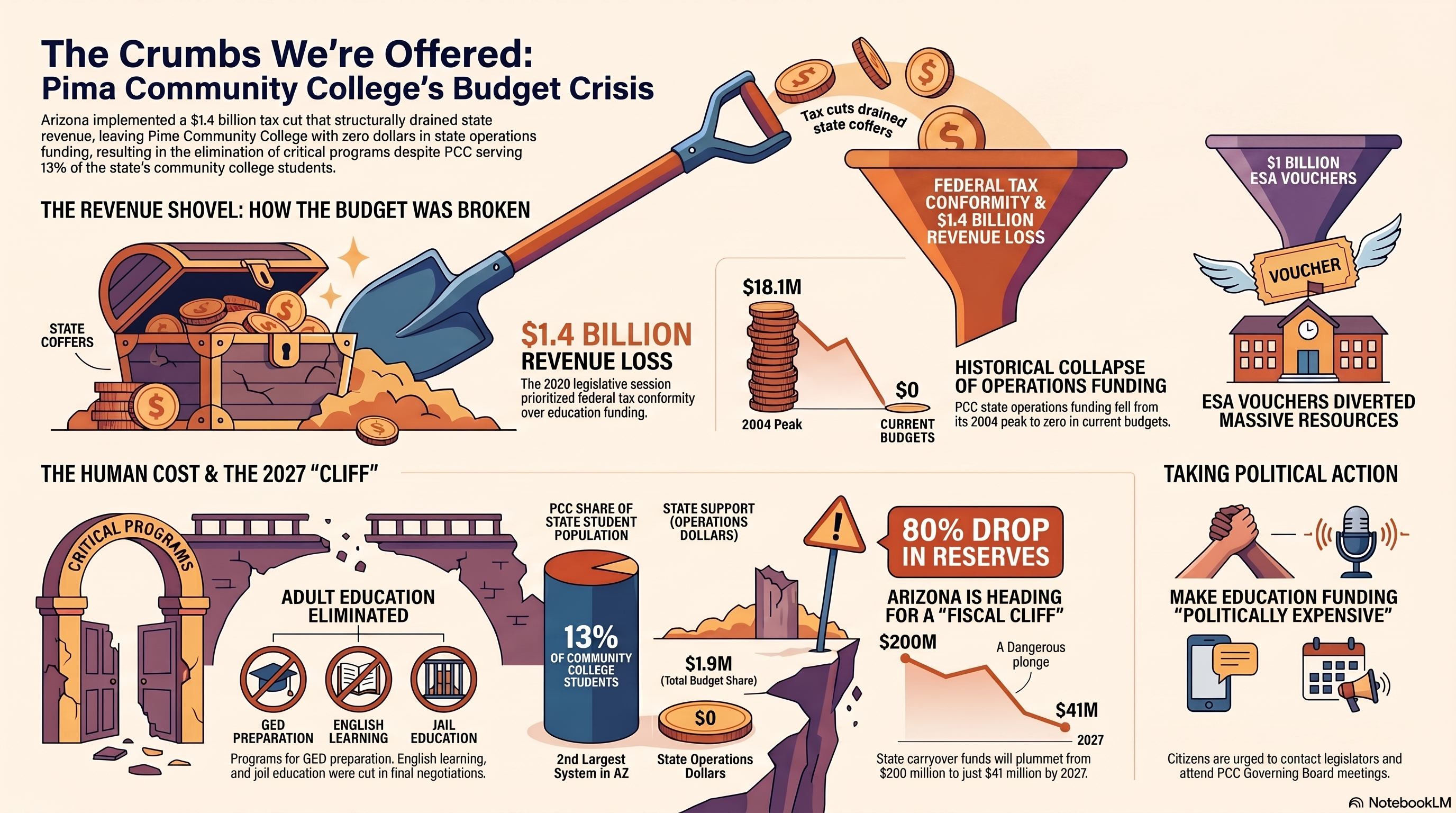
PCC received roughly $1.9 million of the statewide $99.5 million community college budget, despite serving 13% of the state’s community college students. Maricopa Community Colleges serves 60%. Together, the two largest systems in Arizona serve three-quarters of the state’s community college students. Together, they receive no operations funding.
In 2004, at its peak, Pima received $18.1 million in state operations dollars. Maricopa received $46.6 million. By the time operations funding was eliminated, Pima’s share had been whittled down to around $6.4 million. That funding never came back, and this session made clear that “never” is not a figure of speech. It is a legislative position.
How Arizona Made Itself Poor
The Republican majority spent the 2026 legislative session pursuing full conformity with the federal HR 1 tax cut package, a move the Grand Canyon Institute says will drain $1.4 billion from state revenues over four years.
They were not shy about the priority. House Appropriations Chair Rep. David Livingston said the quiet part at full volume.
Compound that with Arizona’s ESA voucher program projected to cost more than $1 billion this year, a Prop 123 funding obligation that expired without a legislative solution, and a $16 million cut to higher education, and you get a budget shaped not by circumstance but by ideology.
The state did not stumble into this hole. It brought a shovel.
Libby Howell, PCC’s executive director of community and government relations, opened her presentation with Livingston’s quote and did not try to soften it. Her husband, she said, tells her she can find the dark lining of every silver cloud. The room laughed.
The numbers on her slide did not.
Article continued below:

Adult Ed’s Near Win
“I’m not gonna be on the budget unless you give me what I want.”
— Reps. Consuelo and Alma Hernandez, via Jonathan Paton
Adult basic education nearly made it. That near-miss matters because it means the fight was real, not ceremonial, and that the 2027 session opens with genuine momentum rather than ground zero.
Jonathan Paton, PCC’s contract state lobbyist, walked the board through exactly how it fell apart. Every legislator he met with, Republicans and Democrats alike, said adult ed was worthwhile. Conservative Sen. Vince Leach championed it publicly.
Tucson-area Democratic Reps. Consuelo and Alma Hernandez refused to vote for the final budget because adult ed was not in it.
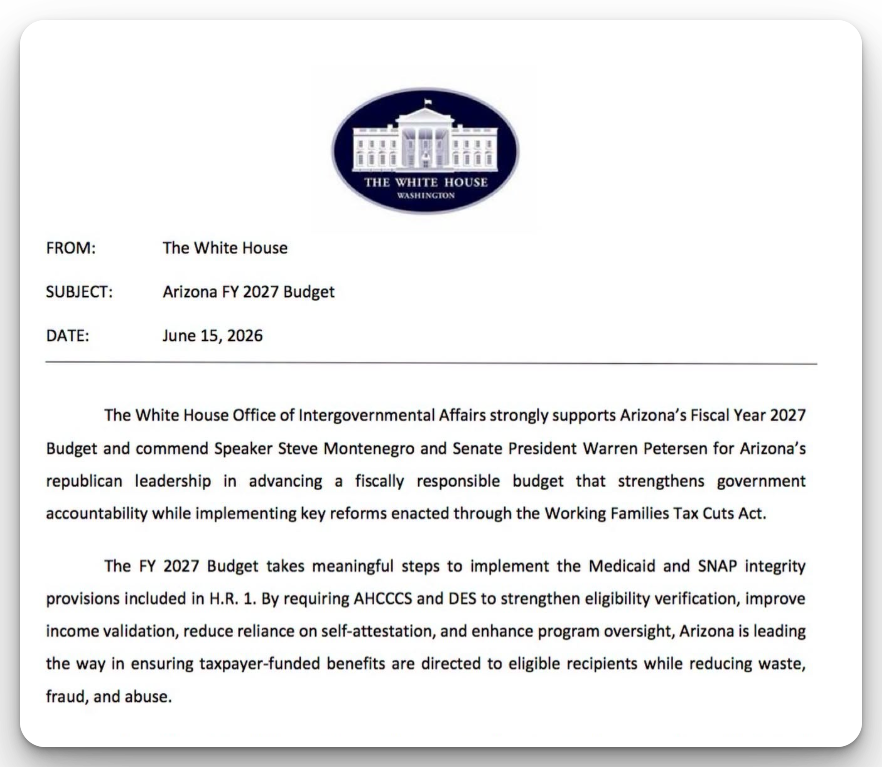
That is about as committed as a legislator can be. The budget passed without their votes anyway. The Democratic Governor signed the budget bill that the White House praised.
In the final budget negotiation, adult education was the top item on the Republican “honorable mentions” list, sitting first in a pool of roughly $6 to $8 million in priorities. The governor’s asks were general-fund related. Republicans wanted non-general-fund offsets. Neither side blinked.
The session closed. Adult ed got left in the hallway.
It was not killed by opposition. It was killed by a process that ran out of time and political will at the same moment.
Before going further, it is worth pausing on who is delivering this analysis. Paton is not a neutral political consultant. He is a former Republican state legislator and the politician associated with the controversial immigration-enforcement law known as Paton’s Law (SB1281), which made it a felony to transport any undocumented person in your vehicle.
That history sits uncomfortably next to the reality that PCC serves Dreamers, DACA students, immigrant adult learners, and students who depended on TRiO, DEI-related supports, and adult education to stay enrolled.
PCC is paying a man whose legislative record includes policies that made higher education harder to access for the very communities the college serves. That is a civic irony worth naming plainly. The college can make its own choices about who it hires to lobby in Phoenix. But the community has every right to ask whether that hire reflects PCC’s stated values, particularly in this political moment.
The Fragmented Coalition
Asking AC4, the statewide community college lobbying association, to represent every Arizona community college this session was a bit like asking one person to argue that the buffet needs more salad, better steak, and also fewer buffets.
Everyone was hungry. Nobody agreed on the menu.
Maricopa’s only ask was operations funding. The rural colleges were defending their rural aid, which for many of them is an existential lifeline, not a supplement.
Eastern Arizona College alone receives $24.4 million in equalization dollars because, without that support, its county’s tax base simply cannot sustain a college.
Pima was fighting for adult ed and trying to plant seeds for an eventual push for operations funding.
When every college is trying to save its own lifeboat, nobody is steering the ship. AC4 found itself trying to carry all of those asks into a legislature that had already decided it was only interested in one thing.
Paton was candid about this: “I think that’s a very difficult position for the lobbyist for AC4 to be in because he has to serve all of these masters that all want something completely different.”
Board Chair Greg Taylor’s question, essentially “what are we paying for,” is a legitimate one that should apply to anti-immigrant bill sponsor Paton.
Paton’s answer was practical: on shared fights, like past expenditure limitation battles, the coalition has real value. But the fracture this year was deep. That is worth understanding before the next session opens.
The Randall Question
“It seems like this is intentionally designed this way.”
— Board Member Kristen Randall
Board Member Kristen Randall asked the question that should follow every budget presentation in every public institution in this state: if Arizona’s job numbers are stable and the economy is not in freefall, why is the state always broke when education bills come due?
Paton did not offer a comfortable answer.
Arizona is a sales-tax-dependent state, which makes its revenue volatile and boom-bust prone. The flat income tax has shrunk the revenue base, and raising it requires a legislative supermajority that does not exist.
The HR 1 conformity package has made the cycle worse, not temporarily but structurally, according to Paton.
Going into the 2027 session, the state will carry forward roughly $41 million. This year, it carried forward $200 million. That is not a dip. That is a cliff.
Paton also noted that statewide agencies are absorbing 2.5% cuts and approximately 1,000 state positions are being eliminated. Courts, health services, corrections, education. Everything is losing the same percentage. That kind of across-the-board blunt-instrument cutting is what happens when the revenue structure is broken and nobody in power wants to say so.
Randall named it anyway. When she said it seemed intentionally designed, she was not being conspiratorial. She was reading the pattern.
What the Board Said Out Loud
“I’m tired of hearing the business community say, ‘We need educated workers.’ Well, if you’re not going to elect people that support public education, you’re not really wanting educated workers. You’re wanting maybe cheap and compliant workers.”
— Board Member Theresa Riel
Theresa Riel got the line of the night.
Her observation is not just a zinger. It is a structural diagnosis.
The business community in Arizona has spent decades claiming it needs a skilled workforce while funding and supporting the politicians who keep defunding the institutions that produce one. That is not a contradiction they have had to resolve because the consequences fall elsewhere.
On community colleges. On students. On Tucson.
Riel’s point also connects directly to the Paton dynamic. The same political ecosystem that produces immigration-enforcement legislation also produces budgets that defund adult education, eliminate dual enrollment, and cut nursing pathways.
These are not separate issues. They share a logic: who gets to participate in the economy, and on whose terms.
Why These Cuts Are Not Abstract
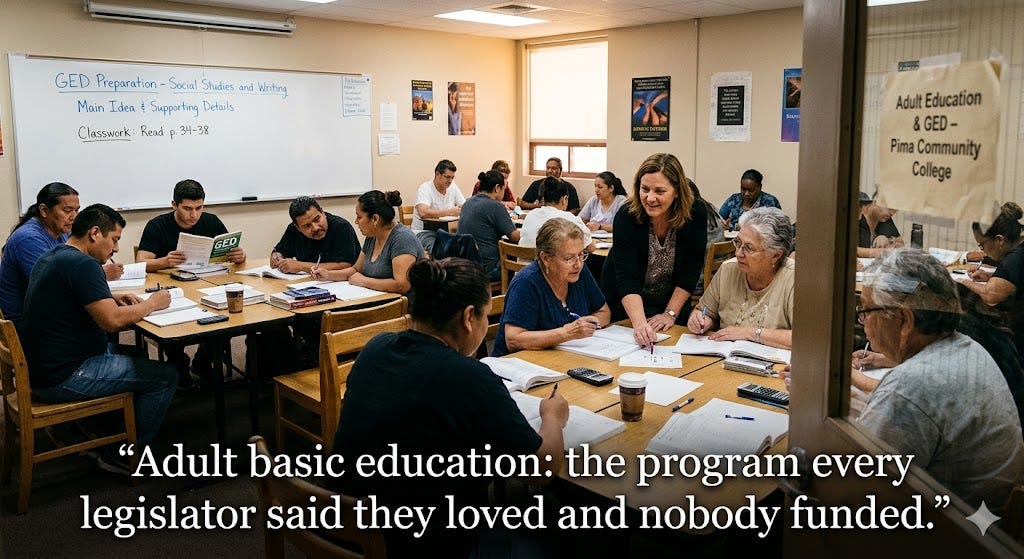
Adult basic education is how immigrants learn English, how adults finish GEDs, how workers rebuild after a layoff, and how people move from precarity to stability.
That same ecosystem reaches into Pima County Jail, where GED and other adult education classes are ending even though roughly 700 incarcerated people participated in them over the past three years, and roughly 400 passed at least one GED subject.
Randall made that case publicly before the board meeting in a Tucson Sentinel guest opinion, arguing that the jail should not close the door on education.
Pima Community College also offers free GED preparation through its Adult Basic Education for College & Career program, which makes the loss even harder to shrug off as some niche bureaucratic trim.
Dual enrollment gives high school students a foothold before the full cost of higher education descends on them.
Nursing programs feed the health care pipeline in a city that needs nurses.
TRiO and related support services help first-generation and low-income students stay enrolled when life, which is endlessly creative in its crises, tries to knock them out.
Cutting those programs is not trimming fat. It is cutting muscle and calling the body lighter.
What happened at the Arizona Capitol on June 11 was not isolated. It is a downstream effect of the vote taken on June 9, when the U.S. House passed Trump’s HR 1 reconciliation package 214 to 212.
Those votes live in Tucson classrooms whether the members who cast them ever visit one or not.
What Happens Next
The 2027 session opens in January. Budget negotiations begin in earnest by October. That is the window when constituent pressure moves things before positions freeze.
Here is what you can do now:
Contact your Arizona state legislators and tell them adult basic education, dual enrollment, and nursing education funding matter to your community. The most powerful lobbying is the call from the constituent, not the consultant. Find your legislators at azleg.gov.
Attend or tune in to PCC Governing Board meetings, which are public and hybrid. Schedules and links are on the PCC Governing Board page.
Read the revenue analysis. The Grand Canyon Institute and the Arizona Economy Center both have accessible breakdowns of what HR 1 conformity is actually doing to the state budget. Once you understand this is a revenue problem, the “we just had a bad year” framing becomes a lot harder to accept.
Tell PCC’s story. If adult ed changed your life, or someone you know, or someone in your neighborhood, say so. Publicly. To your legislators, at community meetings, on social media.
PCC is not short on evidence. It is short on political power. Those are different problems with different solutions.
The state is heading into the next session with $41 million in reserves instead of $200 million. The hole is getting deeper. The institutions that serve the most students with the least political cover will absorb the impact first. That has always been true. The only thing that changes it is making that outcome politically expensive for the people engineering it.
Three Sonorans is an independent Substack rooted in Tucson, the borderlands, and the budget meetings where working people’s futures get decided in rooms they’re never invited into. We sit through the study sessions nobody else covers, follow the money from Washington to Phoenix to the classrooms it never quite reaches, and report on the institutions that shape Tucson’s future. If this piece moved you, share it — that’s how the word spreads when the watchdogs get muzzled.
Have a scoop or a story you want us to follow up on?
Send us a message below or via ENCRYPTED email (all messages kept CONFIDENTIAL) at ThreeSonorans@protonmail.com.