
🎯 TRiO Programs Cut Mid-Grant at Pima College as Hispanic-Serving Institution Status Under Attack by Trump | PCC MEETING
$1.7 million in federal funding eliminated while PCC uses own reserves to keep programs alive

😽 Keepin’ It Simple Summary for Younger Readers
👧🏾✊🏾👦🏾
The people who run Pima Community College 🎓 had a big meeting 🏛️ where they learned that the federal government 🏛️ is taking away millions of dollars 💸 that help students go to college 🎒, especially students whose families don't have much money 💰 or whose parents never went to college 👨👩👧👦.
Even though this is really bad news 😟, the college leaders decided to keep their main boss (called the Chancellor 👔) for five more years 📅 because he's doing a good job 👍.
Now they have to figure out 🧠 how to help students with less money 💵, so they might ask voters 🗳️ in Pima County 📍 to approve new taxes 💲 to build better buildings 🏗️ and keep programs running 📚.
Quotes
Joseph Mais: "Three of our Upward Bound grants were, we were notified that they would be suspended, that mid-grant, that we would not be receiving the funds for them." (Context: Announcing $1.7M in TRIO funding cuts)
Chancellor Nasse: "We used to get in total about 23 million for operating purposes. And then now it's a million and a half for stem." (Context: Explaining state funding elimination)
Chair Taylor: "It bothers me as a taxpayer that I'm paying taxes into the state... But I want my community college and my community to also receive benefits of that." (Context: Criticizing state funding inequity)
Joseph Mais: "The Department of Ed made an announcement this morning essentially saying that they believe that HSI grants are illegal and that they would stop spending money on these programs." (Context: Federal attack on Hispanic-Serving Institution funding)
Makyla Hays: "One of the things I noticed is in the Chancellor goals that you have written out is that movement and plan towards right sizing essentially... looking more towards 360 evaluations or some sort of feedback mechanism." (Context: Faculty calling for administrative accountability)

PCC Board Navigates Federal Funding Crisis While Extending Chancellor's Contract
September 10th meeting reveals institutional resilience amid federal program cuts targeting Hispanic-serving institutions
🗝️ Takeaways
🔥 Three TRIO grants suspended mid-program, cutting $1.7M in federal funding for first-generation college students
📉 Department of Education declares Hispanic-Serving Institution grants "illegal," threatening $10.4M in active funding
💸 Federal adult education elimination could trigger state funding cuts through loss of matching requirements
🏫 PCC receives zero operational funding from Arizona despite serving diverse student population
✅ Chancellor Nasse receives unanimous 5-year contract extension with 2.95% salary increase
🎯 Six strategic goals include $4M expense reduction and potential November 2026 bond election
🤝 Multiple new partnerships approved with K-12 districts and community organizations
💻 Board approves sale of surplus internet addresses for estimated $1.2-1.9M revenue
The September 10, 2025, Pima Community College Governing Board meeting featured a parade of institutional leaders delivering sobering news about federal funding attacks while simultaneously celebrating Chancellor Nasse's contract extension.
Mathematics faculty Makyla Hays opened with pointed observations about shared governance, while government relations directors Libby Howell and Joseph Mais painted a devastating picture of systematic federal disinvestment targeting programs serving working-class and Hispanic students.
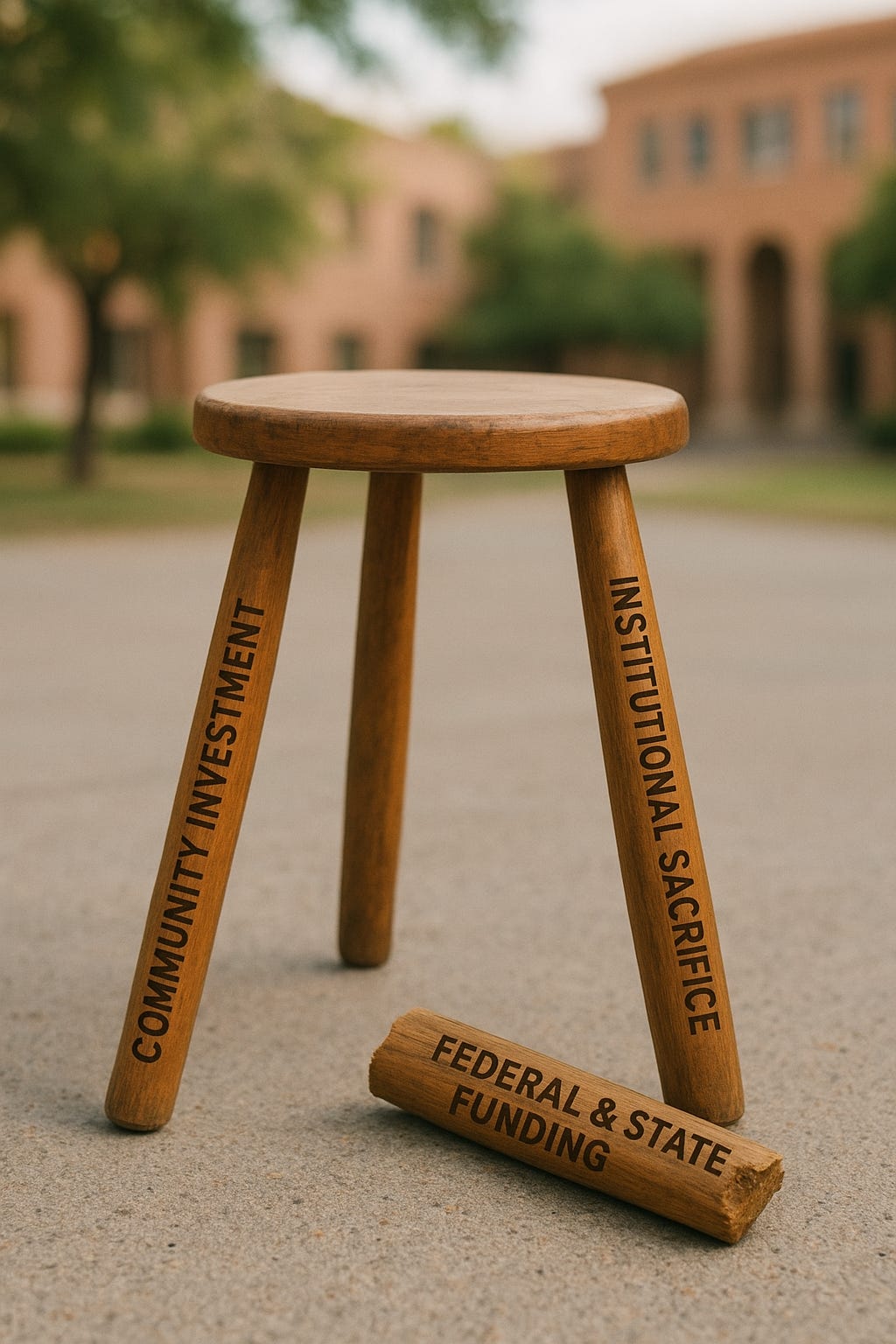
Board members wrestled with the reality of operating on what Chair Taylor called "two legs of a three-legged stool" while approving ambitious goals requiring community investment.
Because apparently, funding programs that help first-generation college students achieve economic mobility is now considered controversial federal policy.
The Federal Funding Apocalypse: Death by a Thousand Cuts
TRIO Programs: First-Generation Students Under Siege
Joseph Mais delivered the meeting's most devastating blow: three of PCC's ten TRIO grants were suspended mid-program, eliminating $1.7 million in funding specifically designed to support first-generation college students from low-income backgrounds.
"For three of our Upward Bound grants, we were notified that they would be suspended, that mid-grant, that we would not be receiving the funds for them," Mais explained, his voice carrying the weight of knowing this affects real students with real dreams.
Let's be crystal clear about what's happening here: programs with decades of proven success in helping kids whose parents never went to college are being systematically eliminated. This isn't about fiscal responsibility—it's about ideology.
When Edgar Soto—in charge of the Desert Vista Campus that houses the Upward Bound programs that work with the Sunnyside district, a key administrator with detailed knowledge of these programs—had already left the meeting, it underscored how these sudden cuts leave institutions scrambling to understand their full impact. "Is Edgar here. Did he leave? Yeah," Libby Howell noted when questions arose about program funding details near the beginning of the meeting.
Chancellor Nasse's full response revealed the scope of institutional sacrifice: "So we have 10 TRiO grants. Three were what they called non-continued. And the board chose where we kept funding two of those, two of the three, through our own pockets. There are four that were continued without funding, but we are hopeful that they will continue to be funded, and we are actually maintaining them through college funding. And so we are hopeful at the end of the day that seven out of the 10 this year will remain active."
The human impact became clear when Board Member Randall shared: "I had the opportunity to speak to a woman who was an Upward Bound student and spoke, not here but up in Maricopa County, but she spoke really highly of the program and credited it with being able to achieve a higher education. So we all know how important it is."
PCC is literally spending its own money to keep 7 of 10 federal programs alive while Washington plays politics with students' futures. That's institutional integrity in the face of federal abandonment.
For readers unfamiliar with TRiO, these federally funded programs provide academic support, mentoring, and college preparation for students whose parents didn't attend college.
In Pima County, where 53% of high school graduates don't pursue any college education, these programs represent the difference between generational poverty and economic mobility.
Hispanic-Serving Institution Status: Existential Threat
The morning of the meeting brought fresh hell: the Department of Education announced it considers Hispanic-Serving Institution grants illegal.
With $10.4 million in active grants based on our HSI status and about a little over $4 million of that remaining, as Mais reported, PCC faces potential elimination of programs serving its student body, that is 25% Hispanic.
The cruel irony? These grants aren't race-based handouts—they support institutions serving communities historically excluded from higher education. But nuance died somewhere around 2016.
"The status makes us eligible for these grants, which we spend on our entire community population," Mais clarified, though one suspects such facts matter little to an administration determined to dismantle educational equity infrastructure.
The Adult Education Domino Effect
Perhaps most insidiously, the House appropriations subcommittee completely eliminated federal adult education funding.
As Mais astutely observed: "One of our strongest arguments in going to the state to get them to support adult education at the levels they have is because that number triggers the grant from the federal government. And if there's no longer a federal trigger, that argument disappears."
Translation: kill federal funding, and state legislators get cover to eliminate their matching funds. It's a double-tap strategy that would make any military strategist proud.
This threatens PCC's robust adult education programming, which Vice Chair Morales witnessed during her cafecitos at El Rio and El Pueblo centers.
"The one thing that I heard across the board in every single classroom is how appreciative they are for the teachers and the investment that those teachers make in them," she reported, describing programs serving working adults grinding through evening classes after full workdays.
State-Level Stagnation: Arizona's Community College Apartheid
Libby Howell's state update revealed the persistent structural inequity facing PCC and the Maricopa Community College District. While securing modest categorical funding increases, the fundamental injustice remains: zero operational funding from a state that funds every other community college system.
"We used to get in total about $23 million for operating purposes. And then now it's a million and a half for STEM," Chancellor Nasse confirmed, quantifying over a decade of disinvestment.
So let's do some basic math that apparently escapes state legislators: $20 million annually for over 15 years equals more than $300 million in lost funding. But sure, let's talk about how community colleges need to be more "efficient."
Board Member Riel highlighted a crucial advocacy challenge: "When people hear this, since it's stated that way, it's assumed that Community Colleges are getting money because this would have reduced funding, right?" She referred to legislative language suggesting community college funding cuts when PCC receives no operational funding to begin with.
Chair Taylor's "soapbox moment" crystallized the inequity: "It bothers me as a taxpayer that I'm paying taxes into the state. And I have no problem with those taxes supporting Coconino, Arizona Western, and all the others. But I want my community college and my community to also receive the benefits of that."
Apparently, taxation without representation is perfectly acceptable when it affects urban, diverse communities.
Chancellor Contract Extension: Stability Amid Chaos
The board unanimously approved Chancellor Nasse's five-year contract extension with a 2.95% salary increase tied to average faculty and staff raises. Board Member Riel offered context: "We are all in agreement that Dr. Nasse has done a great job and he is responsive to all of you... We are proud of the work that this man has done for our college."
The extension provides institutional stability during what Chair Taylor described as "financially tumultuous" times.
"Providing this extension, which is the maximum extension that we can, I'm hopeful we'll provide stability for this institution as we get into this, what will be financially tumultuous over the next year or beyond."
2025-26 Goals: Ambitious Vision Meets Fiscal Reality
Chancellor Nasse's six strategic goals balance growth ambitions with stark financial realities:
Goal 5 requires $4 million in ongoing expense savings—real cuts, not accounting tricks. "That's something I think we can do, and that's going to take a lot of thoughtful planning methodology. Where can we gain efficiencies at the institutions? And by the way, difficult decisions," Nasse acknowledged.
Goal 6 proposes community investment through a potential November 2026 general obligation bond election. "Coming to the board with a detailed plan, an investment plan to consider... by February at the very latest," Nasse committed.
The juxtaposition is striking: cut $4 million while planning major capital investments. It's either sophisticated institutional planning or cognitive dissonance—time will tell.
Faculty Voice: Shared Governance as Institutional Insurance
Mathematics faculty member Makyla Hays opened public comments with substantive policy recommendations that deserve board attention. "Shared governance is always our top priority. We have been doing really well with the actions of shared governance. It feels like it's going in the right direction," she began, before proposing formal codification through board policy.
Her call for 360-degree administrative evaluations directly addresses accountability: "Looking for feedback from peers and from people that work for the person and not just the supervisor and the employee faculty are the closest to that with student evaluations."
Novel concept: maybe administrators should face the same accountability measures as faculty. Revolutionary thinking in higher education.
Community Partnership Expansion
The consent agenda revealed extensive community partnership development, including intergovernmental agreements with multiple school districts for data sharing and concurrent enrollment. These partnerships represent comprehensive ecosystem engagement from K-12 through workforce development.
The approval of contracts totaling over $1.2 million in potential revenue from selling surplus Internet Protocol addresses demonstrates innovative asset management. "We currently own over 65,000 of them, currently use 650, less than 650, and that number is going to decrease over time," explained IT representative Isaac.
The Path Forward: Community Investment or Managed Decline
Chair Taylor's comments throughout the meeting reflected sobering realism about federal unreliability: "I'd rather have bad news than just this limbo that seems constant where we just don't really know what's going to be there or not."
His vision for moving forward requires honest community conversations: "Having honest conversations going into the future as we do this strategic planning about what does it look like to... What can we do as a community with the revenue streams that we have access to to make investments in the proper places?"
Translation: if the feds and state won't fund community colleges serving diverse populations, local communities must step up or watch these institutions slowly die.
Board Member Riel captured the human stakes: "Not only is it economic mobility, but these are human lives that we're talking about, you know, human capital. You know, when a family gains intellectual knowledge, everything about that family continues to improve."
The meeting ended with Chancellor Nasse's rallying cry: "We will not shy from the fight. We will embrace the challenge. We will continue to transform lives across this great community, adapt to change with purpose, and advance with determination."
Because apparently, helping working-class families achieve economic mobility now requires institutional courage in the face of federal hostility.
What Happens Next
PCC faces a critical decision point: accept managed decline or mobilize community support for local investment. The potential 2026 bond election represents a test of whether Pima County values educational access enough to fund it locally when state and federal governments abdicate responsibility.
For students currently enrolled in suspended TRIO programs, for adults grinding through evening classes, for families counting on childcare at Desert Vista campus—the stakes couldn't be higher. These aren't abstract policy discussions, but decisions that affect real people's ability to improve their circumstances.
¡La Lucha Sigue!
Supporting local journalism like Three Sonorans means supporting the kind of in-depth coverage that connects policy decisions to community impact. Corporate media won't tell you how federal funding cuts affect your neighbor's ability to attend college or how state disinvestment perpetuates regional inequities.
Your support keeps this critical coverage coming. Subscribe to Three Sonorans to ensure we can continue monitoring these crucial board meetings and translating policy into plain language that matters to working families.
¿Qué Piensas? What Do You Think?
The September 10th PCC board meeting revealed an institution caught between federal hostility and state neglect, yet demonstrating remarkable resilience under local leadership.
How should community colleges respond when federal and state governments abandon their responsibility to fund educational access? Should local communities fill the gap through property tax increases, or is this just enabling higher levels of government to shirk their duties?
What role should community colleges play in resisting educational inequality, especially when serving predominantly Hispanic and working-class populations? Leave your thoughts below—this conversation affects every family in Pima County seeking economic mobility through education.
Have a scoop or a story you want us to follow up on? Send us a message!

These cuts are coming from a Republican president and a Republican majority Congress. Our state funding issues are coming from a Republican majority state legislature and former Republican governors.
Let's start by never ever voting for any Republicans ever again.
thank you for the "keeping it simple" section.