



Tom Horne spent a career turning Tucson’s Mexican American Studies fight into political fuel. Now the law he championed has been struck down as unconstitutional, his own primary is slipping away to Kimberly Yee, and the attorney general candidate he endorsed lost the same night. This is what it looks like when the panic machine finally turns on the man who built it.
📬 Horne’s Bad Night Gets Worse
The Arizona schools chief spent a career turning Tucson’s Mexican American Studies program into a political weapon. He lost his own primary to Kimberly Yee, and the attorney general candidate he endorsed lost too. Good riddance.
by Three Sonorans
Tom Horne is losing his own primary, and he brought it on himself. Early results from the July 21 vote show State Treasurer Kimberly Yee ahead of the incumbent Republican superintendent of public instruction by roughly ten points, in a primary shaped by a voucher oversight scandal and a racist ad that echoed Horne’s own campaign attacks.
The man losing was never a bystander in Arizona’s war on ethnic studies. He was one of the architects who turned that fear into a career, and on election night, his own party started the process of putting him out.
The Order TUSD Was Already Under
Tucson didn’t need Tom Horne to tell it what its Mexican American students required.
In December 2009, federal Judge David Bury approved Tucson Unified School District’s Post-Unitary Status Plan, closing out three decades of court oversight in the district’s long desegregation case and putting TUSD under a plan built specifically to serve the Black and Latino students the district had once systematically excluded.
The Federal Court had spoken, and TUSD was bound to follow it.
Five months later, Horne helped write the law that blew through it anyway. In May 2010, Arizona enacted HB 2281, the bill Horne championed as state superintendent to ban classes designed for a particular ethnic group.


By January 2012, under the weight of that law and the funding threat attached to it, TUSD suspended its Mexican American Studies program, pulling books including Paulo Freire’s Pedagogy of the Oppressed and Richard Delgado and Jean Stefancic’s Critical Race Theory from MAS classroom use.
TUSD had a federal court order telling it to serve those students. It had a state superintendent telling it not to. Horne won that fight in the short term. He lost it permanently five years later.
A federal judge found that HB 2281 itself was motivated by racial animus, ruling that Horne and John Huppenthal pursued the fight against MAS in part for political gain, invoking their anti-MAS efforts in campaigns, speeches, and radio ads because the issue was a political boon.
The law Horne built his career on was later struck down as unconstitutional. That’s not interpretation. That’s the court record, and it’s the correct starting point for everything that follows: TUSD should have been allowed to follow the federal court order. Horne made sure it couldn’t.
So when Horne remade himself years later as an anti-DEI crusader, the pattern wasn’t new. It was the same equation with fresher branding. Change the acronym, keep the scapegoat, cash the votes.
The Audit That Followed Him Into the Voucher Fight
The central policy fight of this primary was supposed to be school vouchers, and in one sense it was.
An Auditor General report released in May found that Horne’s Department of Education couldn’t show what action, if any, it took on more than 581,000 high-risk Empowerment Scholarship Account transactions, worth nearly $100 million, that auditors flagged for review.
Yee said the findings confirmed her allegations of “complete chaos” inside the department.
Horne’s response, delivered in a televised debate, was to list purchases his agency had refused to approve: a $5,000 Rolex, a $24,000 golf simulator, a vasectomy testing kit, arguing that the system was working.
Arizona’s education bureaucracy had the vigilance to spot a Rolex and a golf simulator. It could not document a review of hundreds of thousands of high-risk transactions worth tens of millions of dollars.
The man who postures as the classroom disciplinarian couldn’t account for how his own signature program was actually being run.
The audit became the centerpiece of Yee’s case against him, and it landed. Among the officials it flagged for conflicts of interest was John Ward, the department’s ESA executive director, hired directly into that role by Horne in 2023.
Auditors found an ESA transaction connected to Ward’s own child that lacked required documentation, along with two families Ward personally directed be fast-tracked for review.
Horne built a department where the man overseeing accountability for other people’s money couldn’t account for his own. Ward earned that scrutiny. He’s spent two decades building a career off other people’s trust and other people’s oversight failures, and at some point a man who keeps landing on the comfortable side of every accountability gap stops being a coincidence and starts being a pattern. Vendido.

The Ad, and the Attack Line Before It
Then came the ad.
A digital attack funded by an outside group portrayed Yee, who is Chinese American, as the “Empress of DEI,” built around gong sounds, bamboo-style lettering, and a claim that she led a “national shadow government of bureaucrats.”
Horne said he was “shocked by the appeal to ethnic prejudice” and asked the group to pull it. Nobody proved his campaign made it. But Yee said it simply repackaged his own talking points, and she wasn’t buying the distance he tried to put between himself and it.
That skepticism has a factual basis that predates the ad itself.
Horne’s campaign had already accused Yee of chairing a DEI committee under the National Association of State Treasurers, an accusation Yee called a lie and moved to stop with a cease-and-desist letter. The specific committee title is disputed. Yee’s underlying relationship with NAST, where she holds a current leadership position, is not.
Whatever the precise label, the DEI attack line was Horne’s before the ad ever existed, and it drew from the same old Arizona trick of turning race into a warning siren for Republican voters, regardless of who ultimately cut the video.
Horne helped normalize a politics that treats the histories of Mexican American students as suspect, that casts culturally grounded education as dangerous, and that keeps finding new ways, coded or not, to say some people are too ethnic, too foreign, too “divisive” to be trusted with public institutions.
On election night, that same fear got aimed at a fellow Republican, built out of an attack line he started.


Not a Redemption Story, and Good Riddance Twice Over
Don’t flatten Yee into a resistance heroine.
She campaigned squarely inside the same right-wing education frame, telling voters she has “always opposed DEI,” and her attacks on Horne centered on management competence, not on any rejection of the premise that DEI is something worth opposing at all.
The contradiction here isn’t that Arizona Republicans produced one villain and one target. It’s that a party built on racialized education politics will still turn on its own the moment tactical convenience demands it.
That history didn’t end when the MAS courtroom emptied. It mutated.
First “ethnic studies.” Then “critical race theory,” a term TUSD was pulling off classroom shelves in January 2012, nine years before Republicans nationally discovered the phrase as a weapon against schools everywhere.
Then “DEI.” The names change. The formula doesn’t: pick a racialized target, call it a threat to children, turn the panic into votes. People who lived through the MAS fight in Tucson aren’t surprised the term came back. They watched it work here first.
Horne’s loss isn’t the only one worth naming. Horne co-chairs the campaign of Rodney Glassman, the Republican candidate for attorney general, who lost his own primary to Senate President Warren Petersen the same night. Place your bets now: What office will Rodney run for next and lose?
Two campaigns carrying Horne’s name. Two losses, same night.
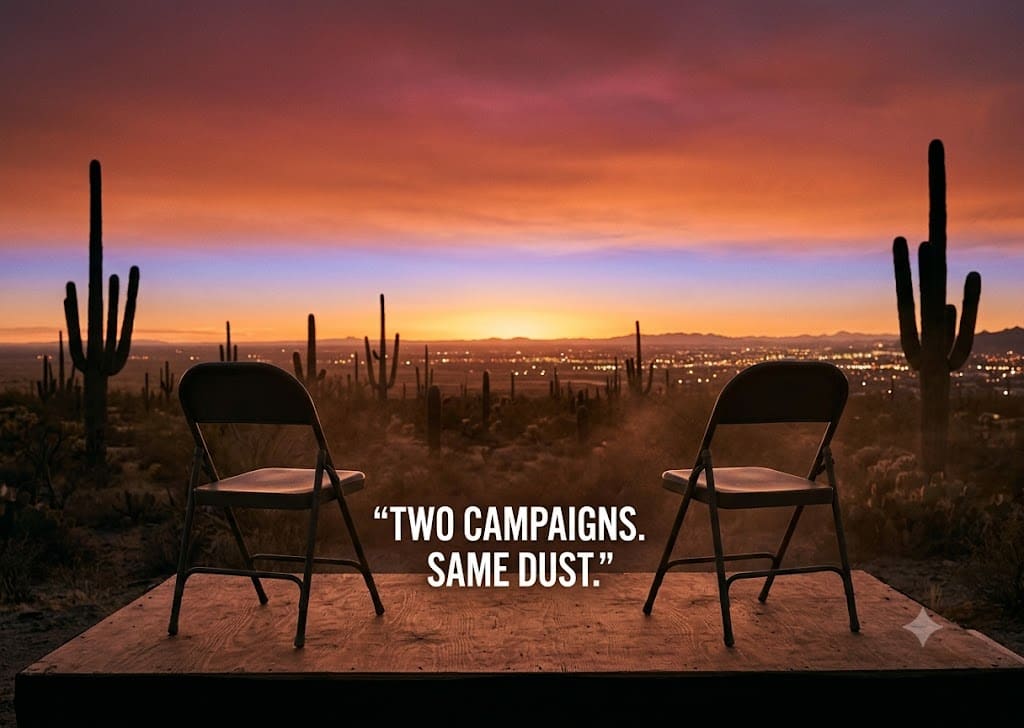
Building a career on resentment doesn’t buy loyalty, not from voters, and not from the machine you built it with.
HB 2281 was struck down as unconstitutional. Horne is losing his own primary. The candidate he backed lost his too. None of that is ambiguous, and none of it needs softening.
Justice looks bigger than one Republican beating another in a primary. It looks like Tucson students never again having their history dragged into court so ambitious men can audition for higher office. It looks like a district that gets to follow its own federal court order instead of a superintendent’s political theater. It looks like a future where la gente names the pattern fast enough to break it before another generation is told their story is the problem.
Three Sonorans has been tracking Tom Horne since before “ethnic studies ban” became a euphemism for something uglier. This piece exists because Tucson remembers what got erased from MAS classrooms in 2012, and remembers who did it. If this landed for you, share it, because watching the architects of racial panic lose is a story worth spreading before the next news cycle buries it.
Have a scoop or a story you want us to follow up on?
Send us a message below or via ENCRYPTED email (all messages kept CONFIDENTIAL) at ThreeSonorans@protonmail.com.


