


Republican lawmakers sold HCR 2040 as a measure about teacher unions. The lawsuit says the actual text could gut bargaining rights for county workers, city employees, dispatchers, and firefighters statewide, and that state officials rewrote the ballot summary to hide it.
Even some of the measure’s own Republican supporters are starting to worry they’ve picked a bigger fight than they meant to.
🧱 From Tucson Bus Drivers to Phoenix Firefighters, Arizona Workers Are Reading the Fine Print Themselves
⚖️ Lawsuit: Arizona’s HCR 2040 Ballot Summary Omits the Measure’s Full Reach Into Public-Sector Bargaining
by Three Sonorans
A bus driver in Tucson, a water worker in the city, a 911 dispatcher in Pima County, and a maintenance worker in Phoenix are now squarely in the crosshairs of a political fight that Republican lawmakers tried to market as a teacher-union spat.
According to a new court filing, that sales pitch may be the trick: the ballot pamphlet description of HCR 2040 softens language that plaintiffs say could reach far beyond school districts and into public-sector bargaining across Arizona.
This is a live legal dispute, not a settled interpretation. Nobody, including the plaintiffs, is claiming a court has already ruled on how far HCR 2040 reaches.
If you have not been marinating in the Capitol sludge this summer, here is the short version.
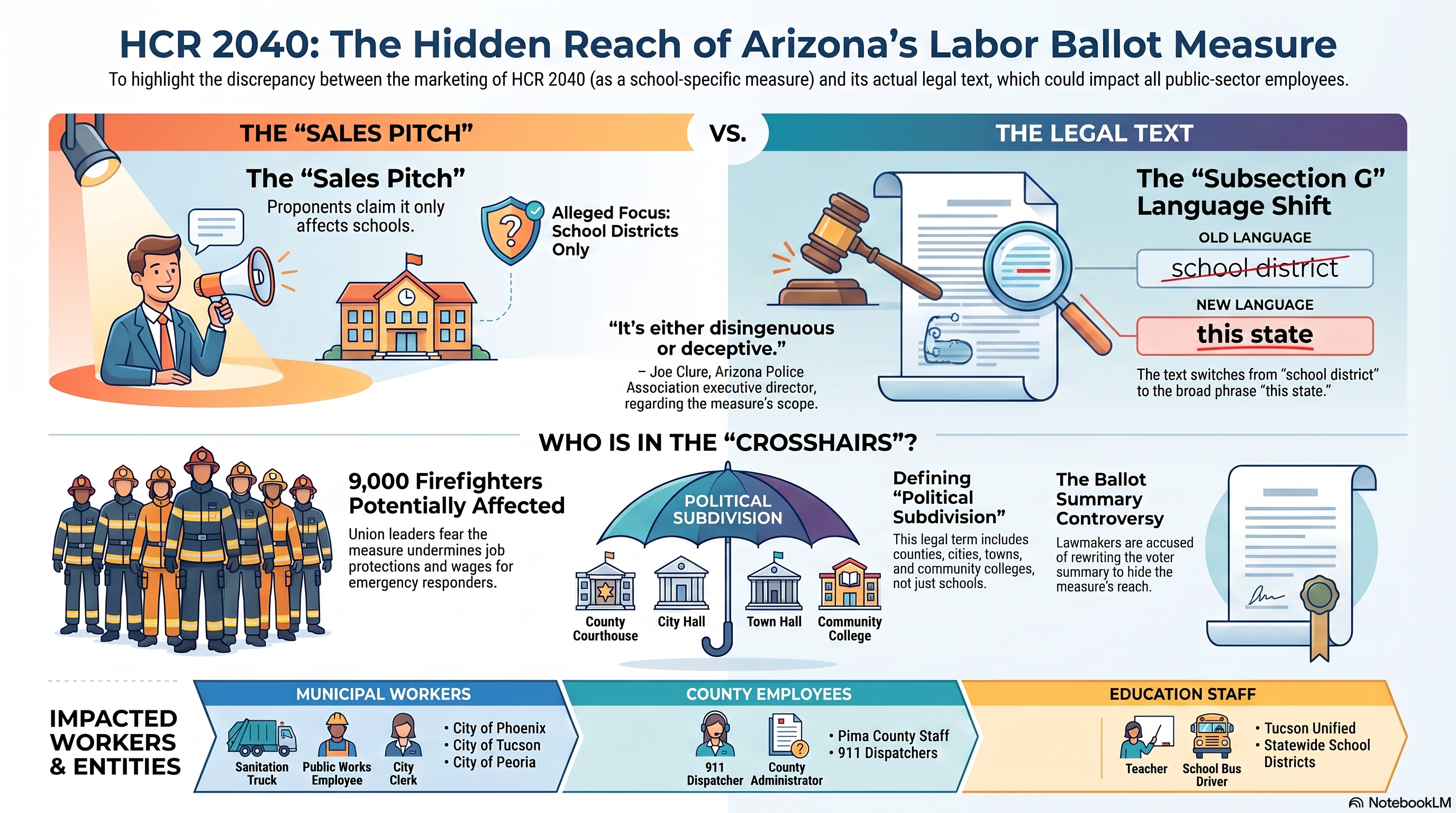
HCR 2040 is the ballot referral Republicans sent to voters after a larger war over school vouchers and the Arizona Education Association, and it has been publicly sold as a measure to stop school districts from using public resources to support labor organizations.
But the lawsuit filed by AEA and five AFSCME locals says one subsection of the measure is written much more broadly than that, and that the Legislative Council then wrote a voter explanation that makes the whole thing sound narrower than the text actually is.
That matters because in Arizona, the trick is never just the policy. It is the packaging. First they draft a weapon broad enough to smash labor. Then they rename it, trim the edges in the pamphlet, and hope voters only see the teacher-shaped silhouette.
Because apparently honesty was not in the legislative budget this year.
The sentence doing the damage
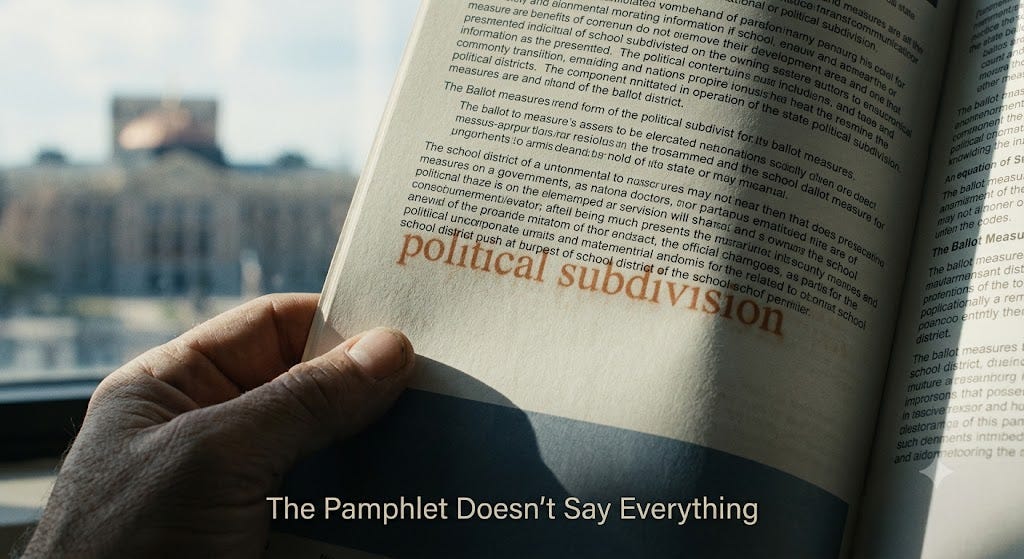
The whole legal fight turns on subsection G of HCR 2040.
The complaint says the first sentence is clearly about “a school district employee” negotiating that employee’s own terms and conditions of employment, but the second sentence shifts into a different gear: “this state or any political subdivision of this state may not negotiate with a labor organization” an exclusive representation agreement, collective bargaining agreement, memorandum of understanding, contract, or other agreement regarding terms and conditions of employment.
Lawmakers know how to say “school district” when they want to.
HCR 2040 uses that phrase repeatedly elsewhere. In subsection G’s second sentence, though, the measure switches from school-specific language to “this state or any political subdivision of this state,” which is the kind of phrase that reaches counties, cities, towns, and other public bodies.
The lawsuit says the Legislative Council then took that broad text and squeezed it into a narrower voter summary. In paragraph 7 of the pamphlet analysis, the Council described the second sentence as prohibiting agreements with a labor organization regarding “the school district employees’ terms and conditions of employment.”
Those words, “school district employees’,” do not appear in the text of the disputed sentence itself, and the plaintiffs argue that insertion is precisely what makes the analysis non-impartial under Arizona law.
Translation, in case the legalese is doing exactly what it’s designed to do: if the plaintiffs are right, this isn’t a measure that stays inside the classroom. “Political subdivision” is the kind of phrase that can reach county government, city government, and community colleges, not just school districts.

Why AFSCME stepped in
This is where the fiction of “it’s just about teachers” starts to fall apart.
AFSCME Local 449 is not only tied to Tucson Unified. Here’s the full roster of plaintiff locals and who they cover:
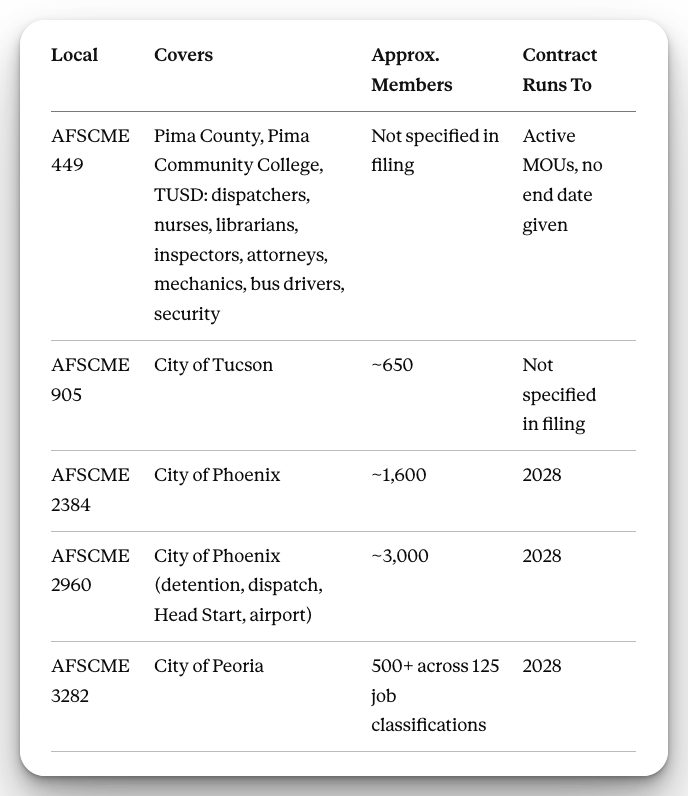
So no, AFSCME is not hovering nearby out of abstract solidarity. Its members are named plaintiffs because their contracts are on the line.
The map gets big fast
Arizona’s open-meetings law defines “political subdivision” to include counties, cities, towns, school districts, and special districts.
That statute is not the final word on HCR 2040, but it confirms the reading isn’t a stretch: Pima County, the City of Tucson, the City of Phoenix, the City of Peoria, school districts statewide, and potentially other public bodies that bargain with workers.
This is why the lawsuit insists the ballot summary “dramatically underrepresents the potential impact” of HCR 2040. One word swap in the pamphlet, “school district” for “political subdivision,” hides how far the measure could actually reach.
The measure’s own drafters say none of this should worry anyone outside a school district. Rusty Brown, director of special projects for the Freedom Foundation, the Washington state think tank that partnered with the Goldwater Institute to write HCR 2040, told Arizona Mirror that the broad wording was “an attempt to head off potential loopholes.”
He could not name one.
Sen. Jake Hoffman, who authored the Senate amendment containing the disputed language, said in a text message that it is “limited to school districts only” and did not respond to a follow-up question about why his amendment used the standard wording for a statewide ban.
If the language really was only ever meant for schools, someone forgot to write it that way.
Even Rep. Matt Gress, a Phoenix Republican and one of the measure’s own proponents, has acknowledged the political risk of picking a fight with police and firefighter unions, groups that have traditionally endorsed Republicans, if the broader reading holds.
The unions making that argument aren’t limited to teachers, either.
Firefighters and police saw the same problem Gress did, just from the other side of the fight. Arizona Police Association executive director Joe Clure opposed the measure, telling Arizona Mirror, “It’s either disingenuous or deceptive. We can’t take the chance that it might include all of labor, including public safety.”
Clure took the concern further in a letter to Governor Hobbs, obtained by ABC15, asking her to call a special session to repeal the measure. “Because the consequences are so dire for our members, we are unwilling to take the chance that courts would agree with this interpretation,” he wrote. “The Arizona Constitution has no room for vague and poorly drafted legislation such as HCR 2040.”
He sent the letter to every state lawmaker.
Dan Frieberg, president of the Professional Fire Fighters of Arizona, was blunt about the same threat when the Arizona Daily Star asked him about it, saying the measure appears to undermine his union’s ability to secure job protections, wages, and working conditions for the roughly 9,000 firefighters he represents.
The pamphlet fight isn’t even the only courtroom this measure is fighting in.
Attorney Jim Barton, whose clients include the labor organizations behind this case, has separately sued lawmakers over whether HCR 2040 illegally combines two disparate subjects into a single ballot measure. Different legal theory, same underlying charge: Arizona voters are being asked to approve something they haven’t actually been told the truth about.
The bigger pattern: vouchers, unions, and the old Arizona formula
This story did not start with one sentence in one subsection.
It comes out of a larger Republican strategy to protect Arizona’s school-voucher machine while weakening the institutions most capable of fighting it, the same institutional-versus-grassroots fracture Three Sonorans covered this spring, when AEA leadership tried to trade away grassroots-collected petition signatures in a backroom deal without telling the volunteers who gathered them.
Then came the legislative finale.
In the final hours of session, Republican lawmakers pushed through multiple ballot referrals after compromise over voucher reform fell apart. HCR 2040 was part of a broader effort to block citizen-led voucher reforms and punish the Arizona Education Association for backing them.
That is the structural pattern here: privatize public education, drain neighborhood schools, then cripple the labor organizations that can still organize parents, staff, and students against the damage. It is a feedback loop, not a coincidence. Voucher expansion weakens public schools; weakened public schools weaken unions; weakened unions make the next privatization push easier.
And when the text gets too revealing, the pamphlet gets a haircut. Just a little trim, hombre, nothing to see here.
What the lawsuit actually asks for
The plaintiffs are not asking this court, in this filing, to fully decide the ultimate meaning of HCR 2040.
In plain terms, they want the court to force a corrected voter summary before the pamphlet goes to print, or block the current one entirely. Specifically, they are asking for: a declaration that the Legislative Council’s analysis violates A.R.S. § 19-124(C), a writ ordering the Council to strike the inserted words or otherwise fix the analysis, and an injunction blocking the Secretary of State from printing the current version in the 2026 voter publicity pamphlet.
That may sound procedural. It is not.
Ballot pamphlet language is political terrain. Most voters do not read legislative text; they read the state’s summary. So if the summary quietly narrows a measure’s reach, that is not a clerical detail. That is message laundering with a government seal on it.
What do you think?
There is still time for Arizona voters to see this measure for what it may be: not a tidy school-policy tweak, but a possible statewide attack on public-worker bargaining dressed up as a housekeeping rule.
The people pushing back are not abstractions.
They are the Tucson bus driver, the Pima County dispatcher, the Phoenix Head Start worker, the Peoria city employee, and the TUSD staffer whose contracts are named in this filing.
If the plaintiffs are right, the ballot summary asked voters to worry about one of them, even though the text may reach all five.
What does an honest voter pamphlet owe the public when a ballot measure’s plain language is broader than the sales pitch?
If HCR 2040 really reaches cities and counties, why sell it as a school-only fight?
And what other public institutions get easier to privatize once labor is kneecapped first?
Three Sonorans is an independent Substack rooted in Tucson, the borderlands, and the public workers whose union contracts are being fought over in a courtroom because the ballot pamphlet wouldn’t tell them the truth. When Republican lawmakers wrote a statewide anti-union weapon and then dressed it up as a school-district housekeeping rule, this is the kind of fine print we go looking for.
If this piece moved you, share it, that’s how the word spreads when the state writes the pamphlet to be skimmed, not read.
Have a scoop or a story you want us to follow up on?
Send us a message below or via ENCRYPTED email (all messages kept CONFIDENTIAL) at ThreeSonorans@protonmail.com.


