

🏛️ Rex Scott's Democratic Dereliction: When County Supervisors Supervise Everything But Democracy
How Pima County's chairman ignored hundreds of constituent contacts to vote for controversial Project Blue, and still had the audacity to chastise them.

Based on the Buckmaster Show for 8/14/25, a daily radio show in Tucson, AZ, interviewing local newsmakers. Analysis and opinions are my own.

Rex Scott's most damning declaration came when Buckmaster asked directly about regrets on his support for Project Blue. The chairman's response was crystalline in its corporate clarity: "None whatsoever, Bill."
😽 Keepin’ It Simple Summary for Younger Readers
👧🏾✊🏾👦🏾
💧🏗️ A county leader named Rex Scott voted to approve a big water-using building project despite hundreds of calls and emails asking him not to.
😡📢 He then got mad at those same people for being upset at public meetings.
✈️😊 Meanwhile, good news came from the airport — Brian Kidd announced that Southwest Airlines will start flying between Tucson and Phoenix twice a day, making travel easier and cheaper for families.
🏛️💼 The story shows how sometimes government workers listen to big companies instead of regular people, but other times they actually help solve real problems.
🗝️ Takeaways
🏛️ Rex Scott admitted receiving "hundreds" of constituent contacts opposing Project Blue but voted for it anyway
✈️ Southwest Airlines adds twice-daily Tucson-Phoenix service starting March 5th, opening its entire western network
💧 Project Blue's defeat exposes fundamental flaws in Southern Arizona's economic development approach
🗣️ Public meetings became "unproductive spectacles" when citizens voiced opposition to predetermined corporate deals
🌵 Environmental justice concerns highlight a pattern of sacrificing desert communities for distant corporate profits
✊ Community organizing successfully defeated a major development project despite official support

Democratic Drowning: When County Supervisors Supervise Everything But Democracy
An Indigenous Chicano's take on Rex Scott's Project Blue betrayal and the occasional government win
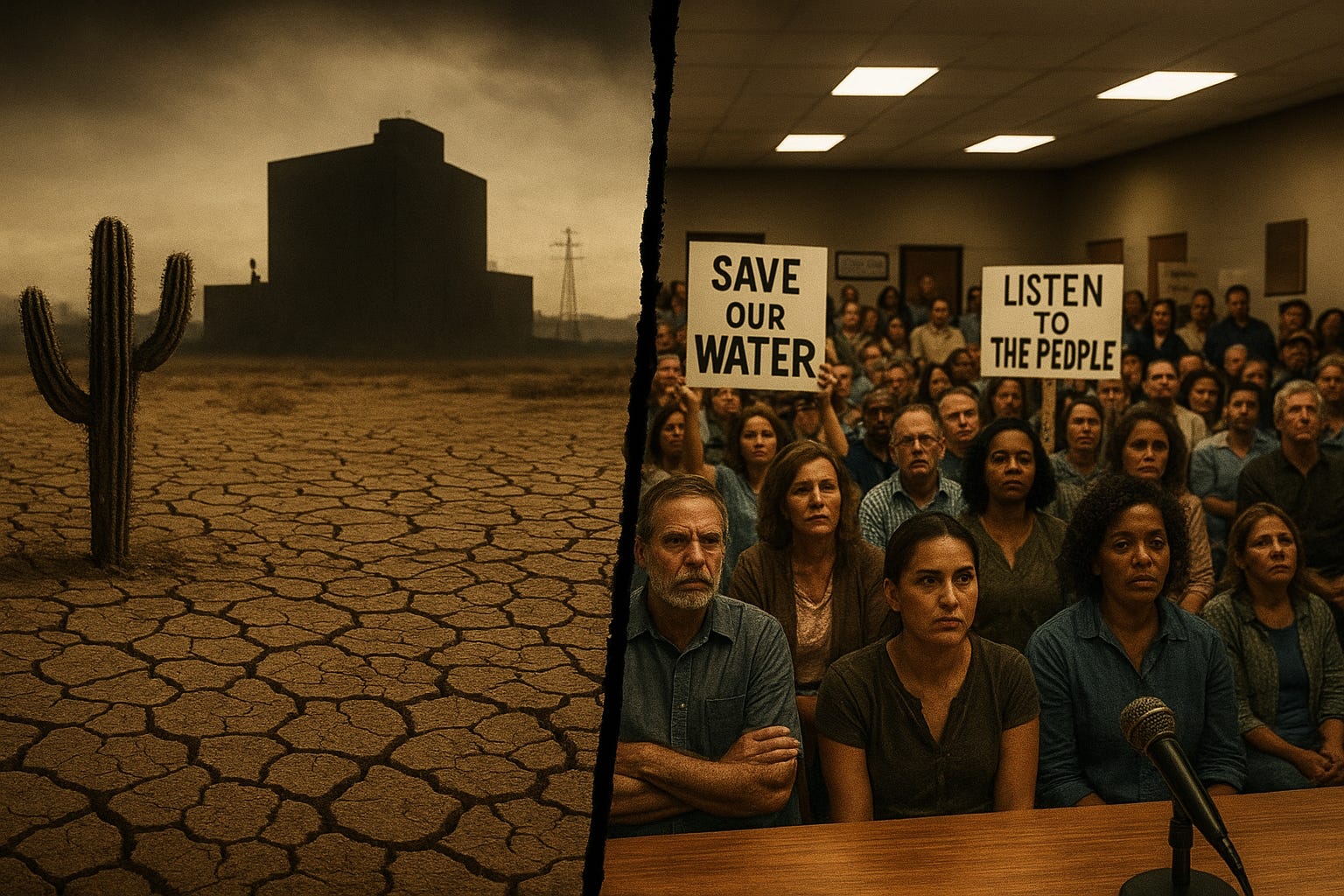
The August 14th edition of the Buckmaster Show delivered a tale of two public servants that perfectly encapsulates the schizophrenic state of Southern Arizona governance.
While one official openly confessed to democratic dereliction, another actually delivered news that might benefit working families for once. Imagine that—a government employee doing their actual job.
The Great Water Heist: Project Blue's Democratic Deficit
For readers just tuning into this corporate colonization saga, Project Blue represents everything wrong with modern economic development.
This proposed data center project promised massive water consumption in a desert region already facing unprecedented drought conditions, all while dangling the usual economic development carrots: jobs, tax revenue, and that nebulous concept of "growth" that somehow never seems to trickle down to the communities most affected by environmental degradation.
Because nothing says "sustainable development" like building water-guzzling data centers in the Sonoran Desert during a megadrought.
The project gained notoriety not just for its environmental implications but for the way it exposed the fundamental disconnect between elected officials and their constituents.
Two raucous public meetings—one at Mica Mountain High School and another at the Tucson Convention Center—became symbols of citizen frustration with a political process that seemed predetermined to favor corporate interests over community concerns.
Pima County Board Chairman Rex Scott, displaying the kind of tone-deaf arrogance that would make Marie Antoinette blush, spent his Buckmaster Show segment defending his unconscionable vote for Project Blue while simultaneously scolding the very citizens whose opposition he openly acknowledged receiving.
"I got hundreds of emails, phone calls, letters, requests for phone conversations from people who were expressing how they felt about Project Blue," Scott admitted, before launching into a sanctimonious lecture about civic decorum. Let me get this straight—you received hundreds of constituent contacts opposing a project, voted for it anyway, then had the audacity to criticize those same constituents for being upset about it?
The chairman's confession reveals the ugly truth about representative democracy in the neoliberal era: representatives who represent everyone except the people who elected them.
Scott acknowledged that his office was flooded with opposition, yet he cast his vote based on what he called "our analysis of the facts, including information that we had gotten from the city's water utility and the city manager's office."
Translation: bureaucratic assurances from the same institutions that have presided over decades of unsustainable growth trumped the expressed will of his constituents.
The Civility Police Strike Again
Scott's pearl-clutching over citizen behavior at the public meetings was particularly galling. He described the gatherings as scenes where people were "sworn at and shouted at and talked over," expressing concern for "our guests from out of town trying to share information about the project."
Oh, the humanity! Imagine subjecting corporate representatives to the same disrespect they've shown our communities for generations.
But Scott's most damning declaration came when Buckmaster asked directly about regrets. The chairman's response was crystalline in its corporate clarity: "None whatsoever, Bill."
He then launched into a litany of lost lucre, lamenting the "biggest capital investment in the history of the county" and mourning the developer's "offer to pony up $100 million to pay for infrastructure that was aligned with Tucson Water's One Water 2100 Plan."
"None whatsoever" — two words that perfectly encapsulate the democratic deficit devouring our desert democracy. Despite drowning in hundreds of constituent contacts opposing the project, Scott expressed zero contrition about ignoring his constituents' overwhelming opposition.
The audacity is absolutely astronomical.
The supervisor's obsession with maintaining appearances for potential corporate suitors revealed his true priorities.
"When a meeting like that takes place and there's media coverage of those meetings, that media coverage is not just seen and heard by people in Pima County and Tucson, it's seen and heard by people who are thinking of locating their businesses here," Scott worried.
"If you're watching and seeing some of the uncivil and rude behavior that occurred among some of the people at those meetings, you're probably asking yourself, do I want to put my staff, my workforce through anything like that?"
This framing exposes the fundamental hierarchy of Scott's concerns: corporate comfort over community concerns. The possibility that "site selectors" might be turned off by actual democracy in action apparently keeps the chairman up at night, while the water insecurity facing his constituents barely registers as a blip on his political radar.
Timeline of Betrayal
The chronology of Scott's involvement with Project Blue reveals a pattern of insider access and constituent exclusion that should infuriate anyone who believes in democratic governance.
According to his own testimony, Scott received his first briefing on Project Blue in early February 2025, about "a month after I became the chair." The broader board received its first memo that same month, but Scott noted that "some elected officials had known about Project Blue and the fact that it was likely to come before both elected bodies since 2023."
So let me understand this timeline: corporate developers and their government allies spent two years crafting this proposal in backroom meetings, while the public got a few weeks of "community input" sessions before the predetermined vote.
This also suggests the former board chair, Adelita Grijalva, may have known about Project Blue earlier this year before resigning.
The democratic deficit here is staggering.
While Scott and his colleagues enjoyed months of insider briefings and corporate presentations, residents were expected to digest complex environmental and economic impacts in the abbreviated timeframe of public comment periods.
When citizens inevitably expressed frustration with this rigged process, Rex Scott had the temerity to criticize their "incivility."
Environmental Justice in the Crosshairs
For Indigenous and Chicano communities in Southern Arizona, Project Blue represents a familiar pattern of environmental racism disguised as economic opportunity. How many times have our communities been told to sacrifice our land, water, and air for the promise of jobs that never materialize for our families?
The proposed data center's massive water demands threatened to exacerbate existing inequities in water access and affordability. While wealthy enclaves enjoy lush landscaping and swimming pools, working-class neighborhoods—particularly those with large Indigenous and Latino populations—already face water shutoffs and rising utility costs.
Project Blue would have exacerbated this disparity by diverting precious water resources to benefit tech companies, whose profits are then distributed to distant shareholders.
Scott's dismissal of community concerns as mere "incivility" echoes centuries of colonial attitudes toward Indigenous resistance. When we refuse to quietly accept the theft of our resources, suddenly we're the problem, not the thieves.
A Rare Government Victory: Southwest Soars
Thankfully, not all public servants have abandoned their duty to actually serve the public.
Brian Kidd from Tucson International Airport brought genuinely welcome news that Southwest Airlines will begin twice-daily service between Tucson and Phoenix starting March 5th.
"Southwest Airlines is going to add Phoenix-Tucson to their route map. There'll be two flights a day, Tucson-Phoenix to basically all over the country, Mexico, Central America, Hawaii, you name it," Kidd announced with justified enthusiasm.
This development represents a genuine victory for working families who have long suffered from limited and expensive travel options. The notorious "Phoenix shuffle"—driving two hours to Sky Harbor for better connections and fares—has forced Tucsonans to subsidize Phoenix's airport infrastructure while abandoning their own. Southwest's expansion finally provides competitive options that keep travel dollars in the local economy.
"This is an attempt to help the local Tucson market stay in Tucson and be able to find the options that work for them at all... days, times, fares so that you don't have to do the Phoenix trip," Kidd explained. Revolutionary concept: a public servant actually trying to solve problems that affect ordinary people's daily lives.
The Southwest expansion opens access to destinations throughout the carrier's western network, including Santa Barbara, Long Beach, and Orange County—routes that would otherwise require expensive connections or inconvenient routing. For communities where every dollar counts, these additional options can mean the difference between affording a family trip and staying home.
Infrastructure Investment vs. Corporate Welfare
The contrast between the airport's modest infrastructure improvements and Project Blue's massive corporate subsidies illustrates the difference between public investment and corporate welfare.
Kidd described upcoming improvements, including "new carpets, there'll be new chairs. Also, there're going to be some really important signage at the airport," focused on wildlife trafficking awareness in partnership with Reid Park Zoo.
These practical upgrades—new lighting, seating, and educational displays—demonstrate how public investment can enhance community life without massive environmental costs. The airport's focus on serving existing passengers better stands in stark contrast to Scott's eagerness to attract new corporate tenants regardless of community impact.
The economic multiplier effects also differ dramatically. Southwest's expanded service creates sustainable employment while generating revenue through passenger fees and fuel purchases. Project Blue promised construction jobs that would disappear once built, leaving permanent environmental costs for temporary economic benefits.
The Water Wars Continue
Scott's unwavering support for Project Blue, despite overwhelming constituent opposition, signals that the water wars in Southern Arizona are far from over.
The chairman's op-ed in the Tucson Sentinel doubled down on his position, arguing that rejecting the project meant losing "$100 million to pay for infrastructure that was aligned with Tucson Water's One Water 2100 plan."
Because nothing solves a water crisis like building facilities that consume more water while promising infrastructure improvements we should fund through public investment anyway.
This framing reveals the insidious logic of corporate extortion masquerading as economic development. Companies demand massive public subsidies and resource access in exchange for providing infrastructure that governments should build through public investment.
When communities reject these Faustian bargains, officials like Scott blame residents for "missing opportunities" rather than corporations for making unreasonable demands.
Looking Forward: Democracy vs. Developers
The Project Blue saga exposes fundamental flaws in Southern Arizona's approach to economic development. When elected officials prioritize corporate recruitment over constituent concerns, democracy becomes a mere performance while real decisions get made in backroom meetings between developers and compliant bureaucrats.
The question isn't whether we want economic development—it's whether we want development that serves our communities or exploits them.
Future economic development proposals must center on community needs from the beginning, not treat public input as an afterthought to predetermined corporate agreements. This means transparent processes, early community engagement, and genuine responsiveness to constituent concerns—revolutionary concepts that officials like Scott seem incapable of grasping.
The Southwest Airlines expansion proves that beneficial development is possible when public servants focus on solving real problems rather than courting corporate favor. Kidd's approach—identifying community needs and working to address them—offers a model for responsive governance that other officials would do well to emulate.
¿Qué Podemos Hacer? What Can We Do?
The fight for responsive government continues beyond individual electoral cycles. Building power requires sustained organization, not just sporadic outrage at public meetings. Community groups must develop the capacity to monitor development proposals from their inception, not just their public presentation.
Supporting independent media like Three Sonorans helps ensure that stories like Project Blue get the critical coverage they deserve, rather than the corporate-friendly spin typical of mainstream outlets. Because when democracy drowns, independent journalism becomes the lifeline.
Residents can also engage directly with elected officials between election cycles through office visits, email campaigns, and consistent pressure on specific issues. Scott's admission that his office received hundreds of contacts shows that sustained constituent pressure can at least force officials to acknowledge opposition, even if they ignore it.
The Project Blue defeat demonstrates that community organizing can prevail against corporate power when residents refuse to accept predetermined outcomes. That victory provides hope for future fights while revealing the importance of maintaining vigilance against officials who prioritize developer dollars over democratic accountability.
¡La lucha sigue! The struggle continues, one community meeting and one critical analysis at a time.
Support independent journalism and progressive analysis by subscribing to Three Sonorans. Help us keep this vital coverage coming.
What Do You Think?
After reading about Rex Scott's admission that he ignored hundreds of constituent contacts opposing Project Blue, what accountability mechanisms do you think should exist for elected officials who consistently vote against their constituents' expressed will?
How can communities build the sustained organizing capacity needed to monitor development proposals from their inception rather than just their public presentation phase?
Have a scoop or a story you want us to follow up on? Send us a message!


A very good articulation and perspective. Thank you three Sonorans!
Rex Scott must be remarkably uninformed about Global Warming, our aquifer, and the decline of water in the Colorado River.
And, have virtually no knowledge of what other communities have experienced when giant data centers move in.
We need to elect better informed people who will work hard to stay informed.
Just showing up and voting is not good enough, especially, if they think they're smarter than the community.