


The GIST
Tucson council pulled a routine-looking item off the consent agenda after hearing how license plate reader data gets shared, and stopped it before it could pass. Hours later, the same council voted 4-2-1 to hand Raytheon 212 acres for free. One accountability win, one foregone conclusion, same meeting.
📋 Tucson City Council, August 18: Surveillance Deal Postponed, Raytheon Land Vote Finalized 4-2-1
by Three Sonorans
In Florida, a sheriff’s deputy used a license plate reader database to find a woman he’d been catcalling on a TV set. In Texas, a deputy used the same kind of system, 83,000 Flock cameras deep, to track down a woman who had self-administered an abortion. In Georgia, a police chief used it to track his ex-girlfriend and her teenage daughter roughly 600 times.
Sean Glaser read those three cases into the record at Tucson’s August 18 council meeting, citing the Institute for Justice’s database of ALPR abuse.
He wasn’t the only speaker that night describing what happens when surveillance data leaves the agency that collected it. A speaker who goes by TLC told the council about a year spent filing public records requests with the University of Arizona, Marana, the Department of Public Safety, Oro Valley, and the city of Tucson, describing repeated stonewalling and an unanswered lawsuit over license plate reader and camera contracts.
“Cops collect location data on us from license plate readers,” she said, describing AI vendors that “scan every photo and video and create a massive searchable database” shareable with any agency in the country, “no formal memorandum of understanding, agreement, or warrant required.”
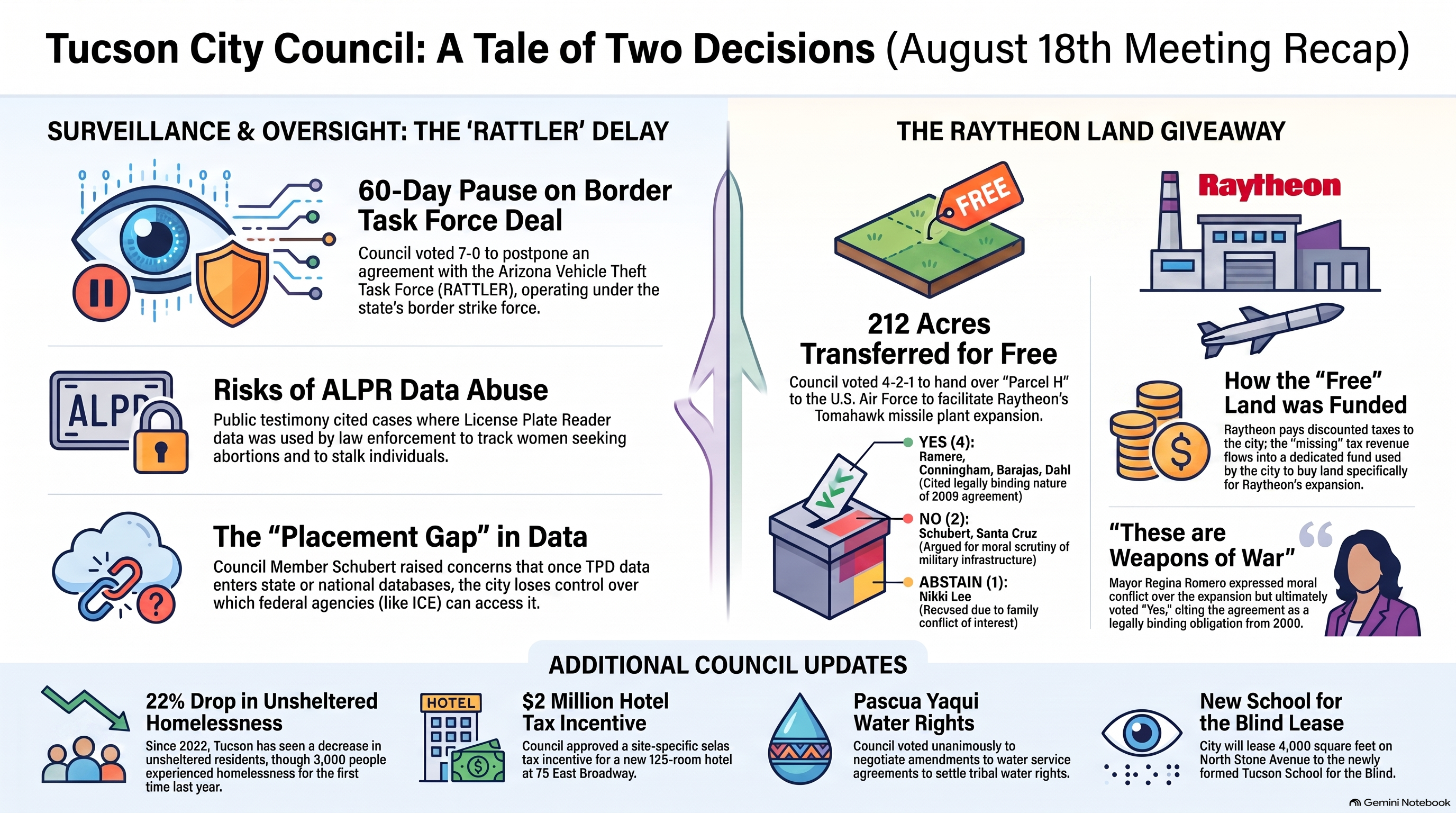
An hour and a half later, an item that looked routine enough to sail through on consent came up for a vote: a Tucson Police Department intergovernmental agreement with the Arizona Department of Public Safety, continuing TPD’s participation in the Arizona Vehicle Theft Task Force.
Council Member Miranda Schubert had already pulled it.
She didn’t vote no and move on. She stopped the whole thing.
The Council Just Stalled a Border Task Force Data Deal
The task force, sometimes called RATTLER, sits inside a larger structure: Arizona’s border strike force, created under Governor Doug Ducey and reorganized as Operation Desert Guardian under Governor Katie Hobbs, with an explicit mandate to coordinate with the Department of Homeland Security and other federal agencies.
Schubert quoted the task force’s own January 2026 newsletter describing an investigation that involved “hundreds of hours of surveillance, suspect network identification, vehicle tracking, and evidence collection.”
Her office had received a wave of calls and emails from constituents about surveillance technology and data sharing, and she said the materials attached to the consent agenda item didn’t provide enough information to responsibly approve it that night.
“While I trust that TPD is not collaborating or sharing information with ICE or other federal agencies,” she said, “once data is shared in statewide and/or national databases, we don’t know who can access it.”
Nikki Lee, who has previously worked on transparency and oversight of city surveillance technology, asked to continue the item to a future study session rather than force an up-or-down vote. Vice Mayor Lane Santa Cruz added a request that council offices be briefed in advance next time. City Manager Tim Thomure agreed to both.
The council settled on 60 days, with Assistant City Attorney Roi Lusk confirming the city’s Independent Police Auditor and Community advisory structure would also get a look at the agreement, which Thomure said falls within that committee’s core function.
The vote to postpone passed 7-0.
TPD’s participation in a state task force embedded in a border-enforcement structure with a direct federal coordination mandate is now on hold, pending a briefing the council didn’t have before it was asked to approve the deal on consent.
Whether the public testimony on license plate readers moved Schubert’s vote or simply landed on the same night is a fact we won’t be able to settle. But the two events happened back to back, and the council’s own postponement suggests someone at the dais was listening.

Meanwhile: The Raytheon Land Giveaway We Flagged Went Through
This outlet reported before the vote that Tucson was about to hand 212 acres to the U.S. Air Force at no cost, so Raytheon could keep expanding the plant that builds Tomahawk missiles. That vote happened at the same meeting, later that night, and it went the way the mechanics of the deal all but guaranteed it would.
Nikki Lee didn’t debate this one either. She recused herself, cited a “family conflict of interest,” and abstained.
When the roll call came for Resolution 24165, the tally landed 4-2-1. Schubert and Santa Cruz voted no. Mayor Regina Romero and council members Paul Cunningham, Selina Barajas, and Kevin Dahl voted yes.
The land is Raytheon’s now.
Nobody on the dais named Minab.
Schubert came the closest, telling the room before the vote that “if we believe the consequences of American military power deserve moral scrutiny abroad, then we should at least be willing to apply some of that same scrutiny when the infrastructure supporting that system appears on our own consent agenda at home.”
Resolution 24165 had been sitting on the consent agenda as item 7N until Schubert pulled it for discussion during that evening’s study session.
The land, known in city records as Parcel H, was purchased by Tucson years ago specifically to buffer Raytheon’s Air Force Plant 44 site against future expansion. Lusk laid out the mechanics on the record. Under a 2009 amendment to the city’s 1995 pre-annexation agreement with Raytheon, the deal worked like this: Raytheon pays a discounted rate on use and electricity taxes because it’s annexed into the city. The difference between that discount and what Raytheon would owe at full rate doesn’t disappear. It flows into a dedicated fund, earmarked for exactly one purpose: buying this parcel and handing it to the Air Force. The city spent $6.47 million doing exactly that.
Schubert asked the plain question: what happens if the council says no?
Thomure and Lusk answered, with the hedging any attorney gives before a legal opinion, that Tucson would “most likely” have to hand the $6.47 million back. Lusk called it correctly: “I’m an attorney, so I don’t really say sure things.” But the practical answer was clear enough that even the council members most uneasy about the vote treated it as effectively foreclosed.
That didn’t stop Schubert from asking what the land will actually be used for.
Thomure preemptively knocked down one rumor circulating in the community: “I will answer the question you haven’t asked yet, but maybe you’re planning to ask, is this a data center? The answer to that is no.”
He confirmed the land would remain zoned I-2 industrial, subject to the city’s new data center and large water user ordinances, should that ever change, but said staff has no knowledge of which weapons programs the eventual expansion will support.
Schubert referenced that morning’s Arizona Daily Star story on Raytheon’s $22.9 billion federal contract for Tomahawk production; Thomure said the city doesn’t know whether the two are connected, only that any growth “would be related to their current types of products and production.”
Cunningham and Dahl both used their turns not to argue the merits but to flag a process failure: this item, a 212-acre, no-cost land transfer to the region’s largest employer, went out on consent with no study session and no advance briefing.
“This warranted a discussion two weeks ago, at least at the study session table,” Cunningham said.
Thomure conceded the point outright: “It is a very fair criticism to say that often items that are on consent aren’t briefed as thoroughly as others. We are going to make that adjustment moving forward.”
He added that he’d relayed that instruction to his own staff “in all caps.”
Before the vote, Romero delivered the closest thing to an official acknowledgment of the contradiction Schubert had named. She invoked the city’s 2025 rejection of Project Blue, the data center proposal, as evidence Tucson has drawn lines against extractive development before.
Then she drew the line differently here: “It feels conflicting for me to have this in front of us because of what it means to expand Raytheon. These are weapons of war.”
“It feels conflicting for me to have this in front of us because of what it means to expand Raytheon. These are weapons of war.” Mayor Regina Romero, moments before voting yes.
She followed it with the same move public officials make when they want credit for candor without changing the outcome: acknowledging the discomfort, then voting yes anyway, on the grounds that the agreement was “legally binding” and long predates the current council.
Lusk, for his part, agreed with Santa Cruz’s broader critique that agreements like this one, locking a future council into obligations negotiated decades earlier, “are not as useful as they used to be.” He said his office would take the advice under consideration.
Whether that means anything the next time a defense contractor asks Tucson to make good on a decades-old promise is a separate question, and one this council didn’t answer.
Also at the Meeting
Homelessness system update: Housing and Community Development deputy director Jason Thorpe told the council Tucson has reduced unsheltered homelessness 22% since 2022 and helped roughly 1,800 people into permanent housing since 2021, but that nearly 3,000 Pima County residents experienced homelessness for the first time last year, meaning inflow is outpacing the system’s ability to house people. Schubert pressed staff on what she called the “placement gap”: whether the city has anywhere to put people who say yes to shelter on a given night, and asked for a cost estimate to close it. No formal action was taken; staff agreed to follow up.
TEP incentive request: A retained TEP speaker, J.D. Wallace, gave the council a company-scripted update on grid capacity and the LIHEAP-adjacent Power AZ bill assistance program, which is scheduled to end September 30, 2026, absent additional funding. A member of the public, identified as JP, addressed the audience, arguing for undergrounding TEP’s transmission infrastructure and criticizing the utility’s 12% dividend structure, on top of pole-repair costs passed to ratepayers, tying it to Proposition 421.
Tucson Inn hotel incentive, item 4: The council voted 7-0 to direct staff to formalize a site-specific sales tax incentive agreement for a proposed 125-room hotel at 75 East Broadway, developed by Tucson Inn LLC. The deal caps reimbursement at 45% of city sales and hotel tax collected, up to $2 million over five years (or $2.9 million if the additional three-year, 30%-cap extension the developer requested is granted), against a projected $5.9 million in direct city revenue over the same period.
TUSD parkland purchase, item M: The council voted 7-0 to approve the city’s purchase of roughly 10 acres of vacant land from Tucson Unified School District for a future Ridge Side Park on the east side, funded through impact fees generated by the adjacent Houghton Reserve development agreement.
Tucson School for the Blind lease, item L: Approved 7-0. The city will lease roughly 4,000 square feet at 149 North Stone Avenue to the newly formed Tucson School for the Blind, which was created after the Arizona School for the Deaf and the Blind announced it would close its historic campus earlier this year.
Fee-relief 90-day update: Planning and Development Services and Transportation and Mobility staff reported back on the affordable-housing impact of fee increases the council approved in May. No changes were proposed; staff will report again in one year. Cunningham used the discussion to push for adaptive reuse incentives, citing more than 1,100 properties within the city limits selling for under $150 per square foot, while new construction runs over $300 per square foot.
Pascua Yaqui water rights settlement: Following executive session, the council voted unanimously to direct the city manager and city attorney to negotiate and execute amendments to the water services intergovernmental agreement with the Pascua Yaqui Tribe, aimed at settling water rights within the Tucson water service area.
PHA board actions: Meeting separately as the Public Housing Authority Board of Commissioners, the council voted 8-0 to amend the PHA annual plan to allow non-competitive allocation of project-based vouchers to PHA-owned units, including those managed by nonprofit subsidiary El Pueblo Housing Development, and voted 8-0 to write off $42,807.70 in uncollectible tenant accounts.
Three Sonorans is Tucson’s independent watchdog on the deals that move through city hall on consent, hoping nobody’s looking. This time, someone was. If this piece moved you, share it, that’s how the word spreads when the agenda is written to be skimmed past.
Have a scoop or a story you want us to follow up on?
Send us a message below or via ENCRYPTED email (all messages kept CONFIDENTIAL) at ThreeSonorans@protonmail.com.


