

They gave Apache sacred land to a foreign mining corporation.
Now, Resolution Copper wants to build the world’s largest toxic waste dump on Arizona state land, upstream of the Gila River, with zero post-closure monitoring.
Governor Hobbs still has the power to say no. ¿Y qué está haciendo? Nothing. Yet. 🌿✊🏽
Skunk Camp: The Kill Switch Nobody’s Talking About
They gave Apache sacred land to a foreign mining corporation. Now they want to turn the Arizona desert into the world’s largest toxic waste dump. And one woman in Phoenix can stop it.
by Three Sonorans
Lios enchim aniavu, ketchem allea? Grab your cafecito and settle in, raza. Picture the scent of rain on desert oak. The sound of Apache prayer rising at dawn in the canyon where the Ga’an have always lived. Now picture a 500-foot dam holding 1.4 billion tons of arsenic-laced mine waste where that canyon used to be.
That is not a hypothetical. That is Resolution Copper’s actual plan. And as of today, one Arizona governor hasn’t said a word about it.
Before we get to the politics, let’s tell the whole story, from the beginning, the way it deserves to be told.
Chíchʼil Bił Dagoteel: Before the Lawyers, Before the Lobbyists
Before any of the legalese, before the corporate press releases and the congressional riders and the federal appraisals, there was the land itself.
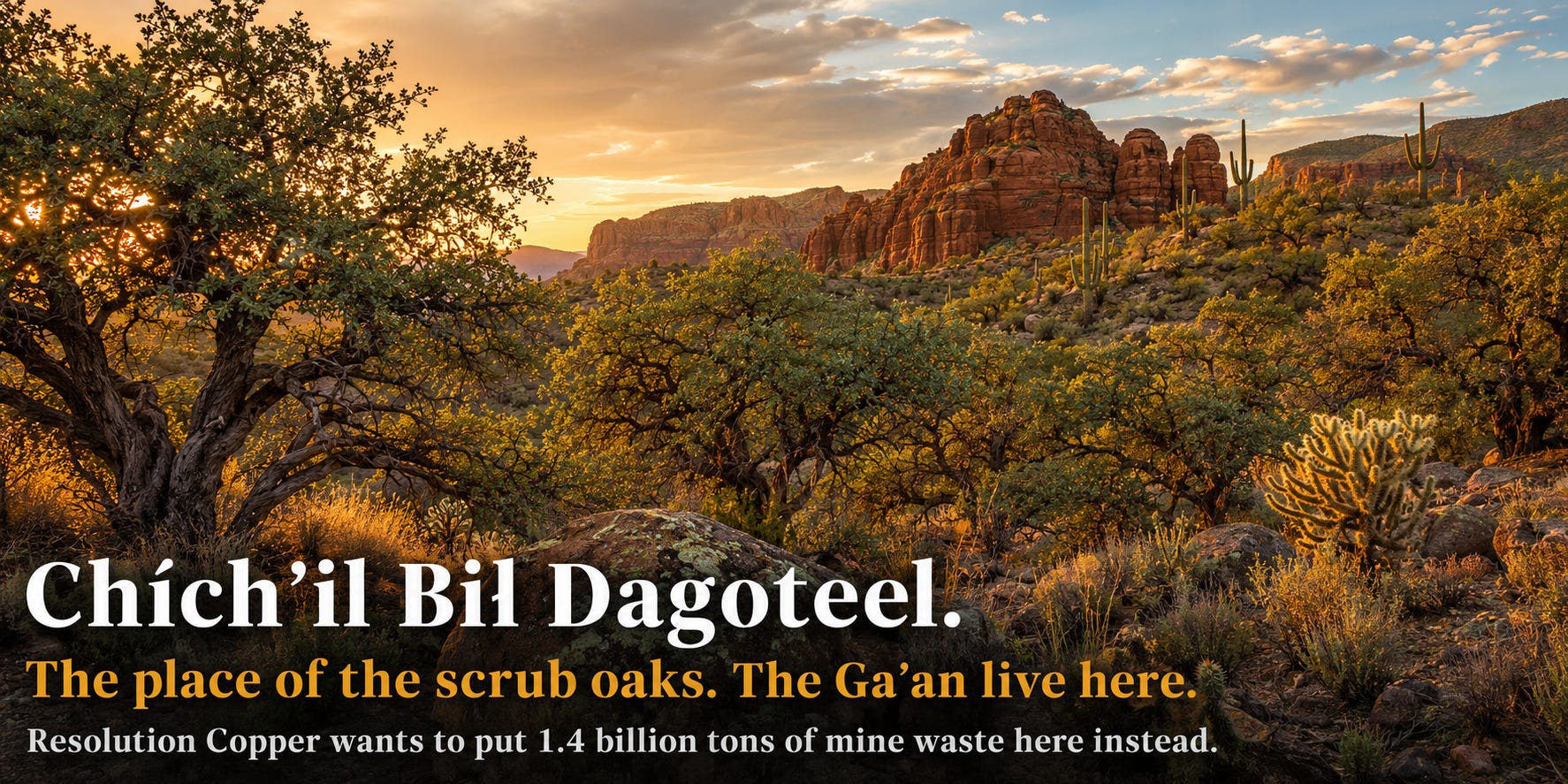
Chíchʼil Bił Dagoteel, “the place of the scrub oaks” in Western Apache, sits in the Tonto National Forest near Superior, Arizona, about 60 miles east of Phoenix.
Interfaith America describes it as the dwelling place of the Ga’an, the guardians and spiritual messengers of the Apache people, a site so sacred that Western Apaches, San Carlos Apaches, the Hopi, the Gila River Indian Community, and other Native peoples have gathered there for ceremony, prayer, and communion across generations that stretch back far beyond anything a federal land deed can measure.
It sits alongside endangered ocelots and Arizona hedgehog cacti, species that have as little say in what happens to their home as the Apache people themselves. It is listed on the National Register of Historic Places as a Traditional Cultural Property.
For 70 years, a series of federal land orders specifically protected it from mining activity.
You already know where this is going. Because this is America, and “protected” only means protected until someone with enough money decides otherwise.
A Midnight Robbery That Took a Decade to Execute
In December 2014, tucked deep inside a must-pass National Defense Authorization Act, without a standalone vote, without public debate, without so much as a press conference: a rider that stripped Oak Flat’s protections and ordered the land’s transfer to Resolution Copper.
Three Sonorans has been following this travesty since it was first exposed. The maneuver was carried by Arizona Senators John McCain and Jeff Flake, two Republicans who coincidentally had received significant contributions from Resolution Copper’s parent companies.
Un regalo envuelto en la bandera, a gift wrapped in the flag, handed to foreign billionaires while Apache grandmothers slept. It was inserted into a defense bill the way abuelita hides vegetables in the soup.
Except abuelita’s intentions were actually good.
The Western Apache people were never meaningfully consulted. They never consented. They were simply informed, after the fact, that their sacred land had been traded away while Congress was arguing about fighter jets.
Resolution Copper is a subsidiary of BHP and Rio Tinto, two of the largest multinational mining corporations on Earth, with BHP now majority-owned by Chinese state interests.
Nothing says “America First” quite like a London-Melbourne corporation majority-owned by Chinese state interests mining Apache sacred land while waving a flag.
The math isn’t mathing, but the lobbying sure is lobbying.
And Rio Tinto admitted at CERAWeek in March 2026 that due to U.S. smelting limitations, much of the copper may be exported. So the “American copper for American needs” talking point isn’t just cynical. It might not even be true.
So let’s be precise: the United States federal government gave Apache sacred land to a foreign corporate entity. In 2026. ¡Que viva la libertad, right?
Ten Years of Fighting, and They’re Still Standing
For over a decade, Apache Stronghold — led by the indefatigable Dr. Wendsler Nosie Sr. — has fought this at every level of the American legal system.
They’ve marched.
They’ve prayed.
They’ve testified before Congress.
They’ve litigated through federal district courts, through the 9th Circuit (which ruled against them 6-5 in March 2024 on religious freedom grounds), all the way to the steps of the Supreme Court, which refused to hear the case in May 2025, with Justice Gorsuch dissenting and calling it a “grievous mistake” that denied Apaches “the same protections other faiths enjoy.”
Even Justice Thomas signed onto that dissent.
Sit with that for a second.
After the Supreme Court’s second refusal in October 2025, three emergency injunctions were still pending in lower courts. The Biden administration had been slow-walking the transfer. Then the Trump administration, which backed the mine from day one, framing copper extraction as a “national security” necessity, didn’t wait for those injunctions to resolve.
On March 13, 2026, the 9th Circuit denied the final emergency appeals. Three days later, the land was transferred. Overnight. Before any court could say another word.
Hours after that March 13 ruling, seven Apache women filed an emergency appeal directly to the U.S. Supreme Court to stop the transfer. Justice Elena Kagan denied it on March 19.
Resolution Copper immediately announced it would begin exploratory drilling.
Órale, they moved fast. The ink wasn’t dry and the drill bits were already spinning. They couldn’t even wait a week. The body was still warm.
Dr. Wendsler Nosie Sr. responded with the kind of quiet defiance that puts politicians to shame.
“The legal system may try to reduce our struggle to questions of ownership and profit. But our connection to Mother Earth predates those systems,” he wrote.
“No matter what the courts rule, no matter what the government tries to do, we will never stop fighting to preserve our sacred places. We will not lose our connection to the Creator.”
His granddaughter, Naelyn Pike, first spoke before Congress on this issue as a teenager and has been one of the movement's most powerful youth voices ever since.
Her message has never wavered: the Apache people’s relationship to Chíchʼil Bił Dagoteel does not end because a title changed hands on a piece of federal paperwork.
The land doesn’t recognize the transfer. Neither do they.
Why Copper? Why Here? Why Now?
The Tonto Basin sits atop one of the largest untapped copper deposits in North America: an estimated 40 billion pounds, worth hundreds of billions of dollars at current market prices.
Global demand for copper is exploding, driven by electric vehicles, solar panels, and, increasingly, cooling cables for AI data centers. Apparently, your next ChatGPT query requires an Apache sacred site as collateral.
The same clean energy revolution being used to justify this mine, the same one politicians invoke to make the project sound noble and inevitable, requires destroying irreplaceable sacred land and living cultural heritage that no amount of money can recreate.
They’re calling it the clean energy future. We’re calling it what it is: colonial sacrifice zone economics, rebranded with a solar panel emoji.
What They Plan to Do: The 1,100-Foot Crater
Let’s be precise about what “mining Oak Flat” actually means, because the corporate brochures make it sound sterile and inevitable.
It is neither.
Resolution Copper plans to use block-cave mining, a technique in which the earth beneath a site is hollowed out until it collapses in on itself, creating a crater nearly 2 miles wide and more than 1,100 feet deep where Oak Flat currently stands.
The sacred campground.
The ceremony sites.
The ancient oaks where the Ga’an dwell.
All of it, swallowed by a man-made abyss.
Gone.
Irreversible.
Think of it as a strip mine, but with extra nihilism.
And then there’s the water.
The operation would pump 25,600 acre-feet of water per year, enough to supply a mid-sized Arizona city, to the Skunk Camp tailings site alone.
In Arizona. During a multi-decade megadrought. In a state already fighting over every last drop of Colorado River water it can get. On r/Arizona, that detail has been cutting through: “So we’re in a drought, and a foreign company gets to use 25,000 acre-feet of water a year? And we’re calling this a jobs program?”
Now: The Fight Is Everywhere at Once
Since the March transfer, Apache Stronghold and their allies have opened multiple legal and political fronts simultaneously. Here is where things stand:
In federal district court: On Earth Day, April 22, 2026, Apache Stronghold filed a 41-page amended complaint invoking the 1852 Treaty of Santa Fe, a brand new legal theory never fully litigated before, alongside violations of NEPA and the National Historic Preservation Act. Their attorneys at the Becket Fund argue the federal government rushed the transfer specifically to dodge judicial review, and that courts can force Resolution Copper to restore the land to its “pristine state” if the swap is found unlawful. Lead attorney Luke Goodrich was direct:
“The feds rushed the Oak Flat transfer through under cover of darkness because they wanted to dodge meaningful judicial review. That was as illegal as it was brazen.”
At the 9th Circuit: On May 1, 2026, the Center for Biological Diversity, Sierra Club, and tribal coalition filed a formal en banc petition asking the full court to reconsider the March panel decision, specifically targeting the rigged land appraisal that treated billions of pounds of copper as essentially worthless, handing the swap to Resolution Copper at a sweetheart price. As CBD’s Russ McSpadden put it:
“I’m hopeful this treasured place will be returned to the people once the legal problems with the land exchange get a full airing in court.”
In Congress: Rep. Adelita Grijalva, carrying on the legacy of her father, the late Congressman Raúl Grijalva, who fought for this land his entire career, has introduced both the Save Oak Flat from Foreign Mining Act and new legislation to protect public lands surrounding Oak Flat from further foreign exploitation.
“Oak Flat is not just a piece of land,” she said after the March ruling. “It is a place of prayer, ceremony, and identity for the Apache people. This site should never have been traded away to foreign mining giants in a backroom deal that ignored Tribal sovereignty.”
Legislative Hail Marys, yes. But Hail Marys, as any Tucsonense will tell you, have landed before.
And then there’s the front that might matter most of all.
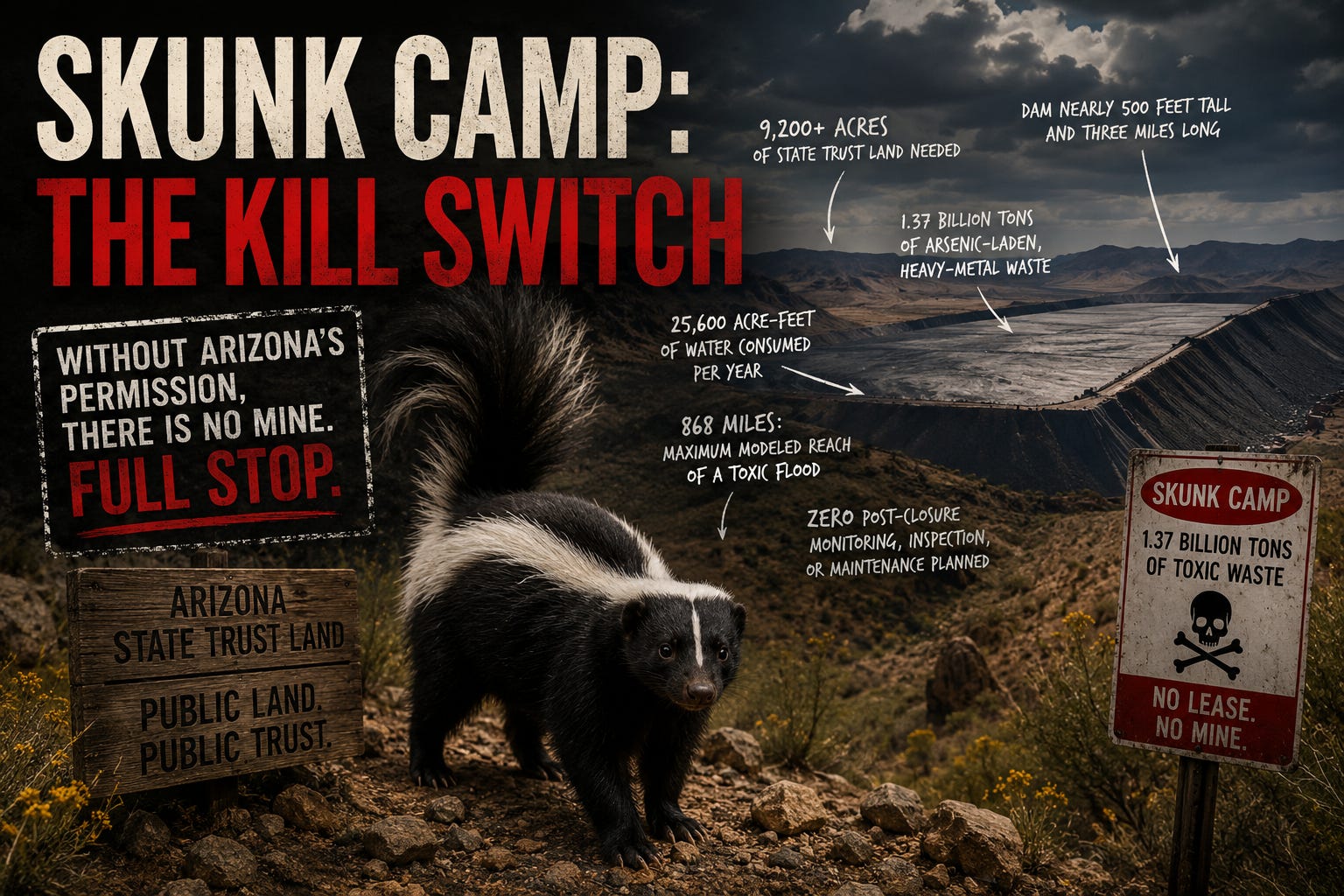
Skunk Camp: The Kill Switch
Here is what the corporate PR machine does not want you to focus on.
Resolution Copper owns Oak Flat.
But they cannot mine it without Arizona’s permission.
The mine’s entire operation depends on building a massive waste storage facility, named, without irony, “Skunk Camp,” in the Dripping Springs Valley near Kearny. They actually named it Skunk Camp. Resolution Copper paid consultants good money to name their 14-square-mile toxic waste dump “Skunk Camp.” Sometimes the universe just does the work for you.
That site sits almost entirely on Arizona state trust land, land the State Land Department would need to auction or lease to Resolution Copper. Land that, as of today, has not been approved, auctioned, or leased. Land that Governor Katie Hobbs has the authority to protect.
By the numbers:
🏔️ 9,200+ acres of state trust land needed (roughly 14 square miles)
☠️ 1.37 billion tons of arsenic-laden, heavy-metal-saturated mine waste
🏗️ Dam nearly 500 feet tall and three miles long, taller than the Chase Tower in downtown Phoenix
💧 25,600 acre-feet of water consumed per year
🚫 Zero post-closure monitoring, inspection, or maintenance planned
📏 868 miles: maximum modeled reach of a toxic flood from dam failure
According to the U.S. Forest Service’s own Final Environmental Impact Statement, the Skunk Camp facility would cover more than 9,200 acres, hold 1.37 billion tons of mine waste, and be contained behind a dam nearly 500 feet tall and three miles long, taller than the Chase Tower in downtown Phoenix. All of it sitting upstream of the Gila River, which flows through Hayden, Winkelman, Kearny, and Florence before reaching the Gila River Indian Community.
Resolution Copper’s own pipeline route would cross 13 Arizona state trust land parcels to reach Skunk Camp. The facility itself would cover 19 more. Without those state land leases, there is nowhere to put the waste. Without Skunk Camp, there is no mine. Full stop.
This is the arithmetic of power. And right now, the math is on our side.
The Ticking Time Bomb
The danger isn’t just if Skunk Camp gets built.
It’s what happens after.
Henry Muñoz knows mining from the inside.
A fifth-generation underground miner, a member of the Retired Miners Concerned Citizens in Superior, Arizona, and of the Hispanic Conservation Leadership Council, he is raising the alarm that nobody in the corporate press wants to touch.
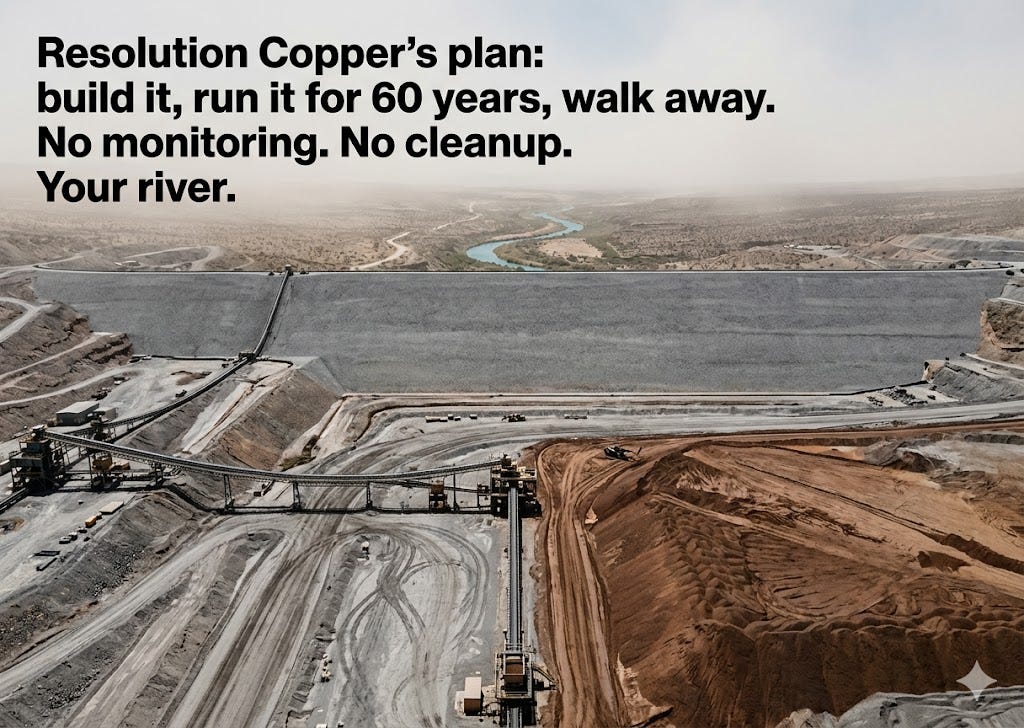
The Final Environmental Impact Statement includes a jaw-dropping admission buried in its fine print: after the mine closes, the Skunk Camp tailings dam will receive no further monitoring, inspection, maintenance, or review.
Resolution Copper will build a 500-foot toxic waste dam upstream of Arizona’s river communities, operate it for 60 years, and then simply walk away.
It’s like a houseguest who eats everything in your refrigerator, breaks your favorite mug, leaves a structural crack in the foundation, and then hands you a brochure about how great their visit was for the local economy. Except the mug is the Gila River watershed.
Let that land.
“While this foreign company describes the proposed mine at Oak Flat as world-class mining, I call it gambling with my community’s future,” Muñoz wrote.
“Their record speaks louder than their promises.”
Article continued below:


Their Record Speaks Louder Than Their Promises
Before you accept Resolution Copper’s assurances that everything will be fine, consider what BHP and Rio Tinto have left behind everywhere else they’ve operated:
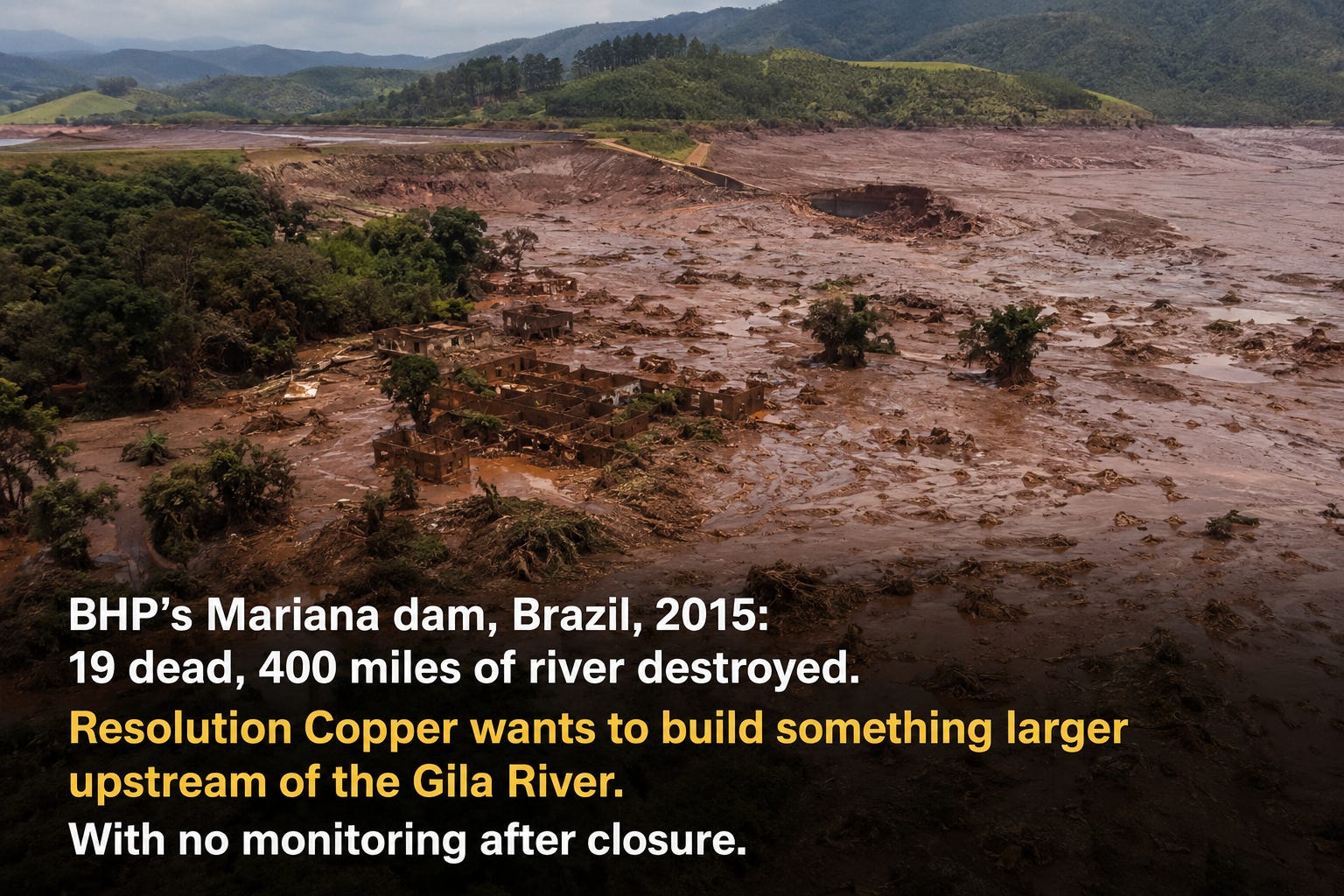
🇧🇷 Brazil, 2015: BHP’s Mariana tailings dam collapses. 19 people killed. 400 miles of river poisoned. Communities destroyed. The apology comes later, in a press release.
🇲🇬 Madagascar, ongoing: Rio Tinto operations contaminate community waterways with uranium and lead. Local families drink the water. Shareholders collect the dividends.
🇦🇺 Australia, 2020: Rio Tinto destroys 46,000-year-old sacred Aboriginal rock shelters at Juukan Gorge because their mining lease legally allowed it. The rocks were 46,000 years old. The apology was two paragraphs. Justice, apparently, is priced by the word.
🇺🇸 Arizona, next?
These are not isolated accidents.
They are the business model.
Now for the mathematical gut-punch.
The FEIS models what would happen if the Skunk Camp dam failed. According to its own projections, toxic tailings could travel between 83 and 868 miles downstream.
That upper figure, 868 miles, is not a worst-case extreme. It is the 75th percentile outcome, meaning in one out of every four modeled scenarios, the tailings travel further than that.
For geographic context: the distance from Skunk Camp to the U.S.-Mexico border via Dripping Springs Wash, the Gila River, and the Colorado River is roughly 425 miles. In approximately 40% of modeled failure scenarios, toxic mine waste reaches the Mexican border.
The Gila River Indian Community, which has already fought for generations to protect its water rights in the Gila watershed, sits directly in that path.
Their community’s survival has always depended on the river.
Resolution Copper’s plan treats that river as a disposal site.
So, Resolution Copper’s plan, in summary: build the world’s largest toxic waste dam in the Arizona desert, run it for six decades, abandon it with zero monitoring, and let future generations, Apache, O’odham, Chicano, Mexican, deal with the consequences. ¡Gracias, señores! ¡Muy amables!
Resolution Copper also, in a flourish of colonial PR theater, published a “Myths and Facts” page on their website and hired a San Carlos Apache-owned small business to manage the Oak Flat campground — the very site they plan to destroy.
It’s a little like the arsonist handing out fire safety pamphlets at the scene.
¡Muy profesional!
The Schoolchildren Argument
Here is the angle that should have every Arizona parent paying attention, regardless of their politics.
Arizona state trust lands exist for a specific constitutional purpose: to generate long-term revenue for public schools and other state beneficiaries.
The State Land Department is a fiduciary, legally obligated to manage these lands in the best interest of those beneficiaries. Leasing to the highest bidder isn’t always enough; the lease must also not harm the long-term value of the trust.
Here’s the problem for Resolution Copper: the Arizona State Land Department has already determined that the Skunk Camp facility would reduce surrounding land values.
That finding did not come from an activist organization. It came from the State Land Department itself. Resolution Copper’s own application contains the argument against itself.
That’s not a loophole.
That’s a canyon.
As Sierra Club Grand Canyon Chapter Director Sandy Bahr put it: “Approving a massive toxic tailings facility that would devalue surrounding lands and create lasting environmental liabilities is incompatible with the State Land Department’s fiduciary duty.”
In other words, leasing those parcels to Resolution Copper may be illegal under Arizona’s own constitutional framework.
The governor doesn’t just have the power to block this.
She may have the obligation to.
Governor Hobbs: The Silence Is Deafening
On April 27, 2026, more than 50 organizations, including Apache Stronghold, the Center for Biological Diversity, the Sierra Club’s Grand Canyon Chapter, the Arizona Mining Reform Coalition, faith leaders, and community organizations across Arizona, sent a formal letter to Governor Katie Hobbs. The message was clear:
“Arizonans would bear the environmental risks, water depletion and long-term liabilities of this project, while foreign investors reap the profits. Your Administration has the authority to protect Arizona families and preserve the integrity of state trust lands by rejecting this dangerous mine tailings facility proposal.”
As of today, Governor Hobbs has not responded publicly.
Let’s be real about what that silence means. Hobbs is a Democrat in a purple state who needs to keep corporate donors happy while not entirely alienating the Indigenous, Latino, and environmental communities that put her in office.
Her political calculation appears to be: say nothing, commit to nothing, let the courts handle it. It is a posture that powerful people have always used when they lack the courage to do what’s right. In the context of a slow-moving environmental catastrophe, silence is also a form of complicity.
But silence is reversible.
That is the difference between Governor Hobbs and a federal government that already handed the land away. She still has a choice. She can stand with Arizona’s schoolchildren, its river communities, its Indigenous nations, and the 67% of Arizonans who oppose this mine; or she can become the final link in a chain that makes the destruction of Chíchʼil Bił Dagoteel irreversible.
Governor Hobbs: This is your moment. The gente are watching. The Apache grandmothers are watching. And history has a long memory.
Who’s Already Saying No
It helps to remember just how isolated Resolution Copper actually is in the court of public opinion.
A February 2026 poll commissioned by the Center for Biological Diversity found that 67% of likely Arizona voters oppose the mine, including 87% of Democrats, 69% of independents, and even 51% of Republicans.
Even after hearing the strongest possible pro-mine arguments, 63% still said no.
The mine is opposed by 21 of 22 federally recognized tribal nations in Arizona.
It’s opposed by the National Congress of American Indians.
It’s opposed by the Access Fund and the climbing community, who have used Oak Flat’s world-class routes for generations — thousands of them, beloved by climbers from across the country.
It’s opposed by an interfaith coalition documented by OSV News and Good Faith Media that stretches from Tucson Catholic parishes to Protestant communities to Wiccan covens in Vermont, all of whom understand that religious freedom is either a universal principle or it’s a velvet rope that only lets certain people through.
The National Wildlife Federation called the land transfer a cause of “irreparable harm and grave injustice.”
On r/IndianCountry, the response to the Supreme Court’s refusal was blunt: “So they can destroy the only place you can practice your religion, and that’s not a burden? This country is deranged.”
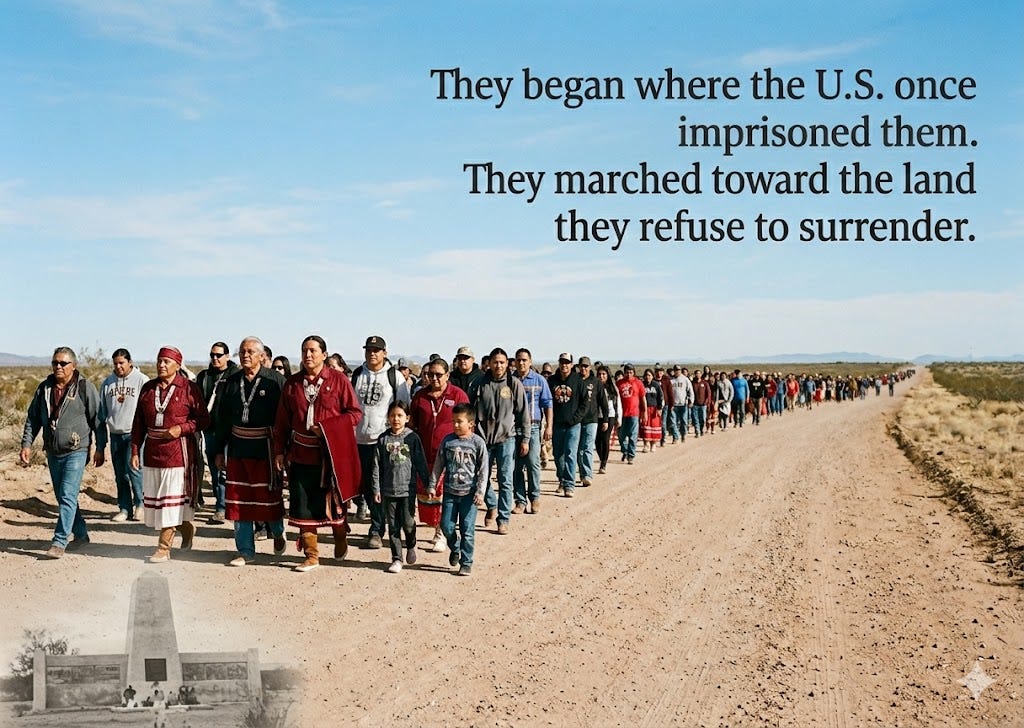
The Apache Stronghold Facebook community documented the 12th Annual Oak Flat March in February 2026, which began at the Old San Carlos Memorial, the site where the U.S. government imprisoned Western Apache people in the 19th century, and ended at the land they’re still fighting to keep. Marching from one site of dispossession toward another: the whole American story in a single afternoon walk.
This past Palm Sunday, faith communities from across Arizona joined Apache Stronghold at Oak Flat for prayer and ceremony, gathering on the sacred ground itself, the same way Apache people have gathered there since before this country had a name.
Selena Lamas, an Akimel O’odham student at Brophy Xavier, Class of 2028, may have said it most clearly:
“Don’t mine what can’t be remade. Some places are more than resources; they hold history, culture and life that can’t be replaced once they’re gone.”
Mija, we see you. And you are not wrong.

This Ain’t Over. Échale Ganas.
The crater Resolution Copper wants to dig is still years away.
The lawsuits are live.
The en banc petition is filed.
The state land leases have not been approved.
The Governor has not spoken.
The 1852 treaty has never been fully litigated.
Rep. Grijalva’s legislation still lives in Congress.
Chíchʼil Bił Dagoteel has survived Spanish colonizers, the U.S. Army, the Indian boarding school era, seventy years of federal ownership, a midnight legislative rider, and a decade of courtroom setbacks. The oaks are still standing. The prayers are still rising.
And as Dr. Wendsler Nosie Sr. has always reminded us: the Creator’s voice cannot be silenced by a mining permit.
Skunk Camp is the pivot point right now. It is the chokehold. If those Arizona state land leases are denied, if Hobbs finds her spine or if enough community pressure makes silence politically impossible, Resolution Copper has a sacred site with nowhere to put 1.4 billion tons of poison.
A mine with no waste facility is no mine at all.
The math is clear.
The moral weight is clear.
The community is already organized and already speaking.
Ahora falta la gobernadora.
What You Can Do Right Now
Contact Governor Hobbs directly by calling (602) 542-4331 or submitting a message through her office, telling her to reject any state land lease or auction for Resolution Copper’s Skunk Camp facility
Sign the petition at Action Network demanding Arizona state leaders protect Chíchʼil Bił Dagoteel
Follow and support Apache Stronghold at apache-stronghold.com, where their updates are the ground truth on this fight
Call Rep. Adelita Grijalva’s Tucson office at (520) 622-6788 and demand a hearing on the Save Oak Flat from Foreign Mining Act
Come to Oak Flat. Camp there. Climb there. Pray there. Bear witness. The Apache people have always said: the land protects those who protect it
Support Three Sonorans by subscribing to our Substack so we can keep following this story until Chíchʼil Bił Dagoteel is free
Three Sonorans has been covering the Oak Flat saga since the midnight rider was first exposed. We’re not stopping.
What Do You Think?
Drop your thoughts in the comments, raza. This community knows things the newspapers don’t.
Governor Hobbs has said nothing publicly about Skunk Camp. What do you think is driving her silence: political calculation, corporate pressure, or something else? And what would it take to move her?
The FEIS projects a 40% chance that a dam failure sends toxic waste to the Mexican border. In what world is that an acceptable risk? Hint: it’s not the shareholders in London and Melbourne who bear it.
Resolution Copper hired a San Carlos Apache-owned small business to manage the Oak Flat campground, the very site they plan to destroy. Is that reconciliation, or is it the most cynical move in this entire saga?
Three Sonorans is an independent Substack rooted in Tucson, the borderlands, and the sacred places that corporate balance sheets cannot appraise and courts have not yet learned to protect. We cover Oak Flat because the land is still standing, the Ga’an still dwell in that canyon, and the Apache people are still fighting — in courtrooms, in Congress, on the march, and in prayer. If this piece moved you, share it. That is how the word spreads when the watchdogs get muzzled, and the lobbyists write the laws.
Have a scoop or a story you want us to follow up on?
Send us a message below or via ENCRYPTED email (all messages kept CONFIDENTIAL) at ThreeSonorans@protonmail.com.