


Jess Walter's So Far Gone is a 5-star novel, but 17 major reviews missed its moral core: a Spokane reservation, a uranium mine, and 40 years of ignored protest signs.
The Witness and the Watershed
When Ruby Ridge, Wounded Knee, and the Tiny Trail of Tears Converge in the American Redoubt
by Three Sonorans Reviews

MIDNITE MINE KILLS!
CLEAN UP DAWN URANIUM.
DOE LIES!
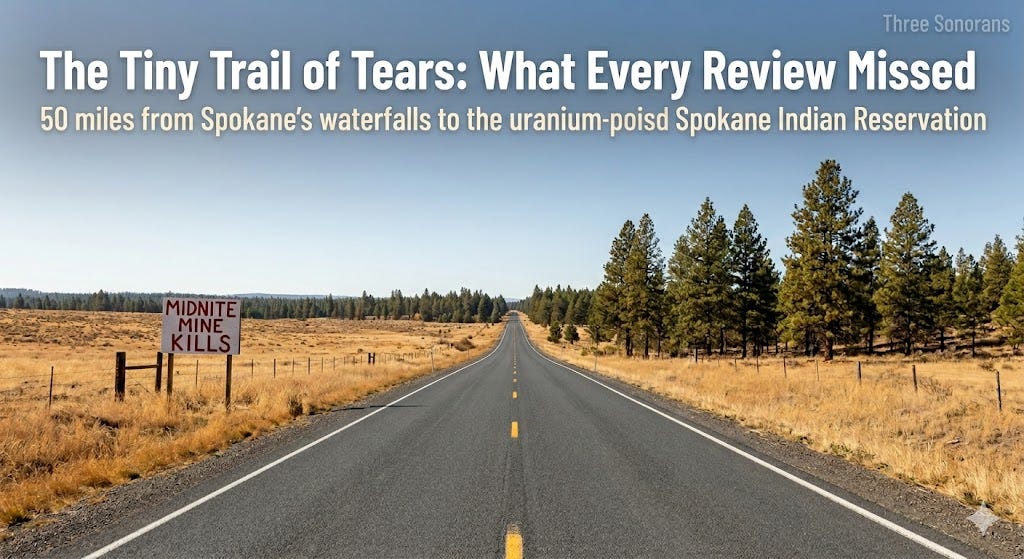
Those three signs — hand-lettered, all-caps, nailed to the fence of a doublewide on the Spokane Indian Reservation — are the most important sentences in Jess Walter’s So Far Gone. They are also the sentences that the New York Times Book Review, the Los Angeles Times, the AP, and the Chicago Review of Books — collectively, across seventeen published reviews — managed entirely to ignore.
That omission is not an accident.
It is a map.
So Far Gone has been called a caper, a dark comedy, a political satire, a family drama, and a love letter to Eastern Washington. Seventeen major reviews have praised it. None of them wrote about those signs.
The Novel: Nine Voices, One Watershed, One Day
So Far Gone opens with Rhys Kinnick — retired environmental journalist, self-appointed hermit, man seven years into a project of spectacular self-erasure — answering a knock at the door of his off-grid cinder block cabin in the woods north of Spokane.
On his porch stand two children with backpacks: thirteen-year-old Leah and nine-year-old Asher, his grandchildren, delivered by Anna Gaines, his daughter Bethany’s neighbor, a Black woman in her thirties with big, round glasses, who drove four hours into the wilderness because she found the emergency letter Bethany had hidden in one of Leah’s snow boots.
The letter — addressed to Anna in Sharpie, marked in case of emergency — contains Bethany’s neat, backward-leaning handwriting on both sides: detailed driving directions to an off-grid cabin with no phone, a warning that Kinnick is “a recluse who cut off contact with our family and now lives in squalor,” and a request to please take the children to him if things go wrong.
As Kinnick reads it on his own porch, growing increasingly offended by the word choices — recluse, squalor, acerbic — he finally accepts the diagnosis and says: “Come in.”
Things have gone wrong.
Bethany has vanished.
Her husband Shane — Kinnick’s conspiracy-radicalized son-in-law, a recovering addict who traded meth for AM radio and evangelical Christianity and has been traveling ever deeper into the paranoid exurbs of American fundamentalism — has left to find her.
And Bethany’s mother, Celia, Kinnick’s beloved ex-wife, died of lymphoma exactly one month ago. She had been, as Kinnick thinks on the porch, “the closest thing Bethany had to a compass.”
With Celia gone, Bethany ran. And now her children are here, on a porch he hasn’t swept in a year.
Within one chaotic day, Kinnick is fighting to keep his grandchildren out of the hands of a militia compound called The Rampart (most likely a reference to the Redoubt Movement)— the stronghold of Shane’s church, the Army of the Lord — while navigating uranium-contaminated reservation land, the impending betrothal of a thirteen-year-old girl to a pastor’s son, and the accumulated damage of seven years of self-imposed exile.
The novel unfolds in nine chapters, each titled “What Happened to [character]” — nine perspectival lenses on the same crisis.
Anna Gaines gets a chapter.
Bethany gets a chapter.
So does Chuck Littlefield, the retired cop who becomes Kinnick’s reluctant ally.
So, crucially, does Brian Stonebird — Spokane and Colville, lifelong resident of the reservation, survivor of cancers caused by uranium tailings, holder of those protest signs, Kinnick’s oldest friend.
It is simultaneously one of the funniest and most politically urgent novels of 2025.

Standing at the Right Coordinate
I am an Indigenous Chicano historian and mathematician living in Tucson’s borderlands. I read this novel from a specific coordinate system — one that makes Brian and Joanie, the Midnite Mine, and the Tiny Trail of Tears visible rather than decorative.
From the Sonoran Desert, looking north toward the mountain corridors of Eastern Washington and Northern Idaho, I can trace the arc from Spanish land grants to Manifest Destiny to the forced reservation system to uranium-poisoned groundwater in one unbroken line.
The ideology this novel excavates is not foreign to me. It is the same ideology that drew a border through my community, that built the missions on our sacred land, that turns Tucson’s South Side into a checkpoint.
It just wears different costumes in different latitudes.
I needed to read So Far Gone because Taylor Sheridan’s Yellowstone franchise — now Marshals, now Madison — has been asking the same question for six seasons without answering it: Whose land is this, exactly?
I needed to read it because I had just finished Ibram X. Kendi’s Chain of Ideas, and I was watching the ideology Kendi describes play out in the pardoning of January 6th insurrectionists by President Trump and in the quiet consolidation of armed Christian nationalist communities across the mountain corridors of Eastern Washington, Idaho, and Montana.
And I needed to read it because Jess Walter was physically present at Ruby Ridge in 1992 — notebook in hand, byline in the Spokesman-Review — and thirty years of sitting with what he witnessed has produced something rarer than literary fiction.
So Far Gone is witness literature.
Testimony transformed into art.
The Author Who Was There
Before you read a single page, you need to know who wrote it and why his authority is different from every other novelist working this territory.
Jess Walter has lived in Spokane his entire life.
He told Literary Hub that the novel began with a single image: “This guy living in the woods and two kids showing up on his porch. I needed something that would shock him out of his paralysis, out of the fact that he has dropped out of the world.”
He found the final push for the novel in the most contemporary of modern humiliations: his iPhone’s weekly screen time summary. The man who wrote a novel about a protagonist who threw his smartphone out a car window was triggered into action by the same device’s usage report, which is a perfect, Walter-grade joke about our collective condition.
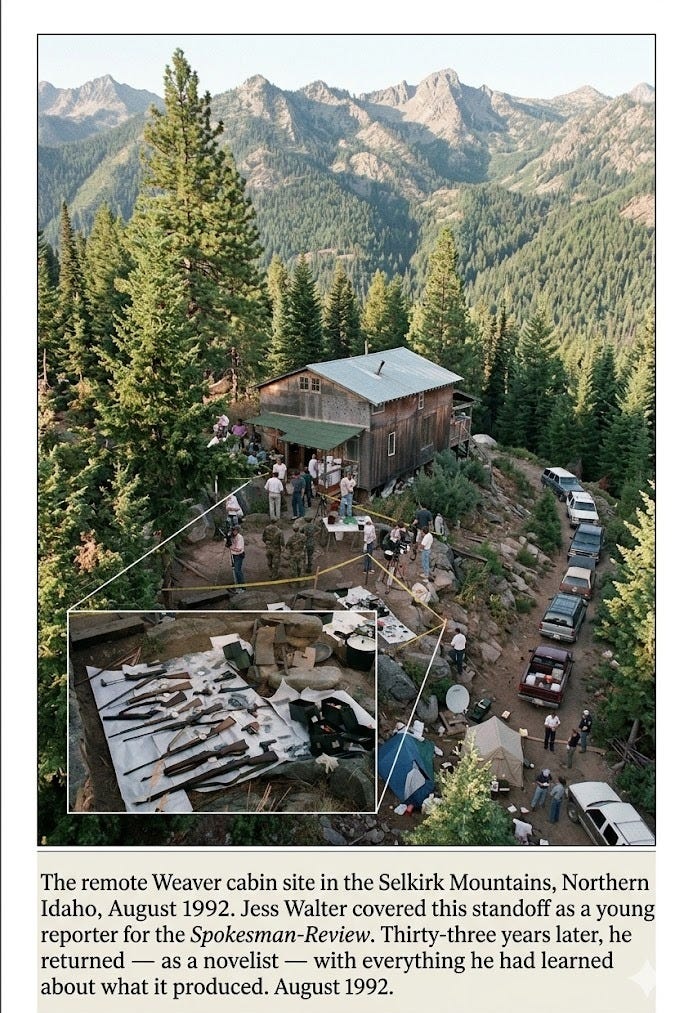
In August 1992, Randy Weaver — an Aryan Nations sympathizer who sold two sawed-off shotguns to an ATF informant and then failed to appear in court — was at his remote Idaho cabin when a federal standoff turned fatal.
A U.S. Marshal, Weaver’s teenage son Sammy, and his wife Vicki — standing in her doorway holding her infant daughter — were all shot dead. Walter rushed to the scene, covered it for the Spokesman-Review, received a Pulitzer nomination, and later wrote the definitive nonfiction account of the standoff.
He told PBS that the Inland Northwest already had a decade-long pattern of white separatist activity before Ruby Ridge — the standoff was simply the moment the story broke into national consciousness.
At his Gonzaga University launch event, Walter revealed that Kinnick’s off-grid cabin is based on his family’s actual land in Stevens County — that he broke through the creek ice himself to get water there.
The cabin is not a literary device. It is the landscape he inherited, and alongside it he inherited the same moral geography: the same watershed, the same uranium mine twenty miles upstream, the same reservation, the same roads.
When the novel’s antagonist Dean Burris — large, bald, militarized, federal poaching convict — is identified as the “Dominion Eagle Killer,” a man who hunted bald eagles on Indian reservations and sold their parts on the black market while invoking sovereign citizen defenses every court rejected, Walter is not inventing.
He is compositing from a criminal dossier he spent his career building. When a novelist has been inside a story for thirty years, the novel knows things the reviewers don’t.
“He had gotten so used to speaking aloud to himself, he didn’t always realize when the words were coming out.”
That line, applied to Kinnick, applies just as well to Walter.
So Far Gone is a book that has been speaking inside him for three decades and has finally found a room.
The American Redoubt: This Is Not a Metaphor
The novel’s fictional “Rampart” is Walter’s composite name for a very real and very active movement.
The American Redoubt was formally organized around Eastern Washington, Eastern Oregon, Idaho, Montana, and Wyoming as, in its founder’s words, “the strategic relocation of conservative, Christian, like-minded patriots.”
The Idaho Statesman documented named leaders building Christian fortresses in Moscow, Coeur d’Alene, and Spokane — the same cities, the same mountains Walter maps with a surveyor’s precision.
This is not a new phenomenon.
Between 1974 and 2001, the Aryan Nations headquarters stood in Hayden Lake, Northern Idaho — same mountain corridor, same community.
The full ideological genealogy: Aryan Nations → militia movement (Ruby Ridge, 1992) → Christian nationalism → American Redoubt.
Walter reported every generation of it.
A Vice News documentary reveals that many of the most prominent conservatives reshaping Idaho’s politics aren’t even originally from Idaho — they relocated specifically to build the infrastructure. Shane Collins’s arc in three sentences.
A 2023 UnHerd investigation inside the Redoubt found Redoubters in combat training using cardboard targets printed with the faces of people they love — “so far, nobody has missed.”
That is Dean Burris made nonfiction.
The movement’s primary strategy is not violence.
It is demographic patience.
Move here. Have children.
Take over school boards.
Build churches.
Wait.
Patience is apparently a Christian virtue with tactical applications.
The sign on the Army of the Lord’s compound hymn board — which Kinnick reads on arrival — announces:
“BLESSING OF THE WEEK: WHEN THE COMMUNIST GROOMERS SEND IN THE MILITARY TO CONTROL THE PEOPLE, REMEMBER THIS: THE LORD THY GOD HAS HIS SOLDIERS IN THEIR MIDST... WHEN THE BLUE HELMETS COME ACROSS THE BORDER TO RAPE AND KIDNAP AND KILL BELIEVERS, THESE BRAVE MEN TOUCHED BY THE LORD SHALL FIGHT ALONGSIDE YOU.”
Chuck Littlefield, the retired cop helping Kinnick navigate the day, reads this and says: “Well, okay, then.”
That is, in fact, the correct response.
The Tiny Trail of Tears: What Every Review Missed
Here is the argument no mainstream review of So Far Gone has made.
Brian Stonebird — Spokane and Colville, lifelong reservation resident, survivor of uranium-caused cancer in his family — is not a supporting character. He and his partner Joanie are the moral center of the entire novel, and their protest signs are the most politically precise sentences in a book full of precise sentences.
The novel’s warmest scene also carries its deepest political charge.
When Kinnick arrives at their doublewide — uninvited, one year after a wine-soaked falling-out in which he drunkenly confessed his feelings for Joanie at the Two Rivers boat launch, and then, in a misguided honesty offensive, told Brian about it — Joanie hustles the grandchildren inside and has cocoa and maple cookies ready before they get their shoes off.
She tells the children the full story: how Brian nearly came to blows with Kinnick over it, how she found it enormously flattering despite being completely uninterested in a throuple. “A girl my age doesn’t get too many confessions of love, even drunk ones. You’re not taking that one back, thank you very much.”
When Asher asks Brian for his warrior name:
“I am known to my people as Standing Water. My older sister is Flooded Basement. And my younger brother is Ruined Carpet.”
Then, corrected by Joanie: “I am known to my people as Brian.”
He offers his hand.
Asher takes it: “I am known to my people as Asher.”
A nine-year-old boy raised inside the Army of the Lord’s world, instinctively matching himself to the indigenous man across the table, claiming the same dignified form of self-naming, and meaning it.
Walter builds the full colonial sequence into the geography. Kinnick explains it while driving the route Brian calls the Tiny Trail of Tears:
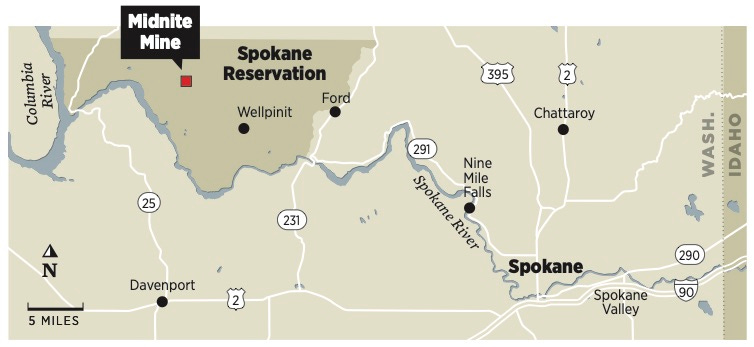
“It was only fifty miles from Spokane’s series of waterfalls... to the remote place where Brian’s tribe had been exiled in 1881, the Spokane Indian Reservation, a starkly beautiful, dry-forested, uranium-rich, radon-sick landscape almost forty miles northwest of the farthest edge of Washington’s second-biggest city.”
Between 1954 and 1981 — exactly one hundred years after that forced relocation — the Midnite Mine, operated by Dawn Mining Company, extracted three million tons of uranium from that reservation land.
Shipped 160 miles south to Hanford.
Enriched. Refined.
Used to test Cold War atomic bombs.
In 1981, when the ore ran out, the mine was abandoned.
The Dawn Mining Company’s tailings were left to leach into the creeks and groundwater. High rates of cancer and multiple sclerosis followed. Brian lost both his parents, his sister, and his nephew to rare cancers because of those tailings ponds.
Kinnick wrote the stories. And then: “Rhys had accepted that the stories he’d written had changed nothing.”
This is where the novel became urgently current news. In February 2025, the DOJ finally reached a cleanup settlement at the Midnite Mine Superfund Site — 44 years after the site was abandoned.
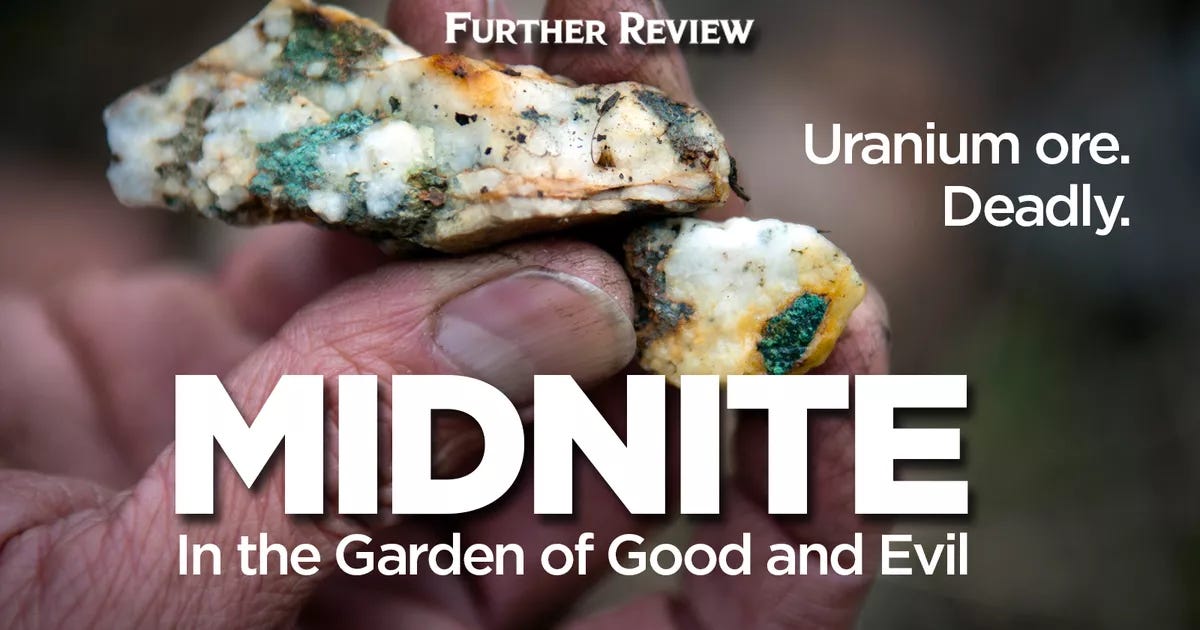
Cleanup efforts are still ongoing, with tribal members watching contaminated water pumped from open uranium pits. Brian and Joanie’s protest signs represent a live federal legal battle that has been running, without a national militia movement born from it, for over four decades.
The Army of the Lord builds its Rampart upstream, claims the mountains as God-given inheritance, and the Tiny Trail of Tears runs fifty miles to their locked gate.
Article continued below:


Wounded Knee, Ruby Ridge, and the Asymmetric Empathy Machine
The federal government’s conduct at those events was genuinely wrong.
At Waco, the FBI provoked a fire that killed 82 people, including 22 children.
The legitimate grievance had been harvested and weaponized.
Now set that next to this: in 1973, the FBI deployed 300 armed agents with M-16 rifles around Wounded Knee, South Dakota, surrounding American Indian Movement members who had occupied the town to protest broken federal treaties.
Over 1,200 arrests.
At least three dead.
Initial rules of engagement: shoot to kill.
The federal government was more militarily aggressive at Wounded Knee than at Ruby Ridge. The grievances were more thoroughly documented, more legally grounded in broken treaties.
And yet:
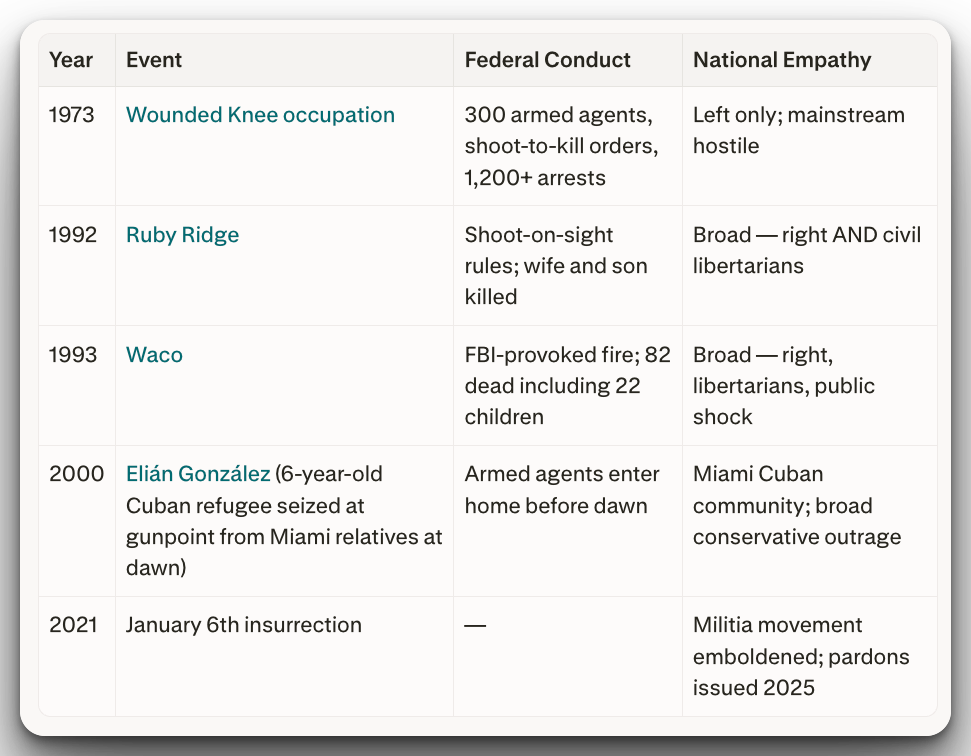
No national militia movement was born from Wounded Knee.
No founding mythology entered the mainstream.
This asymmetry follows the color line with mathematical precision.
When the federal government militarizes against white Americans — even white separatists with explicitly racist ideology — the outrage becomes a national story, a recruitment tool, a political cause.
When it militarizes against indigenous Americans, it becomes a footnote in a curriculum the Army of the Lord’s homeschooled children are never assigned. Brian and Joanie have the most documented, most legitimate grievance against the federal government in the entire novel — and they are the ones nobody joins.
You’ve Got (Holy) War: Gibberenglish, the Pipeline, and the Novel’s Architecture
And now for the best joke in the novel, which is also its sharpest piece of satire.
When Kinnick spots two militarized men in the chess tournament parking lot, he notices a sticker on their black Ram pickup’s tailgate. “At first Rhys thought it was an old email logo, until he read it more closely and saw that AOL actually stood for Army Of the Lord.”
He squares off with the guard and delivers:
“I used to get my email from AOL. What’s the name of your secret lair, MySpace? Naziscape?”
The Army of the Lord has claimed the same acronym as a dial-up internet service that was itself a punchline by 2005. The men who believe they are the vanguard of Christian holy war are, in Kinnick’s framing, America Online: nostalgic, obsolete, and still mailing you free trial CDs.
Kinnick has a name for the conspiracy grammar Shane speaks: Gibberenglish — internally consistent, self-sealing, impossible to enter through normal argument. In the Thanksgiving flashback that opens Kinnick’s backstory, Shane explains that the 2008 Super Bowl was rigged because the Giants — the beast with seven heads and ten horns from Revelation — defeated the Patriots:
“It, Rhys knew by now, was the elaborate and all-encompassing conspiracy to indoctrinate Americans into a Satanic liberal orthodoxy whose end goal was to subsume good Christians like Shane into an immoral, one-world socialist nightmare in which people pooped in the wrong bathrooms.”
When Kinnick points out there are five boroughs in New York, not seven, Shane says: “I get the numbers mixed up.”
Conspiracy thinking is not failed reasoning. It is a different grammar entirely, and Walter names it better than any political analyst has.
Shane’s fluency in Gibberenglish didn’t arrive overnight.
Walter traces the full radicalization pipeline with compassion rather than contempt: Meth → AM radio → evangelical church → Church of the Blessed Fire → Army of the Lord → the Rampart.
Each link is a substitution — one addictive certainty replaced by another, each offering community, purpose, and an explanation for why the world failed him.
Shane’s brother died after two tours in Afghanistan.
His community’s mills and rail stops closed.
He was promised the kingdom of real America and given the ditch.
As Walter told High Country News: “I think that disillusionment is one of the most human things that happens to us.”
That sentence is why So Far Gone is not a political cartoon.
Walter is not diagnosing Shane as broken.
He is diagnosing him as human.
The novel withholds Shane’s interiority until Chapter 7, the moral fulcrum. For six chapters, he exists entirely as others see him — contemptible son-in-law, dangerous father, exhausted husband. Only then do we enter his perspective and find grief rather than malice.
By that point, you have formed your verdict.
Walter requires you to revise it.
The most formally precise chapter is Chapter 6, “What Happened to Asher”: the boy plays Six-nut, his invented cavalry scout who defects to the Native American side — “I am resigning my commission, General. I go to fight with Standing Water and his people” — then, in the same chapter, gives Dean Burris the intelligence to move against his family while trying to be helpful.
The fantasy and the reality are the same action with opposite signs.
Walter never explains this. He doesn’t have to.
Walter is very funny right up until he isn’t, and where he stops being funny is precise.
Leah’s Betrothal: The Quietest Horror
So Far Gone contains an act of institutional harm so understated that several reviewers described the novel as “funny” without registering what is happening to this specific child.
When two Army of the Lord men intercept Kinnick and the grandchildren in the chess tournament parking lot — knocking Kinnick unconscious and driving away with Leah and Asher — the novel’s Act Two crisis is triggered. But before the blackjacking, in the moments when they first arrive, Leah’s behavior tells you everything about what her daily life has required of her.
Leah is thirteen.
She colors.
She asks probing questions about love.
She has adopted her mother Bethany’s survival strategy — don’t start trouble, wait for the pot to boil over — because she has watched it work long enough to believe it is the only strategy available to her.
She is being arranged into marriage with David Jr., the pastor’s nineteen-year-old son — a young man who is quietly, desperately queer, being groomed for conversion therapy by the same church planning to make him her husband.
As the Washington Independent Review of Books noted, the argument that sent Bethany fleeing was precisely this: Shane wanted to move the whole family to the Rampart and betroth Leah to the pastor’s nineteen-year-old son.
Walter never sensationalizes this.
He lets Leah narrate her own situation in the most benign terms she has available, and the gap between her language and her reality is the novel’s quietest horror.
In the parking lot, Leah puts her hand on her grandfather’s arm and gives him Bethany’s don’t-start-trouble eyes — a look Kinnick recognizes from his daughter, and from Celia before her.
She has learned, at thirteen, to manage the temperature of the men around her because no adult in her life has made it safe for her not to.
This is the tradwife ideology made flesh — not as Instagram aesthetics, but as a child performing emotional management in a parking lot.
The Title’s Weight: So Far Gone
The phrase that names this novel appears once.
Bethany spoke it to Celia — to her mother, in those final months before Celia died of lymphoma — about Shane: “He’s so far gone.”
But Kinnick notices, and this is Walter’s entire argument about human possibility in a single observation, that so far implies a distance, not an absolute.
The word far carries directionality.
Shane has traveled a long way from the person he was.
But distance implies a possible return.
Walter does not offer cheap redemption.
He does not suggest the ideology dissolves under sufficient love.
But he refuses — against every instinct of political fiction as polemic — to treat Shane as beyond the human grid entirely. So far gone... still, she’d imagined some hope in that phrase.
The title holds grief and possibility in the same breath.
“At some point, you look around and think, I don’t belong here anymore. I don’t want to have anything to do with any of this.”
That is Kinnick.
But it could be Shane.
It could be Bethany.
It could be any of us who have watched the last decade and felt the vertiginous sense that the ground has shifted beneath the civilization we thought we understood.
The Mathematics of Stolen Landscape
As a mathematician, I read the novel’s central argument as a problem in differential geometry — specifically, coordinate systems on a shared manifold.
A manifold is a mathematical space whose topology is fixed regardless of how you describe it locally. The mountain corridor of Eastern Washington and Northern Idaho is one such manifold: same mountains, same water table, same uranium-contaminated groundwater, same roads — regardless of whose map you use.
But it looks completely different depending on whose coordinate system you apply.
In the Army of the Lord’s coordinates: sacred Christian wilderness, God’s promised Redoubt.
The reservation is below the horizon, off the map. In Brian’s coordinates — Spokane and Colville, born at the end of the Tiny Trail of Tears: contaminated land, legally stolen, its water full of uranium isotopes.
The Rampart is upstream from his house. In Kinnick’s coordinates — the failed witness: a place he chose to disappear into, knowing the mine story, having written it, having changed nothing.
In plain terms: same mountains, same water, same history — invisible or visible depending entirely on where you stand when you look.
Ideology is not just a set of beliefs. It is a coordinate system that determines what the landscape is allowed to contain. There is also a precise vector operation the novel performs: Asher’s Six-nut fantasy — defecting to the Native American side — is a vector pointing toward justice. His real-world action in that same parking lot — giving Burris the information to move against his family — is the identical vector, reversed.
Equal magnitude.
Opposite direction.
Ideology does not corrupt Asher’s intentions.
It corrupts the coordinate system within which his intentions operate.
Walter vs. Sheridan: Same Mountains, Different Camera
So Far Gone and the Yellowstone franchise occupy the exact same geographic and ideological territory.
The comparison illuminates both.
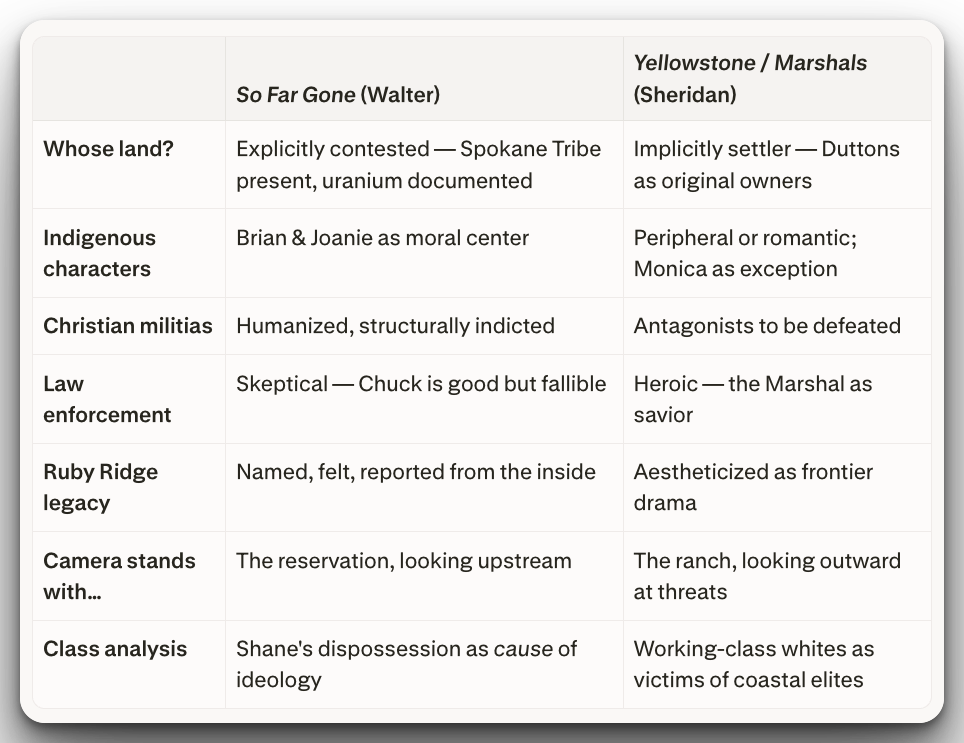
Sheridan places the viewer inside the settler rancher’s perspective — indigenous characters integrated but never holding structural title to the land.
Walter places the reader inside nine perspectives simultaneously, including Brian’s, and the novel’s moral gravity flows outward from the reservation.
Both are enormously talented storytellers working the same raw material. Only one of them was there in 1992 with a notebook.
What the Critics Said, and What They Couldn’t See
So Far Gone received overwhelming praise across seventeen major reviews.
The Chicago Review of Books: “astute commentary on the absurdity of our current political moment.”
The Washington Independent: Walter’s “talent for creating self-aware-yet-charmingly-flawed characters.”
What every review shares — raves and dissents alike — is a complete failure to engage with Brian and Joanie, the Spokane Tribe, or the uranium contamination.
The NYT mentions Brian as Kinnick’s “steadfast best friend.” The Chicago Review of Books does not name him at all. Even BookBrowse’s official discussion guide — designed specifically to deepen reading — omits the uranium contamination from its questions entirely.
The tool designed to make this novel more visible is based on the same limited coordinates. The indigenous layer is not subtext. It is text.
What Readers Are Actually Saying
On Goodreads — over 3,200 reviews and a 3.96 average — readers are living the novel’s central tension. Reviewer Jessica Woodbury: “Somehow Walter walks a real tightrope here — very much about Our Present Moment without getting you so steeped in the terrors of the far right that it’s more stress than entertainment.”
Reviewer David (3.5 stars): “Reading this was the closest I’ve come yet to doom scrolling... referring to these troubles with such a jocular prose style was jarring.”
Reviewer Rebecca, asking the title’s question directly: “Is anyone ever too far gone to be saved?”
On BookTok, reviewers are calling it “a hilarious journalistic adventure” and a must-read, reaching audiences under thirty who have no living memory of Ruby Ridge and for whom the American Redoubt is simply the background noise of their adult political lives.
They are loving the novel for its comedy.
The Ruby Ridge genealogy is invisible to them.
This review is intended, in part, as the map they weren’t given.

Among readers who arrive knowing Walter’s nonfiction, Kent Peterson’s Substack is one of the few that reads So Far Gone alongside Every Knee Shall Bow, calling the latter “one of the best books I have ever read” and treating the novel as the completion of a thirty-year arc.
That cross-read is the right one.
Reading It Alongside Kendi — and Yesteryear
So Far Gone should be read alongside Kendi’s Chain of Ideas — Kendi shows the skeleton of the great replacement chain; Walter shows the body it inhabits: Shane Collins, carpenter, truck driver, recovering addict, grieving brother, father who loves his children, man who is going to get someone killed because he was given a mythology instead of economic justice.
Neither book is complete without the other.
There is also Caro Claire Burke’s 2026 novel Yesteryear, set on a 500-acre Idaho farm where a tradwife influencer is losing her mind in the pioneer-life fantasy she built for 5 million Instagram followers. Burke’s novel devastatingly critiques tradwife aesthetics and Christian nationalist domesticity.
But the indigenous peoples of Idaho’s mountain valleys — the Shoshone, the Bannock, the Nez Perce — are simply absent.
The pioneer cosplay is critiqued as pathology and fraud.
It is never critiqued as colonial fantasy.
Walter put the indigenous layer in.
Burke left it out. Mainstream criticism noticed neither.
And here is the irony that ties all of it together.
Henry David Thoreau’s epigraph — “Not till we are lost... do we begin to find ourselves” — opens Walden (1854) and opens So Far Gone (2025).
Thoreau went to Walden Pond at twenty-seven to find himself: a philosophical experiment twelve miles from Concord with a planned exit and a mother who did his laundry.
Kinnick retreated to the woods at fifty-three to lose himself, and stayed seven years, convinced the exit was weakness. The novel’s epigraph is therefore deeply ironic: Kinnick thought being lost was the destination.
Walter argues it is only where the journey begins.
The Tiny Trail of Tears brought him back.


Why This Book Matters Right Now
I am writing this in the spring of 2026.
January 6th insurrectionists have been pardoned and are walking free.
Armed Christian nationalist militias are re-emboldened.
The American Redoubt is an organized territorial strategy that has been building for fifteen years, quietly, while the national conversation looked elsewhere.
Jess Walter watched the Redoubt be born at Ruby Ridge in 1992.
He covered it for thirty years.

And he wrote a novel that does what journalism could not entirely do: it puts you inside the bodies of every person the ideology touches — the grieving father who chose it, the thirteen-year-old girl whose future it is arranging, the nine-year-old boy whose innocence it will one day consume, the indigenous man downstream whose water it is already poisoning, and the Black neighbor — Anna Gaines — who drove four hours into the woods on a Tuesday because someone she barely knew trusted her with an emergency letter hidden in a snow boot, and who is the functional adult in a situation none of the white characters fully manage.
Brian and Joanie have been holding their protest signs for decades.
MIDNITE MINE KILLS.
CLEAN UP DAWN URANIUM.
DOE LIES.
No national militia movement was born from their standoff with the Department of Energy.
No congressional hearings.
No founding mythology.
No prestige television franchise.
Just two Spokane and Colville people, standing in their front yard in fuzzy slippers and an Oakland Raiders sweatshirt, making hot chocolate for children who just arrived, still fighting.
That is the novel’s real moral landscape.
That is what Walter spent thirty years earning the right to write.
And that is what you will miss entirely if you read So Far Gone from the wrong coordinates.
★★★★★ — Essential
So Far Gone by Jess Walter is published by Harper (2025). Walter’s nonfiction account of Ruby Ridge, Every Knee Shall Bow, remains the definitive journalistic treatment of that standoff and the movement it created.
Read it alongside Kendi’s Chain of Ideas.
Read it alongside Burke’s Yesteryear (just finished it, review coming soon!)
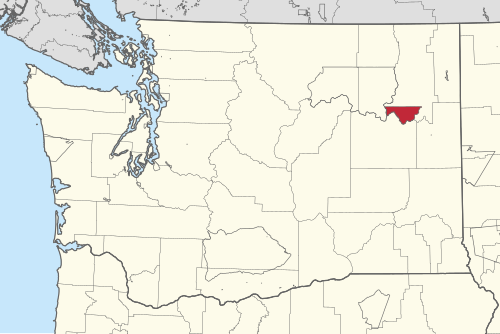
Read it with a map of the Spokane Indian Reservation open beside you — trace the watershed from Kinnick’s off-grid cabin to Brian’s front yard to the Midnite Mine’s abandoned tailings pond to the Columbia River.
Then ask yourself: in whose coordinates has your reading been conducted?
The Tiny Trail of Tears runs fifty miles and thirty years. Jess Walter finally mapped both ends.
Have a scoop or a story you want us to follow up on?
Send us a message below or via ENCRYPTED email (all messages kept CONFIDENTIAL) at ThreeSonorans@protonmail.com.


