
📚 "Necessary" Demolition: Amphi Closes Four Elementary Schools While Voucher Program Bleeds District of Millions
Copper Creek, Donaldson, Nash, and Holaway Elementary students will be displaced next year in consolidations superintendent calls "necessary"

😽 Keepin’ It Simple Summary for Younger Readers
👧🏾✊🏾👦🏾
📚🚸 Today, the superintendent of Amphitheater schools announced that four elementary schools will close at the end of this school year 😔 because not enough students are attending 🧑🏫 and the district doesn’t have enough money 💸.
The four schools are Copper Creek 🏞️, Donaldson 🏠, Nash 🌟, and Holaway 🌳 Elementary. Students who go to those schools will move to other elementary schools nearby 🚶♂️🚶♀️ starting next August.
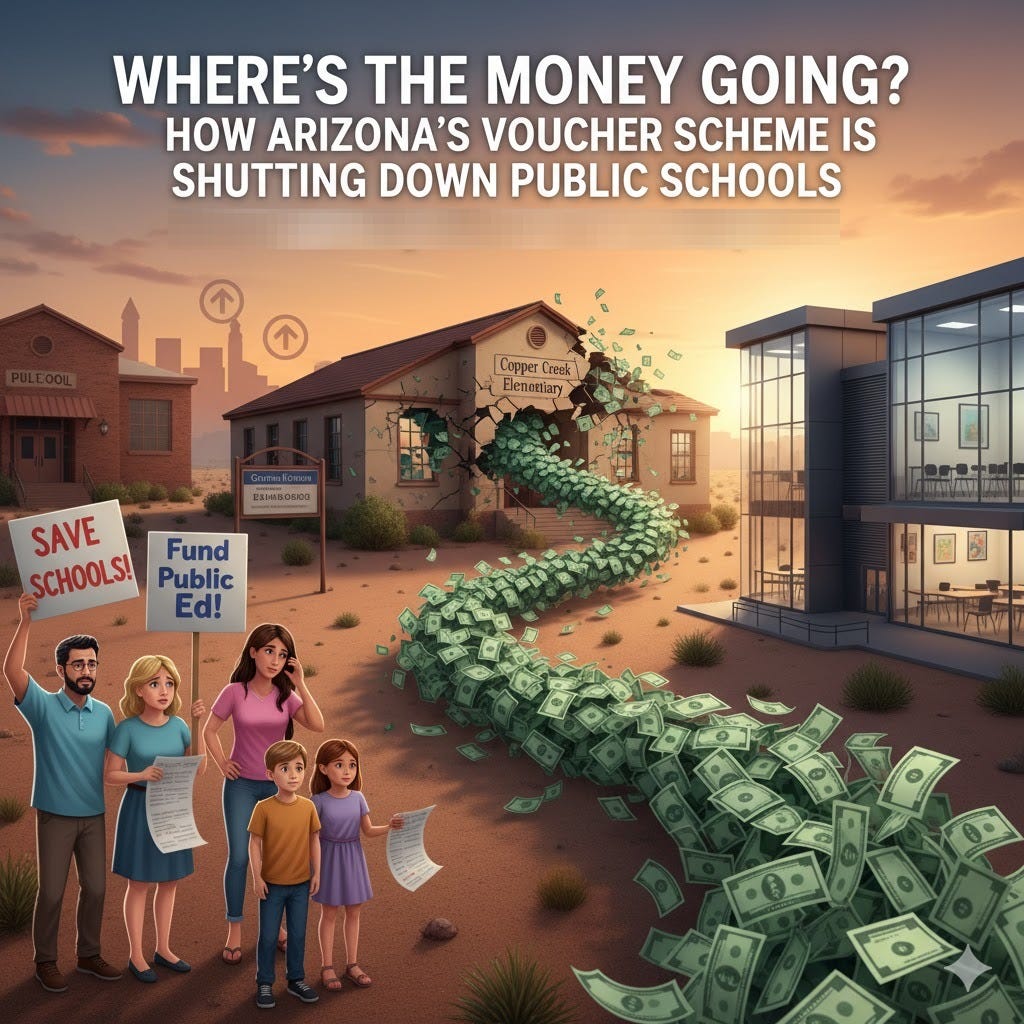
One big reason this is happening is because Arizona created a program that gives families money 💵 to send their kids to private schools 🏫 instead of public schools—1,367 students in the Amphitheater area are using that program, which means $13.5 million 💰 that would have gone to public schools is going somewhere else instead.
The district will hold meetings 🗣️ this week for families to ask questions and share their concerns, and the school board will vote 🗳️ in January about whether to officially close the schools.
Many families and teachers 😡👩🏫 are upset because neighborhood schools 🏡 are important to communities 💖, and closing them affects not just education 📚 but also where kids make friends 👯♂️, how families get to school 🚗, and what neighborhoods feel like 🏘️.


Key Takeaways:
🚨 Amphitheater Public Schools Superintendent Todd Jaeger announced today (November 17, 2025) that four elementary schools will permanently close at the end of this school year: Copper Creek, Donaldson, Nash, and Holaway
💰 1,367 students within Amphi boundaries are receiving vouchers totaling $13.5 million—money stripped from public schools and funneled to private schools with zero accountability
📉 Arizona’s birth rate dropped 33% from 2007 to 2021, but demographic decline alone doesn’t explain the crisis—Republican voucher schemes are systematically bankrupting public districts statewide
👨👩👧👦 Students will be redistributed to other schools starting in the 2026-27 school year, with community meetings scheduled for this Wednesday, Thursday, and Friday evenings
🗳️ The Governing Board will vote on closures January 13, 2026, following a legally-required public review period—but the fiscal math makes closures virtually inevitable under current policies
🏘️ School closures represent the loss of community anchor institutions, neighborhood identity, walking-distance education, and decades of relationships that don’t seamlessly transfer through forced consolidation
✊ Organized resistance can challenge the voucher program: community organizing, school board campaigns, override support, and statewide coalition-building offer pathways to fight back
Buenas tardes from the Sonoran Desert, where families across northwest Tucson woke up this Monday morning with no idea their neighborhood schools were about to become collateral damage in Arizona’s systematic dismantling of public education.
Today—November 17, 2025—Amphitheater Public Schools Superintendent Todd Jaeger sent a letter dropping a bomb on thousands of families: four elementary schools will permanently close their doors at the end of this school year.
Copper Creek, Donaldson, Nash, and Holaway Elementary Schools—institutions that have educated generations of northwest Tucson children—are being shuttered as part of what district officials euphemistically call “necessary consolidations” to address declining enrollment and fiscal crisis.
Students will be redistributed across the district like furniture in a foreclosure:
Copper Creek kids to Painted Sky and Harelson,
Donaldson students to Mesa Verde,
Nash students split between Keeling and Walker, and
Holaway students to Rio Vista.
The district has scheduled three “community meetings” this week—Wednesday, Thursday, and Friday evenings—before the Governing Board takes its final vote on January 13, 2026.
Because nothing says “we value your input” quite like announcing closures on a Monday and scheduling feedback sessions two days later, after the decisions have already been made.
The Voucher Vampire Bleeds Public Schools Dry
Let’s be absolutely clear about what’s happening here: Arizona’s universal voucher scheme is systematically bankrupting public school districts while funneling taxpayer money to private and religious schools with zero accountability.
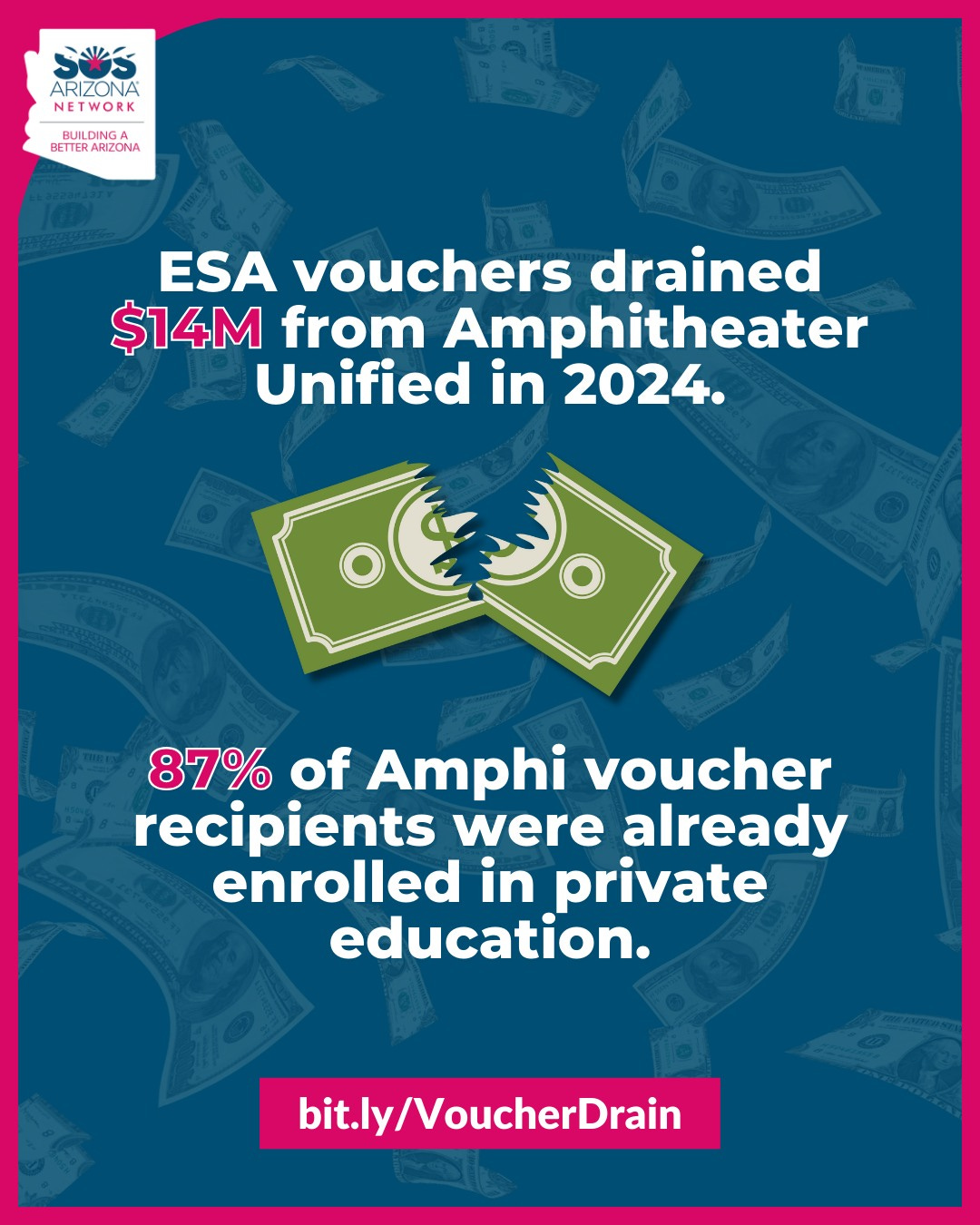
According to Amphitheater’s own data, as of the fourth quarter of 2024, 1,367 students within Amphi boundaries were receiving vouchers, totaling $13.5 million in funding—money that would otherwise support neighborhood public schools. Statewide, 88,862 students were receiving vouchers as of May 2025, representing hundreds of millions of dollars stripped from public education.
This isn’t about “parental choice”—it’s about organized theft disguised as educational policy.
The so-called Empowerment Scholarship Account (ESA) program, championed by far-right Republicans and their billionaire backers, allows families to use taxpayer dollars for private school tuition, homeschool curricula, tutoring services, and even things like musical instruments and gaming consoles. Meanwhile, public schools serving the most vulnerable students watch their budgets evaporate.
Arizona’s birth rate dropped 33% from 2007 to 2021, yes—but demographic decline alone doesn’t explain the crisis. Districts like Amphitheater are being drained by a voucher program specifically designed to starve public education until communities have no choice but to close schools.
Superintendent Jaeger’s letter acknowledges the culprits: “declining birth rate, the state’s private school voucher system, rising education costs, inadequate state funding, and significant budget shortfalls.”
But let’s not bury the lede in bureaucratic passive voice—Republican legislators and their corporate allies are deliberately engineering this crisis.
The Math of Manufactured Scarcity
As someone who spent years teaching mathematics, let me break down the numbers with precision, because this is where the real story lives.
Amphitheater’s enrollment has been declining steadily since 2005. The district currently operates multiple elementary schools that are significantly under-enrolled, making it financially unsustainable to maintain adequate programming, retain quality staff, and keep facilities in good repair.
When enrollment drops, so does per-pupil state funding. Arizona ranks near the bottom nationally in education funding—consistently hovering around 48th or 49th—which means districts start from a position of scarcity before the voucher program even enters the equation.
Now add in the $13.5 million stripped from Amphi boundaries alone, and you’ve got a mathematical equation with only one solution: closure.
It’s the fiscal equivalent of cutting someone’s legs off and then criticizing them for not running fast enough.
Here’s what Superintendent Jaeger isn’t saying in his carefully worded letter: closing four elementary schools won’t solve the underlying problem. As long as the voucher program continues hemorrhaging students and funding, this will happen again.
And again. School districts across Arizona—Paradise Valley, Roosevelt, Cave Creek, Mesa, Kyrene, and more—are closing schools for the exact same reasons.
Phoenix Union High School District saw enrollment decline even during a recent flurry of school closures. Roosevelt School District voted to close five South Phoenix schools in December 2024.
The pattern is clear: Arizona’s voucher scheme is a statewide demolition project targeting public education infrastructure built over generations.
Which Schools, Which Families, Which Neighborhoods?
The four schools slated for closure represent 132 years of community history—Amphitheater Public Schools was founded in 1893, and these elementary campuses have served as neighborhood anchors for decades.
Here’s the redistribution plan Jaeger announced today:
Copper Creek Elementary → Students redistributed to Painted Sky and Harelson Elementary Schools
Donaldson Elementary → Students move to Mesa Verde Elementary (with small sections of the attendance boundary adjusted to Walker)
Nash Elementary → Students split between Keeling and Walker Elementary Schools
Holaway Elementary → Students move to Rio Vista Elementary (with small boundary adjustments to Walker)
Current fifth-graders will attend the same middle schools they were already assigned to—unless they choose to open-enroll elsewhere, which many families will likely do after watching their neighborhood school disappear. Families with preschool students will receive separate communication in the coming weeks.
What Jaeger’s letter doesn’t address: Which communities are being most impacted? Are these closures disproportionately affecting working-class families, immigrant families, or specific neighborhoods?
The data matters, and the district should be transparent about the demographic and economic impacts of these closures.
The Timeline: Democracy Theatre in Three Acts
Here’s how Amphitheater’s “community engagement process” will unfold over the next two months:
This Week (November 19-21, 2025): Three community meetings organized by high school feeder pattern, where district officials will present consolidation details and collect public feedback:
Wednesday, November 19, 6:30 PM at Ironwood Ridge High School Auditorium (Copper Creek/Painted Sky/Harelson consolidation)
Thursday, November 20, 6:30 PM at Amphitheater High School Auditorium (Nash/Walker/Keeling and Holaway/Rio Vista consolidations)
Friday, November 21, 6:30 PM at Canyon del Oro High School Auditorium (Donaldson/Mesa Verde consolidation)
December 9, 2025: Superintendent Jaeger presents a formal recommendation report to the Governing Board, including a summary of public feedback. No vote taken because Arizona law requires at least 10 days between public review and voting.
January 13, 2026: Governing Board expected to vote on school closures, allowing implementation to proceed for the 2026-27 school year.
Translation: The decision has already been made. The “community input” phase is performative box-checking required by state law.
To be fair to Superintendent Jaeger, he’s operating within impossible constraints created by state lawmakers who have spent decades systematically defunding public education.
But let’s not pretend this timeline represents genuine community decision-making. Districts announce closures, hold meetings, collect feedback that they largely can’t act upon due to fiscal realities, and then boards vote to approve what was inevitable from the start.
What Amphi Promises to Preserve (And Why We Should Be Skeptical)
Superintendent Jaeger’s letter includes a lengthy list of commitments the district pledges to maintain despite closures:
Putting students first in every decision
Rigorous academic programs with talented educators
Class-size commitments, including reduced K-3 class sizes from the voter-approved budget override
Free, full-day kindergarten district-wide (even though the state only funds half-day)
One-to-one laptop access and strong technology support
Expanded elementary programming, including preschool, gifted education, Special Education, STEM, and arts
These are worthy commitments, and I don’t doubt Jaeger’s sincerity in wanting to honor them.
But here’s the mathematical reality: you cannot consolidate four schools, displace hundreds of students and dozens of staff members, absorb enrollment into already-strained campuses, and somehow expand programming.
The physics don’t work. The budget doesn’t work. The staffing ratios don’t work.
What’s more likely: class sizes creep upward, programming gets streamlined (which is code for “cut”), and the “enhanced opportunities” promised through consolidation turn out to be rebranded versions of what schools already offered separately.
This isn’t cynicism—it’s pattern recognition based on watching Arizona decimate public education for decades.
The Broader Context: Arizona’s Education Apocalypse
Amphitheater isn’t alone. Not even close.
School closures are accelerating across Arizona as the voucher crisis compounds demographic decline. Urban districts, suburban districts, rural districts—nobody is safe from the systematic defunding of public education.
Tucson Unified School District is also grappling with enrollment decline and voucher losses, with Superintendent Gabriel Trujillo warning that school closures are inevitable there, too. As Three Sonorans previously reported, when radio host Buckmaster asked about TUSD closures, Trujillo pointed to Amphitheater as the district that would “be breaking that ice” for Southern Arizona—a prediction that came true today.
The National Education Association reports that vouchers are delivering devastating blows to rural schools especially, with districts losing students and funding they can’t afford to lose.
Even conservative-leaning communities are discovering that “school choice” means wealthy families get subsidized private schools while working-class families watch their neighborhood public schools crumble.
Meanwhile, charter schools and private schools receiving voucher money operate with minimal oversight, no accountability for academic outcomes, and the ability to discriminate in admissions.
They can reject students with disabilities, English language learners, and students with behavior challenges—all of whom end up concentrated in public schools that are simultaneously losing the funding needed to serve them.
The People Behind the Policy Failure
Let’s name names, because accountability requires specificity.
Todd Jaeger, Superintendent of Amphitheater Public Schools, is the messenger delivering impossibly bad news created by people far above his pay grade. He’s also the one asking families to accept school closures as “necessary” without mobilizing them to fight the root causes.
Arizona’s Republican-controlled legislature has spent decades systematically defunding public education while funneling taxpayer money to private schools through voucher schemes. They’ve turned education policy into a wealth transfer from working families to religious institutions and for-profit companies.
Governor Katie Hobbs, a Democrat who has been unwilling or unable to effectively push back against the voucher program despite its catastrophic impact on public schools. She inherited this mess but hasn’t demonstrated the political courage to dismantle it.
The billionaire-funded school privatization lobby, including organizations like the Goldwater Institute and American Federation for Children, which have poured millions into Arizona politics to engineer exactly this outcome: the collapse of public education and its replacement with a market-based system that treats children as customers and education as a commodity.
What Families Are Losing
Let’s talk about what actually disappears when you close a neighborhood elementary school, because Superintendent Jaeger’s letter glosses over these losses with bureaucratic language about “consolidation” and “enhanced opportunities.”
Community anchor institutions: Elementary schools aren’t just buildings where kids learn multiplication tables. They’re gathering places for families, polling locations for elections, hubs for community organizing, and landmarks that define neighborhoods. When they close, social fabric tears.
Walking distance education: Many families chose their homes specifically because they were within walking distance of their neighborhood school. Closure means longer bus rides for young children, more logistical complexity for working parents, and reduced connection between schools and the neighborhoods they serve.
School culture and identity: Every school has its own culture, traditions, relationships, and sense of belonging. Students aren’t generic units that can be redistributed without harm—they’re children who formed friendships, learned from specific teachers, and built memories in particular places. Those relationships don’t seamlessly transfer when you force consolidation.
Staff displacement: While Jaeger promises that “members of my administrative team will begin meeting with staff at each of our affected schools this week,” the reality is that teachers, counselors, administrators, custodians, cafeteria workers, and other staff will face uncertainty about their jobs, transfers to unfamiliar campuses, and the emotional toll of watching schools they built being shuttered.
Property values and neighborhood stability: Whether we like it or not, proximity to quality schools affects home values and neighborhood desirability. Closures can trigger cascading economic effects on surrounding communities.
The Hope Hiding in the Rubble
Pero aquí está la verdad que the privatization profiteers don’t want you to hear: Community power can stop this.
The voucher program is politically vulnerable. Polls consistently show that when people understand how vouchers work—subsidizing wealthy families to attend private schools while defunding public schools—public support collapses. Even conservative communities are waking up to the reality that “school choice” means losing their neighborhood schools.
Here’s what organized resistance looks like:
Show up to the community meetings this week. Wednesday, Thursday, and Friday evenings at the three high school auditoriums. Bring your neighbors. Bring your questions. Bring your anger. Make them hear you, even if the decision feels predetermined.
Demand the data. Which communities are most impacted by these closures? What are the demographic and economic characteristics of affected neighborhoods? How much money has the district specifically lost to vouchers? Numbers matter, and transparency creates accountability.
Connect with statewide organizing. Groups like Save Our Schools Arizona are building power to fight vouchers and defend public education. This isn’t just an Amphitheater problem—it’s a statewide crisis requiring coordinated resistance.
Run for the school board. Governing Board members make these decisions. If you want different outcomes, elect different people. School board races are low-turnout elections where organized communities can win.
Support the override. Amphi voters approved a budget override to reduce class sizes and maintain programs. Those local funding mechanisms become even more critical as state funding collapses. Protect and expand them.
Organize your neighbors around public education as a community asset. When people understand what they’re losing—not just test scores, but community infrastructure, property values, neighborhood identity—they fight harder to keep it.
What Happens Next
Amphitheater’s closures are a preview of what’s coming for districts across Arizona and the nation. The voucher crisis is accelerating, demographic decline continues, and state funding remains catastrophically inadequate.
But closures also create political opportunities. Every shuttered school is a visible, tangible example of policy failure. Every displaced family is a potential activist. Every teacher forced to transfer understands exactly what’s being stolen.
The question isn’t whether more schools will close—they will, unless the underlying policies change. The question is whether communities will accept closure as inevitable or use it as a catalyst for organizing, resistance, and transformative change.
Amphitheater families received devastating news today. They have two months to decide whether to accept it quietly or fight like hell to make sure no other families endure the same loss.
Support independent education justice reporting that connects local struggles to systemic change. Subscribe to Three Sonorans to keep this coverage going and our accountability rooted in community, not corporate interests.
Questions for Community Dialogue
What would it take to organize a coordinated statewide campaign to repeal Arizona’s universal voucher program, and which communities have the most political leverage to lead it?
How can Amphitheater families facing school closures connect with families in other Arizona districts who’ve gone through the same experience to build solidarity and strategy?
Should Superintendent Jaeger be doing more to publicly name and challenge the state policies creating this crisis, or is his responsibility limited to managing the fiscal constraints he’s given?
Have a story about how school closures are affecting your family, or insider information about education privatization schemes in Arizona? Send us a confidential message at ThreeSonorans@gmail.com.
Have a scoop or a story you want us to follow up on? Send us a message below or via email (all messages kept confidential) at ThreeSonorans@gmail.com.
What crappy news!
I want to thank Three Sonorans for this excellent coverage of the impact of the Arizona Legislature's enacting unlimited vouchers allowing parents to divert their share of public education funding to private schools. Studies have shown that 75% of the families using the vouchers are wealthy families who had their children in private schools before the vouchers were created. Poor families cannot effectively use the vouchers, because the voucher funding is not enough to pay for most private schools. ***** Did you know that the scheme to create vouchers to blead public schools of funding and subsidize the wealthy was first created by the Koch Brothers Network in 1954, when the Supreme Court first ruled that public schools must be racially integrated? The history of this is best covered in Professor Nancy MacLeans' excellent history of the Koch Brothers, titled, Democracy in Chains.