

🏜️ Amazon's Desert Dreams Dashed: How Dr. Dave Wells and Supervisor Cano Exposed Arizona's Economic Mirage | BUCKMASTER
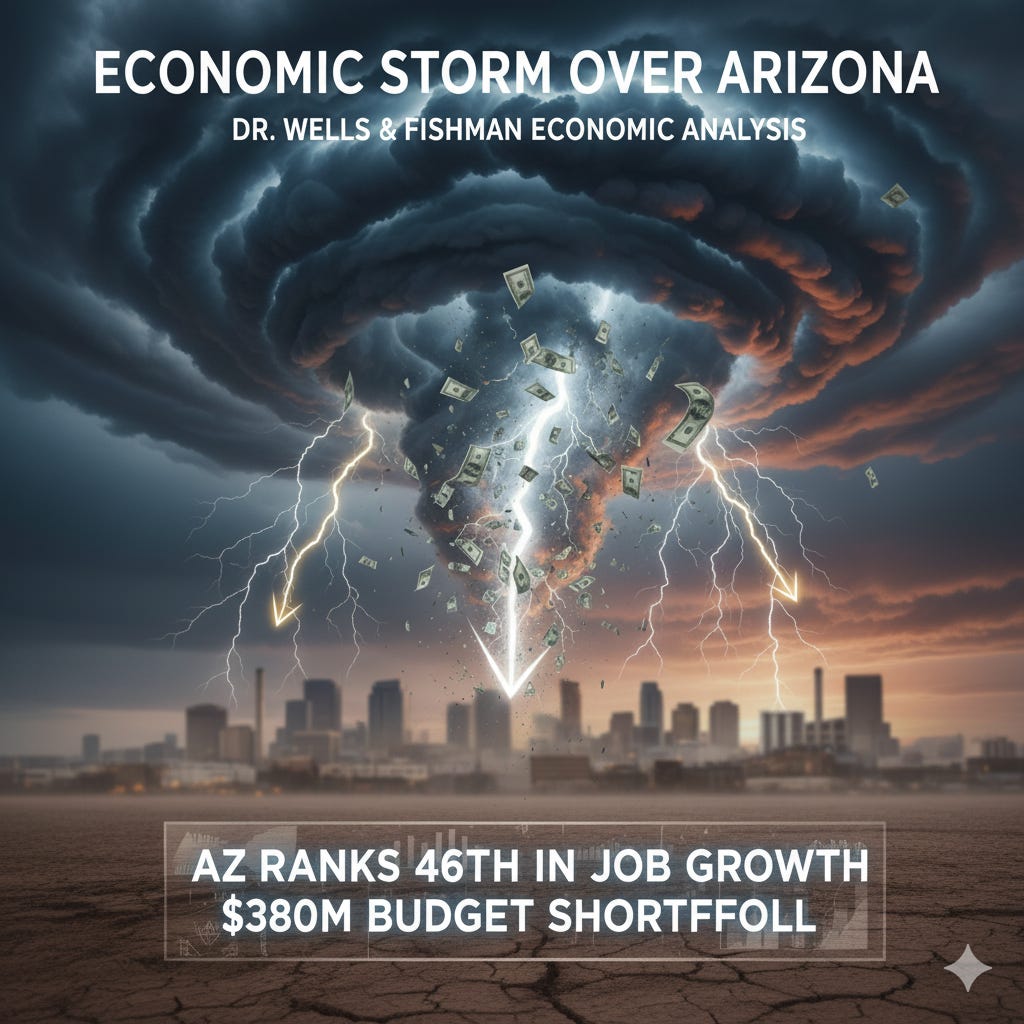
While Wall Street soars and corporations scheme, the Grand Canyon State ranks 46th in job creation as water wars heat up

Based on the Buckmaster Show for 9/9/25, a daily radio show in Tucson, AZ, interviewing local newsmakers. Analysis and opinions are my own.

😽 Keepin’ It Simple Summary for Younger Readers
👧🏾✊🏾👦🏾
Arizona's economy is struggling really badly 😔—imagine if your allowance 💸 got cut in half ✂️ while everything at the store 🏪 got more expensive 💰📈.
The state is terrible at creating new jobs (ranking 46th out of 50 states 🏚️📉), and a giant company called Amazon 📦 wanted to build a massive computer center 🖥️🏢 that would drink up tons of our desert's precious water 💧🌵.
But thousands of regular people 🧑🤝🧑✊ said "absolutely not!" 🚫 and got together to stop it 🛑, proving that when communities work together 🤝, they can beat even the biggest corporations 🏢💥.
Meanwhile, rich people's stock investments 📊💼 keep making money 💵💵 while regular families 👨👩👧👦 struggle to afford homes 🏠 and childcare 🍼, showing how unfair ⚖️🚨 our economic system really is.

Data Centers and Dollar Signs: When Corporate Power Clashes with Community Voice
🗝️ Takeaways
💧 Arizona's aquifer-draining data center boom threatens desert survival while corporations chase profits over sustainability
📉 The Grand Canyon State stumbles at 46th place nationally for job creation, managing only 5,000 new positions this year
🍁 Canadian snowbirds flee Arizona properties in protest of Trump's territorial tantrums and annexation absurdity
💸 Federal tax conformity catastrophe will cost Arizona $380 million while politicians preach about "beautiful bills"
🏘️ Pima County invests $8.5 million in actual human needs—affordable housing and childcare for working families
🚌 Regional Transportation Authority extension empowers voters to decide transit funding in March ballot battle
🏛️ Community organizing conquers corporate colonization as thousands defeat Amazon's Project Blue water-wasting scheme
Tuesday's Buckmaster Show delivered a devastating dose of desert reality, serving up a triple threat of truth-telling that cuts through corporate cheerleading like a flash flood through a Phoenix subdivision. Host Bill Buckmaster assembled an all-star cast of economic soothsayers and political prophets to dissect Arizona's deteriorating financial fortunes with surgical precision.
The guest lineup read like a who's who of people actually paying attention while Rome burns: Dr. Dave Wells from the Grand Canyon Institute brought the brutal economic data that politicians prefer to ignore, financial advisor Shelly Fishman translated Wall Street wizardry for Main Street mortals, and Pima County Supervisor Andres Cano delivered a masterclass in democratic resistance against corporate colonization. Together, they painted a portrait of a state struggling with stagnant job growth, water-guzzling data centers, and the kind of economic inequality that would make a robber baron blush.
But here's the kicker that should have every desert dweller sitting up straighter than a saguaro at sunset: while Arizona ranks a pathetic 46th in job creation and faces a $380 million budget hole, corporate giants like Amazon are still trying to ram through massive data centers that would drain our aquifers faster than a drunk tourist empties a margarita.
The only thing more shocking than their audacity? The fact that grassroots organizing actually stopped them.
Economic Storm Clouds: Dr. Wells Warns of Worsening Waters
Dr. Dave Wells from the Grand Canyon Institute painted a particularly painful picture of Arizona's anemic economic outlook.
Wells dropped bombshell after bombshell about Arizona's deteriorating position. The state ranks a pathetic 46th nationally in job creation, adding only 5,000 jobs since January—numbers that would make a small-town chamber of commerce weep. "We've only gained about 5,000 jobs since the beginning of the year in Arizona. We ranked 46th in the country in that," Wells revealed, his voice carrying the weight of uncomfortable truth.
The federal budget reconciliation bill—that legislative monstrosity politicians euphemistically dubbed "one big beautiful bill"—threatens to drain $380 million from Arizona's already-strained state budget through tax conformity requirements. One big beautiful bill? More like one big beautiful boondoggle, designed to enrich the wealthy while everyday Arizonans scramble for scraps.
Perhaps most tellingly, Wells highlighted how Arizona's traditional economic engine—migration from other states and countries—has ground to a halt. The anti-immigrant hysteria whipped up by the current administration has created a perfect storm of economic self-sabotage. Canadian snowbirds, apparently peeved by presidential proclamations about annexing their homeland, are selling their Arizona properties in protest. Nothing says "America First" like driving away tourists who actually spend money here.
"A number of Canadians are selling their properties in Arizona, largely out of protest to the president saying he wants Canada to be the 51st state and they find that quite irritating, beyond irritating," Wells explained, capturing the absurdity of alienating our literal neighbors for political theater.
The Bureau of Labor Statistics revision revealing nearly 900,000 fewer jobs nationally than previously reported adds another layer of economic devastation. Turns out, cooking the books only works until someone checks the math.
Market Machinations with Shelly Fishman
Financial advisor Shelly Fishman provided a fascinating counterpoint, demonstrating that while working families struggle, disciplined investors continue riding the wave of Wall Street wealth.
The Dow's 7.85% year-to-date gain, S&P's 10.9% rise, and NASDAQ's 13.25% surge reveal the stark disconnect between market performance and Main Street reality.
It's almost poetic—while Arizona families choose between rent and groceries, stock portfolios are partying like it's 1999.
Fishman's analysis carried ominous undertones about potential stagflation—that economic nightmare combination of stagnant growth and rising prices that devastated working families in the 1970s.
The July and August labor numbers that came out were negative in July and almost flat for August. Indicated the weakness in the market, in the labor market," he warned, his measured tone masking the magnitude of the crisis.
The Federal Reserve faces an impossible balancing act: lower interest rates to stimulate growth while controlling inflation that's already squeezing families. Fishman predicted a modest quarter-point rate cut, but cautioned against expecting dramatic relief.
Project Blue Gets Buried: Supervisor Cano Celebrates Community Power
The show's most electrifying segment featured Pima County Supervisor Andres Cano delivering a masterclass in principled resistance against corporate colonization. Cano and colleague Jen Allen had courageously voted against the massive Amazon-backed Project Blue data center, foreseeing the environmental catastrophe that corporate boosters willfully ignored.
Finally—elected officials who understand that their job is representing constituents, not genuflecting before corporate overlords.
Cano's critique cut deeper than a Sonoran Desert arroyo, describing continued corporate maneuvering as "tone-deaf and it's a slap in the face to local decision-making." The supervisor's passionate defense of democratic participation over corporate diktat proved particularly pointed when thousands of community members mobilized against the project.
The environmental implications are staggering. Data centers consume massive amounts of water and electricity—resources the desert Southwest can barely sustain. Cano pointed to Maricopa County's aquifer depletion as a cautionary tale: "When saguaros are falling down in downtown Scottsdale next to the botanical gardens there, of course, that's going to happen when you've got a giant straw sucking up our most precious finite resource."
Apparently, Amazon thinks they can suck the desert dry just like they've sucked the soul out of American retail.
The corporate response to community rejection reveals the anti-democratic nature of modern capitalism. Amazon, Tucson Electric Power, and their enablers at Beale LLC are now attempting an end-run around local democracy by appealing to the Arizona Corporation Commission—a regulatory body historically friendly to corporate interests over community concerns.
Cano's condemnation was withering: "I think it's disingenuous for a large utility like Tucson Electric Power to really just be trying to secure what would be its largest customer more so than all of the residential users combined." Translation: TEP cares more about one corporate customer than all their residential ratepayers who actually live here.
The supervisor also delivered a devastating critique of the Chamber of Southern Arizona's continued advocacy for this corporate boondoggle. Despite Pima County paying $550,000 annually to the Chamber, the organization seems more interested in mega-deals than supporting the region's 100,000 small businesses. "How about talking to the 100,000 small businesses that need our support and looking for ways to incentivize current projects that can help our tax base be able to support good quality jobs," Cano challenged.
Housing Hope and Educational Investment
Amid the economic gloom, Cano outlined substantial investments in community wellbeing that demonstrate what progressive governance looks like. The Board of Supervisors allocated $8.5 million toward affordable housing initiatives, including eviction relief and weatherization programs—particularly crucial given Arizona's extreme temperatures and aging housing stock.
Revolutionary concept: using public money to help actual people instead of subsidizing corporate profits.
The PEEPS (Pima Early Childhood Education Program) received special attention, with Cano successfully advocating to maintain scholarship levels despite budget pressures. With childcare costs ranging from $5,000 to $10,000 annually per child, these scholarships provide vital support for working families while investing in long-term community prosperity.
"I worked with my colleagues two meetings ago to be able to hold this program harmless. We were going to face a reduction in scholarships based on where we are as a region right now, and I said no to that because I don't think we should be cutting critical services from our kids," Cano declared, demonstrating the kind of leadership working families desperately need.
💸 The Great PEEPS Heist: Why The County Raiding $600K From Libraries Won't Save Early Education | PIMA BOS MEETING

📚 Pima County raided $600,000 from library reserves to emergency-fund PEEPS preschool program
Transportation Investment and Democratic Participation
The Board's unanimous decision to place the 20-year Regional Transportation Authority extension on the March ballot exemplifies responsive democratic governance. Rather than imposing decisions from above, supervisors are trusting voters to determine their community's transportation future.
Cano enthusiastically endorsed the measure: "I'm fully on board with our regional transit authority going to the voters, and now it's in their hands." The investment supports robust public transportation connecting communities from Oro Valley to Sahuarita, ensuring disabled residents and working families can access essential services regardless of their economic status.
The Bigger Picture: Resistance in the Desert
This episode of the Buckmaster Show reveals the broader struggle between corporate colonization and community self-determination playing out across the Southwest. The successful mobilization against Project Blue demonstrates that organized communities can still defeat corporate power when they engage meaningfully with local democratic processes.
Who knew that democracy still works when people actually participate in it?
The contrast between Cano's community-centered approach and the Chamber's corporate cheerleading illustrates competing visions for Arizona's future. One prioritizes sustainable development that serves existing residents; the other chases flashy mega-projects that enrich out-of-state corporations while depleting local resources.
As Dr. Wells noted, Arizona's traditional growth model based on constant in-migration has reached its limits. The current administration's anti-immigrant policies have strangled the labor force growth that historically powered the state's economy. Meanwhile, climate change and water scarcity make massive industrial development increasingly unsustainable.
A Note of Hope and How to Get Involved
Despite the economic headwinds and corporate pressure, Tuesday's show revealed powerful reasons for cautious optimism. Supervisor Cano's principled leadership demonstrates that progressive governance can prevail when communities organize effectively. The successful mobilization against Project Blue proves that grassroots democracy remains powerful when citizens engage with local government.
Moreover, investments in affordable housing and early childhood education represent the foundational work that builds lasting prosperity rather than chasing harmful mega-projects. As Indigenous peoples have always understood, the desert rewards patience over haste, conservation over consumption.
Here's how you can join the resistance:
Attend Pima County Board meetings and make your voice heard on development projects
Contact your representatives about protecting water resources from corporate exploitation
Vote in local elections where your impact is greatest
Join community organizations fighting for environmental justice and affordable housing
Stay informed by supporting Three Sonorans Substack to keep this vital news and analysis coming. Independent media remains essential for holding power accountable and amplifying community voices against corporate propaganda.
The desert has always belonged to the people who call it home. It's time to reclaim it from the corporations trying to strip-mine our future for quarterly profits.
What Do You Think?
The struggle between corporate power and community democracy continues across the Southwest. As we face mounting economic challenges and environmental threats, local organizing becomes more crucial than ever.
Two questions for our readers: How can communities effectively resist corporate projects that threaten environmental sustainability while still pursuing economic development? What role should chambers of commerce play when their advocacy conflicts with broader community interests and environmental protection?
Share your thoughts in the comments below—your voice matters in this ongoing fight for our desert home's future.
Have a scoop or a story you want us to follow up on? Send us a message!


I am old, septuagenarian working on another few years on this cherished earth… and Tucson has always been my home. It has always been difficult to live here and stay employed, so I migrated to where work would support me. Now, I live here by pension and like so many pensioners, I live at the threshold of subsistence. As a retired second-career registered nurse, I can still be a communitarian, a consultant if you may. Over many iterations I have observed our community try and mimic the business model of cities whose resources, though plentiful, struggled to shoulder the burden of industrial development without any consideration of true cost. We do not need to go down this path of environmental degradation to keep non-communitarians, who at very best lack respect for the community, gainfully employed. We have an opportunity to get this right. Solar, wind, water reclamation and design efficiency standards of housing and infrastructure could offer a stable structure to build local business and development models free of constant growth and its dynamic environmental impacts on a fragile ecosystem… but then, this “conserve” approach does not foster the exploitation by corporate interests who themselves are like a plague of locusts, consuming without restraint, and leaving the residents with the wastes of corporate greed.