

🚨 342 Deaths, Zero Convictions: Border Patrol's Impunity Exposed by Arizona's Top Reporters
Four reporters with 50+ years combined experience explain why militarization enriches contractors while destroying communities

😽 Keepin’ It Simple Summary for Younger Readers
👧🏾✊🏾👦🏾
Imagine if someone told you your neighborhood was dangerous 🏘️⚠️, then spent billions of dollars 💸 building a giant fence 🚧 that didn’t actually keep anyone safer 🚫🛡️—but destroyed the water wells 🚰 families have used for thousands of years 💧🥀. That’s what’s happening at the Arizona-México border 🇺🇸🌵🇲🇽.
Four reporters 🎙️👥 who’ve been covering this area for decades explained on a radio show 📻 how Border Patrol agents 👮♂️ have killed hundreds of people ⚰️ without ever being punished ⚖️🚫, how companies connected to President Trump are getting rich 🤑💰 building walls that don’t work 🧱👎, and how families are scared 😨 to go grocery shopping 🛒 because immigration agents might stop them 🛑 even if they have permission to be here ✅📄.
The reporters also explained that millions of people cross the border legally 🛂 every month for work 💼 and to visit family 👨👩👧👦, and that México already has its own military 🪖 fighting drug cartels 💊—so sending American troops wouldn’t help and would probably make things worse 📉🚫.
The most important thing they said ‼️ is that local organizations are teaching people how to safely watch what immigration agents are doing 👁️📸, because one woman in Minnesota was shot and killed 🔫💔 just for observing them near her kids’ school 🏫🧸.


🎙️ Four Border Journalists Unpack Trump’s Immigration Crackdown: Why Militarization Won’t Solve What Money Created
When AZPM’s Press Room assembled Arizona’s top border reporters, the truths they revealed should scare every politician banking on walls to save their careers
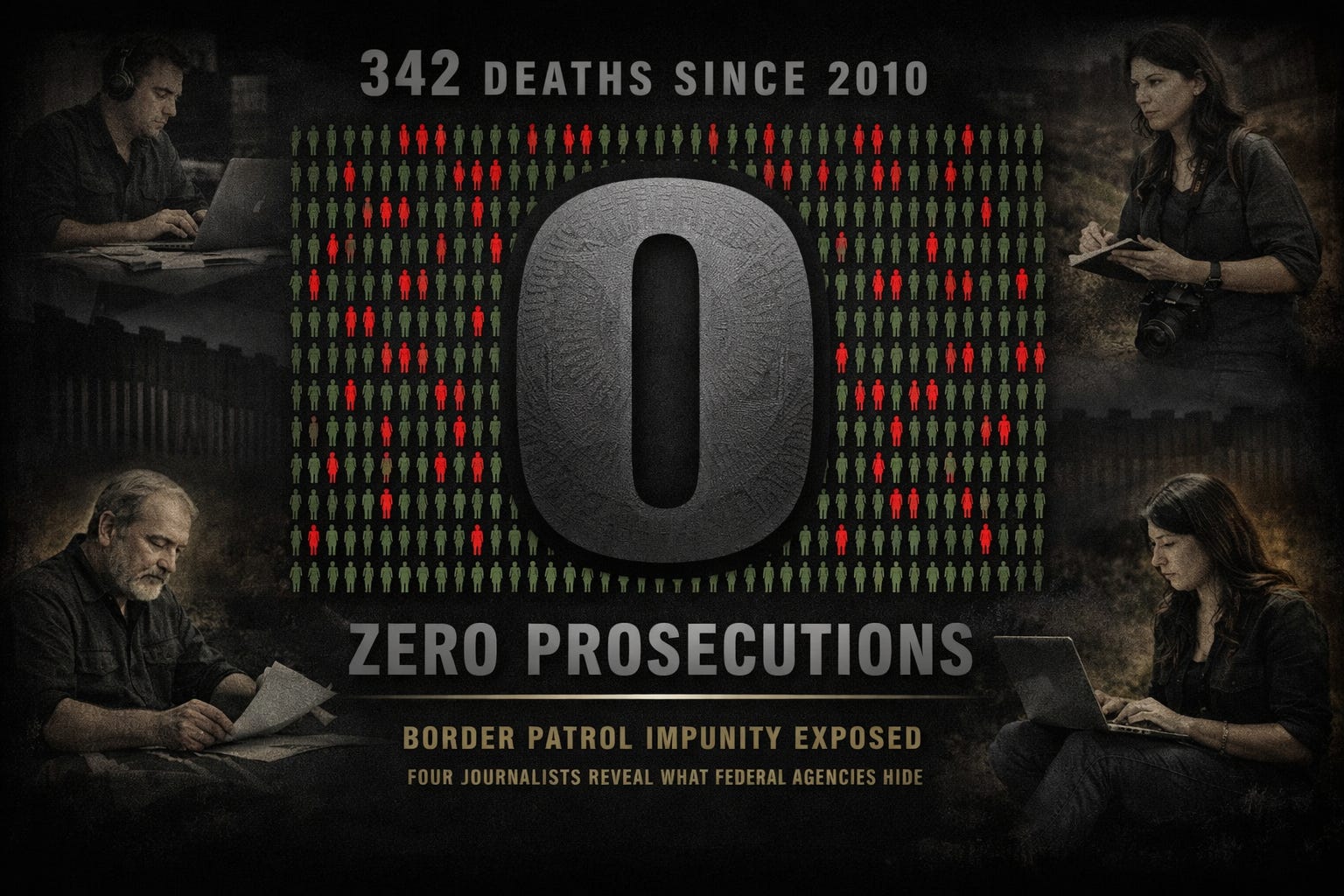
On January 23, 2026, AZPM’s The Press Room hosted a roundtable that felt less like typical public radio and more like a war correspondents’ debrief. Host David Lee gathered four journalists who’ve collectively spent decades covering the Arizona-Sonora borderlands—and what they revealed about Trump’s second-term immigration crackdown should make every Tucsonan pay attention.
Rafael Carranza (Arizona Luminaria/ProPublica), Melissa del Bosque (The Border Chronicle), Emily Bregel (Arizona Daily Star), and Danyelle Khmara (AZPM News) brought receipts, not rhetoric—and their message was clear: the border “crisis” is a manufactured spectacle designed to enrich contractors while terrorizing communities that have coexisted binacionally for generations.
The Panelists: Who’s Telling Our Stories
These aren’t parachute journalists flying in for sweeps week.
Carranza, born in México and raised in Phoenix, has covered the borderlands for 15 years and was part of The Arizona Republic team that won a 2018 Pulitzer Prize for its investigation into the impacts of the border wall.
Del Bosque has reported on the Texas-México border since the late ‘90s, earning an Emmy and National Magazine Award for her work at The Texas Observer before co-founding The Border Chronicle.
Bregel lived in Sonora for four years, teaching English and freelancing before returning full-time to the Daily Star’s border beat.
And Khmara has covered immigration for AZPM for three years after cutting her teeth on the same beat at the Star.
“Arizona is my home,” Carranza said during his introduction. “I feel honored to join a team that is focused on providing clear-cut, community-based reporting on issues impacting our state.”
That commitment to community-based reporting—not sensationalized border theater for cable news—defined the entire conversation.
Border Patrol’s Legacy of Impunity
Del Bosque didn’t waste time with pleasantries. When Lee asked how border enforcement has evolved, she went straight for the jugular:
“There’s never been an actual successful prosecution for a fatal Border Patrol shooting.”
Let that sink in.
Since 2010, 342 people have died in encounters with Customs and Border Protection agents, including 76 fatal shootings—some of them cross-border shootings into México.
Zero convictions.
The Department of Homeland Security was “hastily put together” after 9/11, del Bosque explained, and “there’s never really been the proper oversight of the agents there.” Border Patrol operates with what she called “impunity”—a polite word for “they can kill you and face no consequences.”
Nice to know la migra has more legal protection than a Tucson street vendor.
The issue isn’t abstract. As del Bosque noted, Border Patrol agents are “ubiquitous in border communities,” responding to accidents and recruited from bilingual border towns. That intimacy makes the lack of accountability even more chilling—these aren’t distant federal agents; they’re your neighbors, armed with qualified immunity and a history the Southern Border Communities Coalition describes as systemic brutality.
ICE at the Port: Racial Profiling Gets a Holiday Boost
Bregel dropped another bombshell about new tactics: just before Christmas 2024, ICE agents started interrogating people leaving the U.S. at Nogales ports of entry—“trying to grab people who might be going home to visit family for the holidays and boost ICE’s deportation numbers.”
Because nothing says “Feliz Navidad” like deporting abuelas trying to visit their hijos.
This wasn’t a normal port-of-entry procedure, where Customs officials check people entering the country. This was ICE—Interior and Customs Enforcement, typically operating inside the U.S.—stationed at the border to racially profile Latinx travelers. “It seems like they were using racial profiling and seeking out people who appeared to be Hispanic,” Bregel reported.
The tactic made “a lot of people nervous in the Nogales area,” and it’s part of a broader pattern: Border Patrol increasingly operates in the interior (Minneapolis, Chicago, New York), while ICE creeps toward the actual border.
Meanwhile, CBP announced plans for biometric facial scans of non-citizens entering and leaving the country—though Bregel noted it hadn’t started in Nogales as of the broadcast. Porque why focus on actual public safety when you can build a surveillance state one face scan at a time?
Mixed-Status Families: Living in Limbo
Khmara’s reporting centered on the human cost of this enforcement escalation.
“Families who might be mixed-status families, where maybe a couple of parents, or even one of the parents, might be undocumented, maybe even sometimes a couple of children are U.S. citizens, maybe another child has DACA—a lot of those families...are feeling really nervous,” she said.
People are scared to go grocery shopping, to attend community events, to live.
But here’s the kicker:
“People are still crossing the border legally every day. I think we have a couple of million people crossing the border every month, visiting family, shopping, going to work.”
The binational economy doesn’t stop because Trump needs a campaign issue—but the fear is real.
“People are feeling nervous to go out and do fun community activities, go to the grocery store, things like that,” Khmara continued. “The risk of people feeling at risk, even when they do have their legal paperwork in order...is heightened.
But nonetheless, people are still going about their daily lives because they don’t really have a choice.”
That last line? Eso es resistance. Not marching with signs (though we love those too), but existing despite the terror campaign.
Arizona: The Border Industrial Complex’s Testing Ground
Carranza explained why Arizona keeps popping up in national border policy:
“Arizona [has] been sort of a testing ground for many years where CBP would attempt to try out a new program along the border and then attempt to launch it elsewhere.” He also noted Arizona has “some of the most rugged parts of the US-Mexico borderlands”—and as a result, it’s become “almost...the most fortified state of the four border states.”
Translation: We’re the guinea pigs for every dystopian border policy that eventually goes national. Lucky us.
The terrain argument is particularly cynical. Yes, the Sonoran Desert is brutal—which is exactly why funneling migrants into deadly crossing routes through “prevention through deterrence” has killed thousands. The “fortification” isn’t about security; it’s about forcing human beings into the deadliest landscapes, then blaming them for dying.
Trump’s México Fantasy: What Could Go Wrong?
When Lee asked about Trump’s threats to send troops into México to fight cartels, the panel’s exasperation was palpable.
Emily Bregel had recently interviewed five experts about Trump’s designation of cartels as Foreign Terrorist Organizations (FTOs)—a move that sounds scary but doesn’t actually authorize military strikes.
“There’s a misconception that that gives legal backing for some kind of strike in Mexico,” she explained. “One of the experts I talked to said that is not the case.”
But since when has Trump cared about pesky things like “law” or “international treaties”?
Del Bosque delivered the history lesson:
“In 2006, Mexico deployed its military to fight narco-traffickers, and the military has been there...fighting narco-traffickers since then. After Mexico deployed the military, there was a huge spike in murders, killings, and violence because the military is not trained to work amongst a civilian population.”
The solution?
“If you want to go after drug cartels, you need to go after the money, you need to do investigations, you need to go after the accountants and the banks. It’s not through military force.”
But that would require dismantling the financial systems that profit from cartel operations—including U.S. banks. Mucho más fácil to send helicopters and blame México, ¿verdad?
Khmara added the obvious: “Mexico already has its military...if you go to Mexico, if you’re just driving on the highways, you can see that they’re very present.”
Mexican President Claudia Sheinbaum has been crystal clear: no queremos tu “ayuda,” gabacho. She’s pursuing diplomatic channels, which must be frustrating for Trump, who prefers explosions to conversations.
Carranza wrapped it up: “As long as there’s a big appetite for these drugs...I think [cartels will] be willing to kind of go whatever lengths to follow up with that demand.”
The U.S. demand for drugs created the cartels. Blaming México for U.S. addiction is like blaming your dealer for your habit—except in this case, we’re the addict with the guns.

The Wall Grift Continues: Fisher Industries Gets Paid
Bregel reported on the latest border wall contract: $1.5 billion to Fisher Industries for construction in Arizona, including the ecologically sensitive San Rafael Valley.
Fisher Industries—the North Dakota company Trump repeatedly touted during his first term—has a “problematic” and “difficult environmental record” and “ties to the Trump administration,” Bregel noted delicately.
Shocking. A Trump-connected company is getting billions in no-bid contracts to build useless infrastructure. I’m clutching my chanclas in disbelief.
When completed, the wall will stretch uninterrupted from Yuma to Texas—except for the Tohono O’odham Nation, whose sovereignty even Trump (barely) respects.
The environmental devastation? Catastrophic. The effectiveness?
“People can cut through the wall [using] a battery-powered hand tool,” Bregel said. “There’s ways around it. There are certain places that cannot be permanently closed off because of the water flows that go through there.”
Carranza added that CBP sells the wall as a “wall system”—“lights and sensors and all this other equipment”—but in his reporting trips, “people crossing the border from the Mexican side will go and cut the cables.”
Billions spent, ecosystems destroyed, and a guy with bolt cutters renders it useless.
Water Wars: Wall Construction Drains Aquifers
Khmara and her colleague Cato Mendoza investigated how border wall construction impacts water systems—and the findings should alarm every borderlands resident.
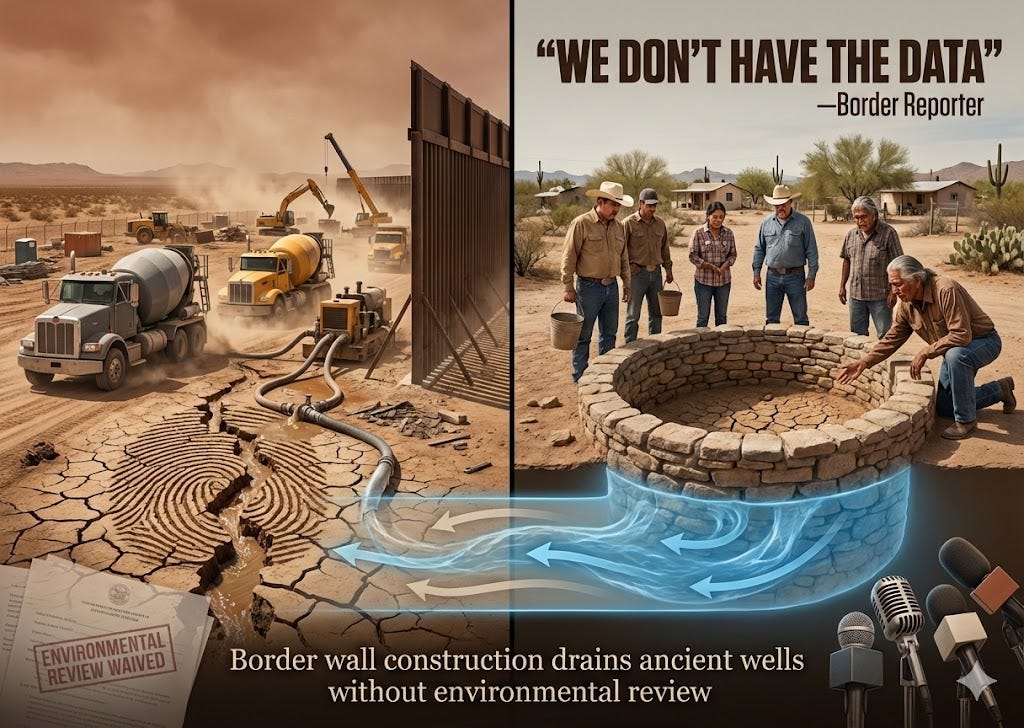
At the San Bernardino Wildlife Refuge, an artesian well that has existed for “likely thousands of years...now needs a pump to continue running.”
The cause?
“Border wall construction uses millions of gallons of water for cement, for mixing cement.”
Here’s the kicker:
“Because DHS is allowed to waive environmental laws in order to build these structures, they haven’t done the research in order to be able to say, ‘We have enough water here to be able to build this barrier.’”
So we’re draining Indigenous water sources—during a megadrought—to build a wall that doesn’t work, to solve a “crisis” that’s mostly performative. Cool. Cool cool cool.
Ranchers in the San Rafael Valley are “nervous” about their wells drying up, Khmara reported, “and we just really don’t know. We don’t have the data.”
That’s by design. No environmental review means no inconvenient facts about the destruction of aquifers that borderlands communities—human and animal—depend on.
Asylum Shut Down, Reverse Migration Rising
When Lee asked about asylum seekers, del Bosque was blunt: “Asylum is basically all but shut down at the border.”
Numbers are down because “a lot of people are down at the Guatemalan-Mexican border in shelters,” and many are choosing “reverse migration”—heading back through the Darién Gap because “they know that they’re not going to be able to seek protection here.”
Khmara spoke with migrants stranded in Mexican shelters after Biden left office, people who “came to the border when...there was some access to asylum.” Some were separated from their families, who got humanitarian parole right before Trump’s inauguration.
“They’re now waiting on the southern side of the border saying, ‘Well, my family is on the north side. I have nothing to go back to.’ And they’re basically just living in a shelter, which is not really set up for long-term...living a life.”
Because nothing says “rule of law” like stranding families on opposite sides of an arbitrary line.
287(g): Turning Cops Into ICE Agents
Carranza has been investigating the 287(g) program, which allows local police to partner with ICE for immigration arrests.
It’s a “big question...in many communities about the role of local police in helping with immigration arrests,” he said.
Southern Arizona’s top law enforcement—Pima County Sheriff Chris Nanos, Tucson Police Chief—have “been pretty clear in stating that they don’t want to participate...they don’t support these immigration arrests.”
Gracias a Dios for local leadership with spines. But as Carranza noted, police are still “caught in the middle between federal officials who are carrying out these arrests, sometimes in very aggressive ways,” and community members watching.
Del Bosque clarified the confusion about who’s doing what: “A lot of people refer to ICE, but a lot of what we’re seeing is actually Border Patrol...up there in Minnesota, for instance. Those are...Border Patrol strike teams” led by Gregory Bovino, the El Centro Sector Chief.
So when you see camouflage goons breaking car windows in Chicago, that’s Border Patrol, not ICE. The distinction matters for understanding jurisdiction and accountability—or lack thereof.
“How Can I Help Without Getting Shot?”
Bregel shared the most common question she’s been receiving: “How can I get involved? How can I help? I feel powerless. And if I do get involved, will I be safe?”—especially after Renee Good was shot and killed by an ICE agent in Minneapolis on January 7, 2026, while observing ICE operations.
Good, a 37-year-old poet, mother of three, and U.S. citizen, was part of an “ICE Watch” group monitoring federal agents near her kids’ school. ICE agent Jonathan Ross fired three shots in under one second into her vehicle. Secretary Kristi Noem claimed that Good “weaponized her vehicle”; video evidence analyzed by The New York Times, ABC, and CNN showed she was pulling away when Ross shot her.
Porque apparently observing law enforcement is now a capital offense.
Bregel referred people to Coalición de Derechos Humanos and BorderLinks, groups that “train people on how to safely observe and record, express your First Amendment rights without putting yourself in danger.” Khmara added another concern:
“People who have some sort of legal immigration status are now concerned—people with green cards, people with visas—they’re asking, ‘Is this going to protect me from getting detained?’”
The answer, increasingly, is no. When the deportation machine needs to hit quotas, legal status becomes negotiable.
What This Means for Borderlands Communities
This wasn’t a typical panel discussion—it was a collective warning from journalists who’ve watched enforcement escalate for decades. The throughlines are clear:
Border Patrol and ICE operate with impunity. 342 deaths since 2010, zero prosecutions. That’s not law enforcement; that’s state-sanctioned violence.
The wall is a grift. Billions to Trump-connected contractors for barriers that don’t work, destroying water sources and ecosystems in the process.
Militarization creates violence, not safety. México’s 2006 military deployment against cartels increased murders. Trump’s fantasy of sending troops would be catastrophic.
Local resistance matters. Tucson and Pima County’s refusal to cooperate with ICE, combined with community organizations training observers, creates space for survival.
The binational economy endures. Despite the terror, millions still cross monthly for work, family, and commerce—because the border is a gift, not a burden, as Southern Arizona Hispanic Chamber CEO Rob Elias said: “We need to consider the border as a gift, not as a burden.”
What Do You Think?
Support independent border journalism by subscribing to Three Sonorans, The Border Chronicle, and Arizona Luminaria. These reporters risk their safety to tell our stories—las historias que los gabachos no quieren que sepas.
Discussion Questions:
How can Tucson residents safely support mixed-status families facing increased ICE enforcement?
What accountability mechanisms could prevent Border Patrol fatalities when federal prosecution has failed for 15+ years?
Should local news outlets do more collaborative border reporting like this panel, instead of parachute coverage during “crises”?
Have a scoop or a story you want us to follow up on? Send us a message below or via email (all messages kept confidential) at ThreeSonorans@gmail.com.
This is a VERY important article, and I hope my own followers will read it. The environmental devastation that will result from squandering so much water on Trump's "Maginot Line" may render parts of the US inhospitable (or certainly far less hospitable).
In answer to your "Discussion Questions": (1) "How can Tucson residents safely support mixed-status families facing increased ICE enforcement?" I wish I knew!
(2) "What accountability mechanisms could prevent Border Patrol fatalities when federal prosecution has failed for 15+ years?" None, because Trump has packed the courts with too many ideologue judges. "Justice" is nonexistent in this country (if I may parody a comment by the Marquis de Sade in his novel, JULIETTE).
(3) "Should local news outlets do more collaborative border reporting like this panel, instead of parachute coverage during 'crises'?" Absolutely! They MUST!